
Introduction
QR Codes connect physical surfaces to digital information. Product packaging, event tickets, payment flows, Wi-Fi setup, authentication and marketing campaigns use a camera-readable square to carry text or a URL.
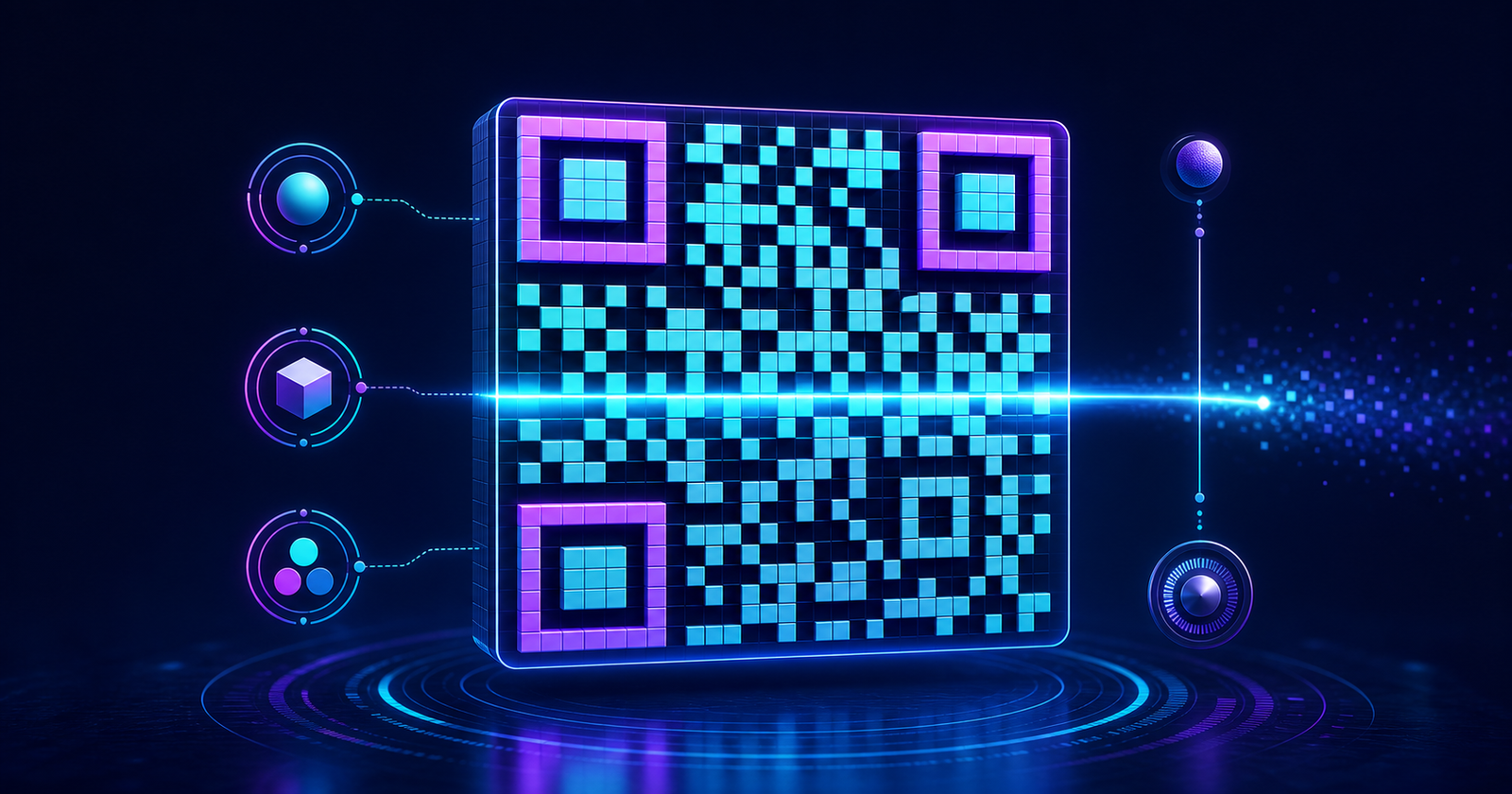
A QR Code is more than random black and white cells. Its geometry helps a scanner locate, orient and recover data even when part of the symbol is damaged. The utily.tools Text to QR Code tool adds visual customization and export while preserving the encoded payload.
A matrix symbol with recoverable data
The matrix contains finder patterns, timing patterns, alignment patterns, format information and encoded data modules. A quiet zone around the symbol separates it from surrounding graphics. Version determines matrix dimensions and capacity.
Input is encoded in numeric, alphanumeric, byte or kanji modes. Reed–Solomon error-correction codewords allow recovery from missing or incorrect modules. Levels L, M, Q and H trade capacity for increasing resilience.
Technical foundations and behavior
Generation selects an encoding mode and version, builds data codewords, adds error-correction blocks, places bits into the matrix and evaluates mask patterns designed to avoid scanner-hostile visual structures.
Capacity and payload design
Long URLs increase the required version and module density. A short redirect URL can create a simpler, more reliable code and allows the destination to change without reprinting the physical symbol.
Masking and contrast
Eight masks alter module placement with reversible formulas. A penalty score selects the pattern with balanced runs and contrast. Custom colors must preserve strong luminance contrast; gradients and transparent backgrounds require real-device testing.
Logos and rounded modules
A centered logo intentionally covers data, relying on error correction. Its size, padding and location must remain conservative. Finder patterns should stay recognizable even when normal modules are drawn as circles or rounded shapes.
Real-world applications
Event admission
A ticket embeds a short signed identifier that the gate application verifies and marks as consumed.
Wi-Fi onboarding
A standard WIFI payload lets a compatible phone configure network name and credentials after user confirmation.
Packaging and manuals
A durable redirect code links a physical product to documentation while analytics and destinations evolve behind the short URL.
Standards and deeper technical reference
DENSO WAVE, ISO/IEC 18004 and symbol anatomy
QR Code was created by DENSO WAVE in 1994 and approved as ISO/IEC 18004 in 2000. A Model 2 symbol has three finder patterns, separators, timing patterns, alignment patterns in larger versions, format information, optional version information and a data region. A mandatory quiet zone of four modules surrounds the symbol.
Versions range from 1 at 21×21 modules to 40 at 177×177, adding four modules per side. The encoder selects a version that fits the mode, data length and error-correction level. Numeric, alphanumeric, byte and Kanji modes have different bit efficiencies, and a symbol may switch modes within one payload.
| Level | Approximate recoverable codewords | Typical trade-off |
|---|---|---|
| L | 7% | Maximum capacity for clean controlled environments |
| M | 15% | Common general-purpose default |
| Q | 25% | More resilience with a larger symbol |
| H | 30% | Highest resilience and lowest capacity at a fixed version |
Bit stream, Reed-Solomon blocks and mask selection
Encoding writes a mode indicator, character count and encoded data bits, adds a terminator and pad bytes, then partitions codewords into blocks. Reed-Solomon error-correction codewords are calculated over GF(256) and interleaved with data codewords so localized damage is distributed across blocks.
Eight candidate masks alter module colors according to fixed formulas. The encoder scores each result for long runs, 2×2 blocks, finder-like patterns and dark/light imbalance, then selects the lowest-penalty mask. Format information records the error-correction level and chosen mask.
Design customization without destroying scan reliability
Module size, contrast, quiet zone and print quality matter more than visual preview size. Test at the final physical dimensions, expected camera distance, lighting and substrate. Avoid gradients with poor local contrast and do not distort the square grid.
A central logo consumes error-correction budget but damage location and block distribution matter, so the nominal percentage is not permission to cover that percentage arbitrarily. Keep finder, timing, alignment and format regions intact and test with multiple scanning engines. Encode short HTTPS URLs rather than large payloads when practical.
Primary specifications and references
- QR Code standardization history and outlineDENSO WAVE
- QR Code versions and capacityDENSO WAVE
- QR Code error correctionDENSO WAVE
- QR Code quiet-zone guidanceDENSO WAVE
Conclusion
QR Codes combine structured geometry, compact encoding, masking and error correction to make data resilient under real camera conditions. Good visual design must respect the technical features scanners depend on.
I enjoy customized QR Codes when aesthetics remain subordinate to scanning reliability. Build and test designs with the utily.tools Text to QR Code tool, and explore more site articles about URL encoding, images and security tokens.