Azure Event Grid: CloudEvents, filters, retries, and custom AI events
Replace polling with event-driven AI workflows that route system and custom CloudEvents through filtered subscriptions, reliable push or controlled pull delivery, retry policies, dead-letter recovery, monitoring, and secure publishing.
Suggested study time: 125 minutes • Intermediate • Complete original rewrite with a concise version of every topic, assessment review, and guided Python lab
By João Ricardo Dutra••Complete original content
1. The event-driven AI scenario and learning goals
A content-moderation platform receives images and text in , creates embeddings, runs classifiers, and asks reviewers to inspect risky results. Polling every source and pipeline stage adds idle requests, delays reactions, couples services, and becomes inefficient when upload volume spikes. The design needs a lightweight signal whenever data arrives, inference completes, a model changes, or a stage hands work to the next one.
Azure provides that routing layer. This chapter explains how to model events, select topics and delivery modes, filter subscriptions, handle transient failures, preserve undeliverable events, observe outcomes, and publish application events through the SDK or REST API.
Identify events, sources, topics, subscriptions, and handlers in an AI workflow.
Choose system, custom, or namespace topics and push or pull delivery.
Create interoperable CloudEvents with useful types, subjects, and compact payloads.
Configure filters, retries, dead-lettering, batching, and monitoring.
Publish securely with , managed identity, Python, or REST.
Topic summary
replaces wasteful polling with explicit, routable state-change notifications that let AI stages react independently.
2. Understand the routing model
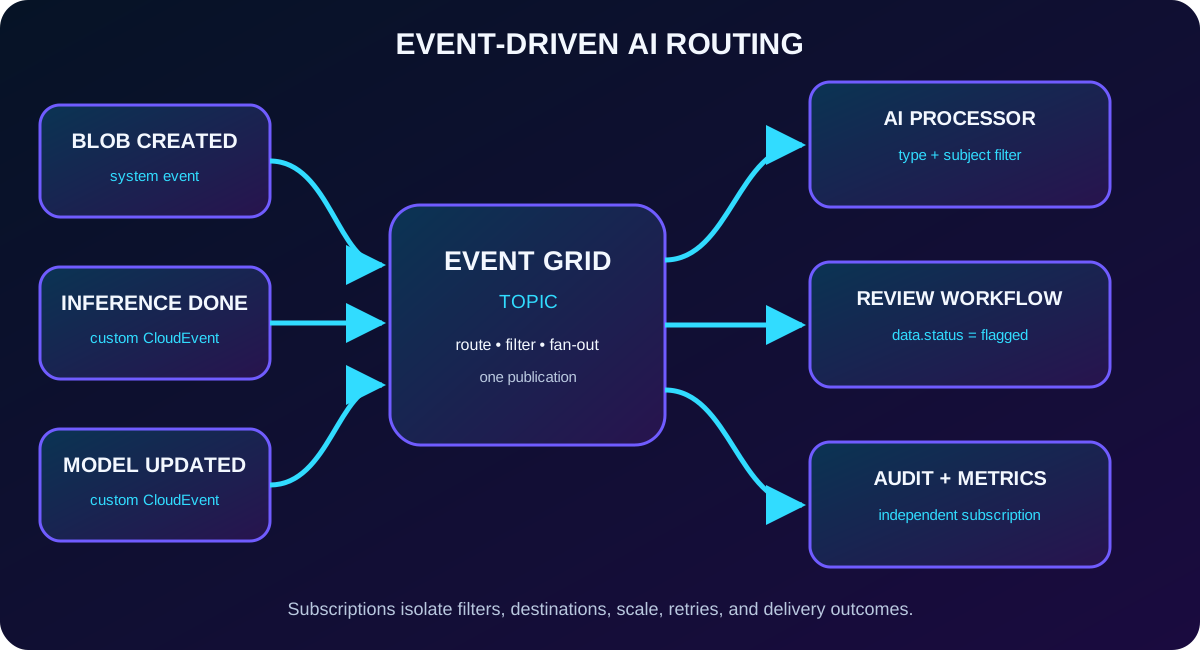
is a fully managed, low-latency publish-subscribe service with usage-based event operations. An event is a compact fact that something changed; it is not the full resource or result. A source publishes the fact to a topic, an event subscription selects matching events, and a handler performs the reaction. ,, Container Registry, , custom applications, and partner SaaS systems can all act as sources.
Core components
Component
Responsibility in an AI solution
Event
Describes a discrete state change with identity, type, source, time, subject, and small data payload
Event source
Produces the change, such as a blob upload, completed inference, or model validation
Topic
Provides the publication and routing boundary for related events
Event subscription
Connects a topic to one destination and optionally applies filters
Event handler
Receives the event and starts processing, notification, audit, or orchestration
Original diagram: one event publication is evaluated by independent subscriptions and delivered only to the handlers whose filters match.
Topic summary
Separate the fact, its producer, the routing topic, each filter, and each reaction; that separation is the foundation of loose coupling.
3. Choose system, custom, or namespace topics
Topic selection
Topic type
Publisher and use
System topic
Represents events emitted by an Azure resource, such as Microsoft..BlobCreated; applications subscribe but do not publish with an endpoint key
Custom topic
Exposes an application endpoint for user-defined events such as InferenceCompleted or ModelRetrained and supports push delivery
Namespace topic
Lives in an namespace, uses CloudEvents, and supports push or pull consumption plus namespace capabilities such as MQTT integration
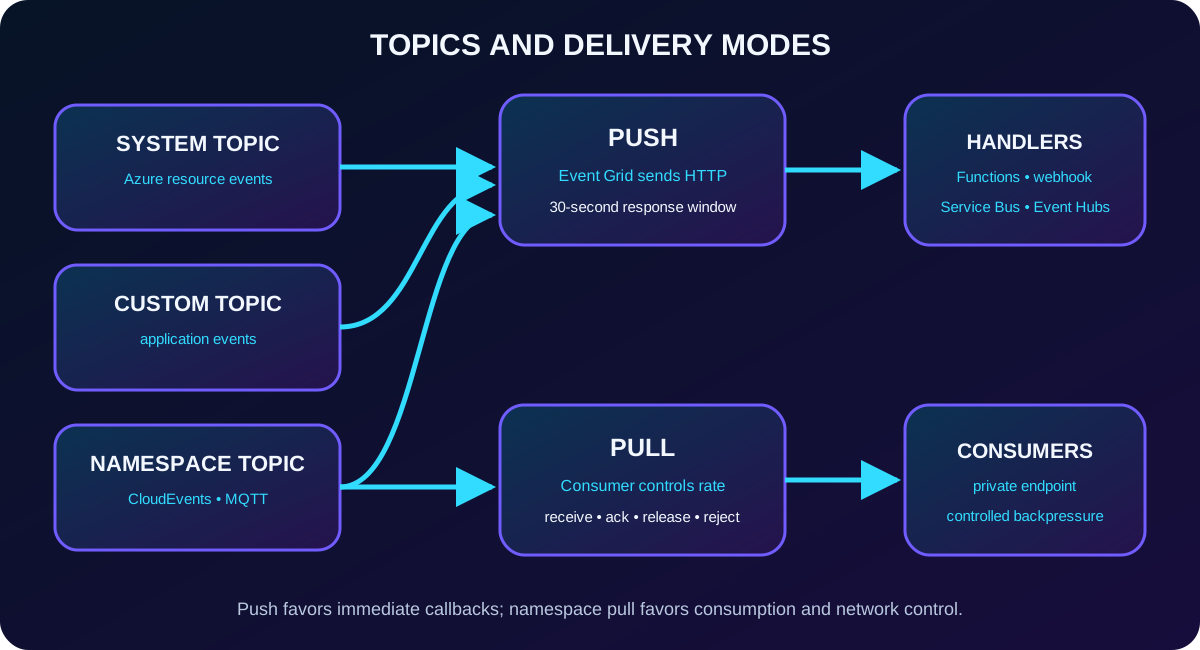
Use system events to react to platform state, custom events to announce application milestones, and namespace topics when consumers need pull control, private endpoints, or a unified namespace model. A moderation flow can start with BlobCreated on a system topic and publish com.contoso.ai.ContentClassified to an application topic after inference.
Topic summary
Match the topic to the publisher and consumption model: Azure resource events, application-defined milestones, or namespace-based push and pull.
4. Apply event-driven patterns and select handlers
Reactive data processing starts work when data arrives. Pipeline coordination publishes a new event only at meaningful boundaries such as embeddings completed or index refreshed. Model lifecycle events announce training, validation, promotion, and deployment. These patterns allow a new audit, notification, or quality service to subscribe without modifying the publisher.
Common push destinations
Handler
Good fit
Short event reactions and serverless orchestration
High-volume streaming and downstream analytics
queue or topic
Durable commands, load leveling, ordered or stateful processing
Webhook
Custom HTTP application with a public, validated endpoint
Azure queue
Simple durable work buffering
Push delivery sends an HTTP request as soon as an event matches. Pull delivery is available for namespace topics: the consumer chooses when and how fast to receive and can acknowledge, release, reject, or renew a lock. Prefer pull when the consumer cannot expose an endpoint, needs private connectivity, or must control the intake rate.
Original diagram: system and custom topics drive push handlers, while a namespace topic can also let controlled consumers pull and settle events.
Topic summary
Publish only meaningful state transitions, use push for immediate callbacks, and use namespace pull when the consumer needs timing, rate, or network control.
5. Standardize events with CloudEvents 1.0
supports its original schema and CloudEvents 1.0. CloudEvents is the recommended format for new designs because it standardizes event context across products and protocols and allows extension attributes. schema remains supported for compatibility. A topic that accepts events can deliver them as CloudEvents, but CloudEvents input cannot be converted to output because the older schema cannot represent CloudEvents extensions.
Schema decision
Input
Output
Supported
schema
schema
Yes
schema
CloudEvents 1.0
Yes
CloudEvents 1.0
CloudEvents 1.0
Yes
CloudEvents 1.0
schema
No
Topic summary
Use CloudEvents 1.0 end to end for new implementations and plan schema compatibility before creating topics and subscriptions.
6. Design useful CloudEvents for AI operations
A CloudEvent requires specversion, type, source, and id. The reverse-DNS type names the business fact; source identifies the producing context; id must uniquely identify the occurrence. Subject, time, datacontenttype, and data add routing and business context. Subject works well as a hierarchical path such as /pipelines/moderation/image-classifier.
Keep data compact. Include correlation identifiers, model and version, duration, status, a decision summary, and a secured URI for the full result. Useful types include InferenceCompleted, EmbeddingsRefreshed, BatchProcessingStarted, AnomalyDetected, ModelRetrained, and ContentClassified. Do not publish every internal variable change; publish facts another component can act on.
Topic summary
Build small, self-describing CloudEvents around meaningful business facts and reference large results instead of embedding them.
7. Filter by event type and subject
A subscription can restrict included event types so a handler receives only the facts it understands. Subject prefix and suffix filters route hierarchical resources, file families, tenants, or pipeline stages without opening the data object. When combined, type and subject conditions must both match.
Stable naming is operational infrastructure. Define event type and subject conventions before producers multiply, preserve casing, and test positive and negative examples. Type tells what happened; subject tells where or to which business object it happened.
Topic summary
Use type for semantic routing and subject prefixes or suffixes for path routing; combine them to reduce unnecessary handler work.
8. Route on data with advanced filters
Advanced filters inspect CloudEvents context or data fields. Operators include StringIn, StringContains, StringBeginsWith, NumberGreaterThan, BoolEquals, and IsNotNull. A moderation subscription can use StringIn on data.status for flagged or review, while another can select confidence above a threshold or a particular model version.
A subscription supports up to 25 advanced filters and 25 total filter values, with string values limited to 512 characters. Conditions across filter clauses use AND; multiple values within one condition provide alternatives. Keys containing a dot cannot be escaped, so design filterable field names accordingly. Filters are routing controls, not an authorization boundary, and handlers must still validate the event.
Topic summary
Advanced filters move lightweight selection into the router, but contracts, limits, field names, and handler validation still require deliberate design.
9. Acknowledge push delivery correctly
For push delivery, sends HTTP POST requests. Only 200, 201, 202, 203, and 204 acknowledge success. The endpoint has 30 seconds to respond; a timeout is a failed attempt. Each request contains an array, with one event by default. Delivery is at least once, so duplicate events can occur and the handler must use the event id or a business key for idempotent effects.
Representative response behavior
Response
Meaning for
200-204
Delivery completed
400, 403, or 413
Permanent failure; not retried
401 or 404 to an Azure resource endpoint
Retried after at least five minutes because provisioning can be transient
408
Retried after at least two minutes
503
Retried after at least 30 seconds
Other failure
Standard exponential backoff applies
Return 503 for temporary capacity or dependency failures instead of mislabeling them as 400. A 401 from a webhook is not retried; the special delayed retry for 401 and 404 applies to Azure resource endpoints. If inference cannot finish within 30 seconds, persist accepted work, return 202, and complete it asynchronously.
Topic summary
Acknowledge quickly with the right 2xx status, classify transient failures accurately, and make every side effect safe under at-least-once delivery.
10. Configure retry lifetime and attempt limits
Retry uses exponential backoff with randomization. The nominal sequence is 10 seconds, 30 seconds, 1 minute, 5 minutes, 10 minutes, 30 minutes, 1 hour, 3 hours, 6 hours, and then every 12 hours through the 24-hour window. The subscription controls two stopping conditions: maximum delivery attempts from 1 to 30, and event TTL from 1 to 1,440 minutes. Both default to 30 attempts and 1,440 minutes; the first limit reached ends delivery. The schedule itself is not configurable.
A short TTL can expire before a high attempt limit becomes relevant. Choose both from the event business value, recovery time of the handler, and downstream capacity. can skip attempts when an endpoint appears unhealthy. If the endpoint later responds within three minutes, best-effort removal from the retry queue can still race with another attempt and produce a duplicate.
Tune TTL and attempt count together because whichever expires first wins, while idempotency remains necessary despite backoff.
11. Preserve undeliverable events with dead-lettering
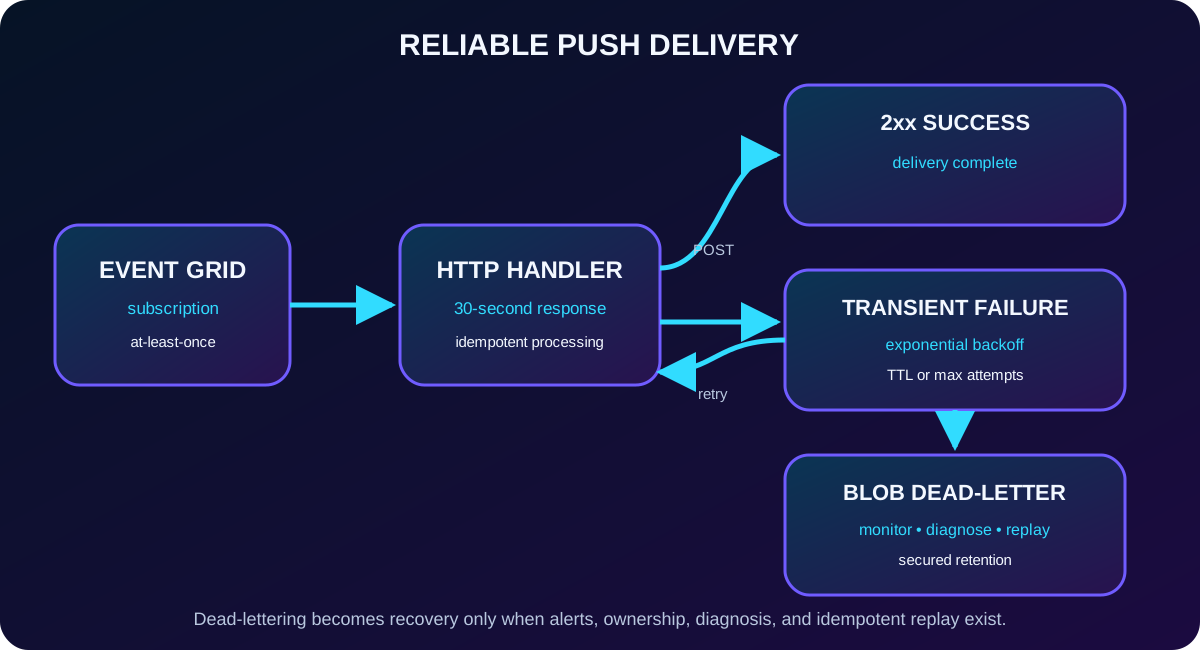
Dead-lettering is disabled until the subscription points to an existing container. When retries or TTL are exhausted, can store the original event plus diagnostic properties such as deadLetterReason (for example, MaxDeliveryAttemptsExceeded or MaxRetryDurationExceeded), deliveryAttempts, lastDeliveryOutcome (such as NotFound, TimedOut, Busy, or Forbidden), publishTime, and lastDeliveryAttemptTime. Without a dead-letter destination, expired events are dropped.
Treat the container as an operational queue. Secure it, set retention, alert on new blobs, inspect patterns such as NotFound or TimedOut, correct the root cause, and replay through a controlled idempotent process. A second event subscription on the dead-letter storage container can trigger notification or reprocessing.
Original diagram: successful handlers acknowledge, transient failures retry until TTL or attempt limits, and exhausted events enter secured Blob for investigation and replay.
Topic summary
Dead-lettering converts exhausted delivery into inspectable evidence, but only an owned alert, diagnosis, retention, and replay process makes it useful.
12. output without breaking reliability
Output batching is off by default. A subscription can request 1 to 5,000 events per batch and a preferred batch size from 1 to 1,024 KB. These are best-effort targets: does not wait to fill a batch, and one large event can exceed the preferred size while remaining deliverable.
Delivery is all or none. The endpoint must process the entire batch and return one result within 30 seconds; partial success is unsupported and any failure retries the whole batch. Select a size the handler can validate and process safely, and retain per-event idempotency because previously completed items can reappear.
Topic summary
Batching lowers HTTP overhead, but the handler must finish the complete batch within the timeout and safely tolerate whole-batch redelivery.
13. Monitor event flow and delivery outcomes
exposes delivery success, delivery failure attempts, matched events, dropped events, and dead-lettered events. Correlate these with handler latency, availability, logs, model capacity, and the event source publication rate. A failure metric counts attempts rather than only final losses, so interpret it with success and dead-letter data.
Alert on sudden dead-letter growth, sustained delivery failures, unexpected drops, disappearance of matched events, and changes in success rate. Include event id, type, subject, correlation id, subscription, handler, and attempt outcome in logs without recording secrets or sensitive payloads.
Topic summary
Observe publication, matching, attempts, success, drops, and dead-letter together so an event-driven pipeline has end-to-end health rather than isolated metrics.
14. Authenticate publishers with least privilege
Publishers can use an access key, a SAS token, or . For Azure-hosted production workloads, prefer a system-assigned or user-assigned managed identity and grant the Data Sender role at the narrowest topic scope. The role supplies Microsoft.EventGrid/events/send/action without embedding a secret.
Access keys use the aeg-sas-key header and are convenient for a short lab. SAS narrows time and resource exposure but is still a secret. supports token-based controls, including applicable Conditional Access policy, and avoids application-managed key rotation. Ingress identity is separate from identity used to authenticate delivery to downstream Azure services.
Topic summary
Use managed identity and Data Sender for production publishing; reserve keys or SAS for explicitly controlled cases and rotate them.
15. Publish CloudEvents with the Python SDK
The current azure-eventgrid package provides EventGridPublisherClient, and azure.core.messaging provides CloudEvent. The client accepts AzureKeyCredential, AzureSasCredential, or a token credential such as DefaultAzureCredential. It can send one event or a homogeneous list. For a namespace topic, supply its topic context as required by the current client API.
import os
from azure.core.messaging import CloudEvent
from azure.eventgrid import EventGridPublisherClient
from azure.identity import DefaultAzureCredential

client = EventGridPublisherClient(
    os.environ["EVENTGRID_TOPIC_ENDPOINT"],
    DefaultAzureCredential(),
)

event = CloudEvent(
    type="com.contoso.ai.InferenceCompleted",
    source="/services/content-moderation",
    subject="/pipelines/moderation/image-classifier",
    data={
        "requestId": "req-78901",
        "modelName": "content-classifier",
        "status": "completed",
        "resultLocation": "https://results.example/output/req-78901.json",
    },
)

client.send(event)  # A list publishes a batch of one event type.
Create one long-lived client where practical, validate event data before sending, propagate correlation, and publish at natural checkpoints such as inference completion, model promotion, anomaly detection, or pipeline transition. A successful send means accepted the event; it does not mean every handler completed.
Topic summary
The SDK handles serialization and authentication, while the application remains responsible for stable contracts, meaningful checkpoints, and acceptance-versus-processing semantics.
16. Publish by REST and design repeatable event patterns
A custom topic also accepts HTTP POST. For a structured CloudEvent, use application/cloudevents+json and authenticate with Microsoft Entra bearer tokens, aeg-sas-key, or SAS as appropriate. A 200 response confirms acceptance for routing; malformed JSON, invalid credentials, or schema mismatch returns a non-2xx response.
Request and correlation IDs, model and version, duration, status, result URI, compact summary
Model updated
Model version, validation metrics, artifact URI, promotion state, deployment target
Pipeline stage transition
Run ID, stage, status, input and output references, duration, next-state hint
Topic summary
REST offers a portable publication path; use the same versioned event patterns and security rules as SDK publishers.
17. Guided lab: route moderation events
The source exercise provisions an namespace and namespace topic, creates subscriptions filtered for flagged, approved, and all content, then runs a Python Flask application that publishes moderation events. A pull consumer receives them and explicitly acknowledges, releases, or rejects each delivery. Allow about 30 minutes after preparing an Azure subscription, , Python 3.12 or later, and the current Azure CLI.
Download the starter project, create the namespace topic with CloudEvents, and deploy three subscriptions with nonoverlapping, tested filters.
Publish approved and flagged events containing stable type, subject, request ID, model, status, and result reference.
Receive in pull mode, inspect event and broker properties, acknowledge success, release transient work, and reject invalid input.
Verify each subscription receives only its intended events and correlate the publisher, , and consumer logs.
Trigger a controlled delivery failure, observe retry or dead-letter behavior, then remove the resource group after the lab.
Topic summary
The lab proves publication, filtered routing, pull settlement, and observability with real events instead of relying on configuration alone.
18. Assessment review and production checklist
Assessment answers
Question
Correct answer
Reason
Publish an application-defined inference completion
Custom topic
The application owns the event and publishes it to an endpoint
Filter a pipeline path by prefix or suffix
CloudEvents subject
Subject is the hierarchical resource path
Handler cold start exceeds 30 seconds
Automatic retry with exponential backoff
A timed-out delivery is attempted again within policy limits
Route flagged or review values in data.status
Advanced StringIn filter
It evaluates alternatives in the data field
publisher in production
with managed identity
No embedded key and least-privilege RBAC
Before production, confirm topic type, CloudEvents contract and versioning, subject and type taxonomy, filter tests, push or pull choice, endpoint validation, 30-second behavior, idempotency store, retry TTL and attempts, Blob dead-letter ownership, batch limit, monitoring and alerts, replay runbook, managed identity and RBAC scope, private connectivity, quotas, cost, and load tests against real handler capacity.
A production design combines an interoperable event contract, precise routing, safe delivery behavior, observable failure recovery, and identity-based publishing.