What the exam validates, how it differs from AI-900, its Microsoft Foundry domains, prerequisites, expected skills, and a complete study strategy.
Official information verified July 31, 2026 • Skills outline effective April 15, 2026
By João Ricardo Dutra••Complete original content
Quick overview and essential exam data
Information verified on Microsoft's official pages on July 31, 2026. The exam skills outline used here has been effective since April 15, 2026.
Quick view
The AI-901 is the current exam for the Microsoft Certified: Azure AI Fundamentals certification. It replaces AI-900 and maintains the introductory level, but presents a more practical orientation: 55% to 60% of the assessment is associated with implementing solutions in . The candidate must understand the main types of AI workload and know how to perform basic activities with prompts, models, agents, text, speech, computer vision, and information extraction.
Essential exam data
Essential AI-901 Exam Data.
Item
Current situation
Code and name
AI-901: Microsoft Azure AI Fundamentals
Certification obtained
Microsoft Certified: Azure AI Fundamentals
Level
Fundamentals/beginner
Main audience
Early career professionals developing AI solutions
Passing score
700 points or more
Language displayed for the exam
English, according to the official page consulted
Retirement date
No date announced on the official page
Evaluated domains
AI concepts and capabilities; implementation of solutions with
Formal prerequisites
No related exams or prior certification required
1. Introduction
Artificial intelligence is no longer a topic restricted to research laboratories and has become part of the daily development of applications, digital services, corporate automation and multimodal experiences. In this scenario, the Microsoft Certified: Azure AI Fundamentals certification works as a gateway for professionals who need to understand the essential concepts of AI and recognize how these concepts are transformed into solutions in the Microsoft Azure cloud.
The AI-901 exam is the assessment associated with this certification. It is designed to validate not only the ability to recognize terms and workload types, but also fundamental technical skills for using Azure AI capabilities through . The current matrix dedicates most of the weight of the test to the basic implementation of solutions, which makes the exam more applied than a purely conceptual assessment.
This article presents the purpose of the exam, the expected profile of the candidate, the structure of the assessment, the contents required and the practical significance of each domain. It also clarifies the transition from AI-900 to AI-901 and indicates how to correctly interpret the required depth level.
2. What is the AI-901 exam
The AI-901: Microsoft Azure AI Fundamentals is the exam that currently meets the Microsoft Certified: Azure AI Fundamentals certification requirement. Upon approval, the candidate demonstrates fundamental knowledge about artificial intelligence and initial skills to work with AI solutions in the Azure ecosystem.
Microsoft classifies the exam as an entry-level credential. However, “beginner” does not mean a complete absence of technical practice. The official profile states that the candidate must have conceptual knowledge of AI solutions in Azure, have fundamental technical skills to work with them, understand syntax and programming techniques in Python, and be familiar with Azure resources. Contact with common forms of integration, such as REST APIs, SDKs and command line interfaces, is also expected.
The exam is associated with the AI Engineer role, although it is not intended to validate the depth expected from an intermediate or advanced certification. Its objective is to verify whether the candidate can identify the appropriate type of AI for a scenario, understand the responsible principles involved, and perform simple tasks to build and consume solutions in .
Exam and certification are not the same thing
AI-901 is the exam code. Microsoft Certified: Azure AI Fundamentals is the name of the certification obtained by fulfilling the requirement. There are currently no additional related exams: passing the AI-901 is the listed requirement for this credential.
3. The transition from AI-900 to AI-901
The AI-901 replaced the former AI-900, which was retired on June 30, 2026. The Azure AI Fundamentals certification remained, but the exam used to earn it was updated to reflect the evolution of Microsoft's AI portfolio and the increasing centrality of the .
AI-900 divided the assessment into five conceptual areas: AI workloads and considerations, machine learning principles, computer vision, natural language processing, and generative AI. AI-901 reorganized the matrix into just two major domains and started reserving between 55% and 60% of the score for implementing solutions with Foundry.
This change indicates an important difference in expectations. In the previous exam, a candidate with good conceptual understanding and general knowledge of services could be well placed. In AI-901, merely theoretical study tends to be insufficient, because the matrix explicitly mentions tasks such as deploying models, interacting through the portal, creating lightweight clients with SDK, testing agents and building simple applications that process text, speech, images and documents.
Summary comparison
Summary comparison between AI-900 and AI-901.
Aspect
AI-900
AI-901
Situation
Retired on 06/30/2026
Current exam
Organization
Five thematic domains
Two big domains
Emphasis
Recognition of concepts and services
Concepts plus basic implementation
Central platform
Azure AI Services
and Foundry Tools
Schedule
It was not a strong requirement for the general profile
Python and programming techniques are expected
Agents
They were not a central axis
Agentic and single-agent applications appear explicitly
Multimodal Extraction
Documents with a more traditional scope
Content Understanding for documents, images, audio and video
4. Who is AI-901 intended for
The official audience is made up of people who are at the beginning of their career developing artificial intelligence solutions. This includes professionals who are not yet practicing AI engineers but want to establish a verifiable technical foundation for understanding, prototyping, and integrating AI capabilities into Azure.
The exam tends to be especially suitable for the following profiles:
Beginner AI developers who have already mastered programming fundamentals and want to learn about the Microsoft ecosystem for generative, multimodal and agentic applications.
Technology professionals who work with applications, APIs, integration, cloud, data, or automation and need to understand where AI capabilities fit into an architecture.
Students in computing, engineering, systems analysis, data science, or a related field seeking a first Microsoft credential in artificial intelligence.
Architects, technical analysts, consultants, and pre-sales professionals who need to talk to engineering teams about models, deployment, security, responsible use, and integration.
Professionals who studied for the AI-900, but want to update their preparation for the new matrix centered on the .
On the other hand, AI-901 is not designed to prove advanced mastery of model training, machine learning mathematics, MLOps, distributed production architecture, or complex agent development. Professionals who already design and implement complete AI systems may find the introductory exam too introductory. Still, it can be useful for organizing official Microsoft terminology and validating familiarity with the platform.
An introductory but not entirely non-technical exam
The main profile change from AI-900 is that AI-901 assumes basic knowledge of Python, programming, and Azure resources. It is not necessary to be an expert, but the candidate must understand how an application authenticates, calls an endpoint, sends input, receives responses and treats an AI solution as part of a software system.
5. Recommended prior knowledge
Microsoft does not require prior certification and does not list mandatory related exams. Even so, the official profile and learning paths indicate a minimum recommended base. The candidate must understand computing concepts, elementary mathematics, Python, and cloud fundamentals.
Computing and programming: variables, data types, conditional structures, repetition, functions, modules, basic error handling and reading code examples in Python.
Application integration: notions of HTTP, requests and responses, JSON, authentication, endpoints and use of libraries or SDKs to consume services.
Basic mathematics: interpretation of probabilities, metrics, structured and unstructured data and general idea of how models learn patterns. The matrix does not require advanced mathematical demonstrations.
AI concepts: difference between predictive and generative models, text, speech, vision, information extraction, multimodality and agents.
The candidate must also be comfortable with practical vocabulary: portal, project, endpoint, model deployment, credential, SDK, system prompt, user prompt, agent, tool, multimodal input, and extracted content.
6. Exam structure and characteristics
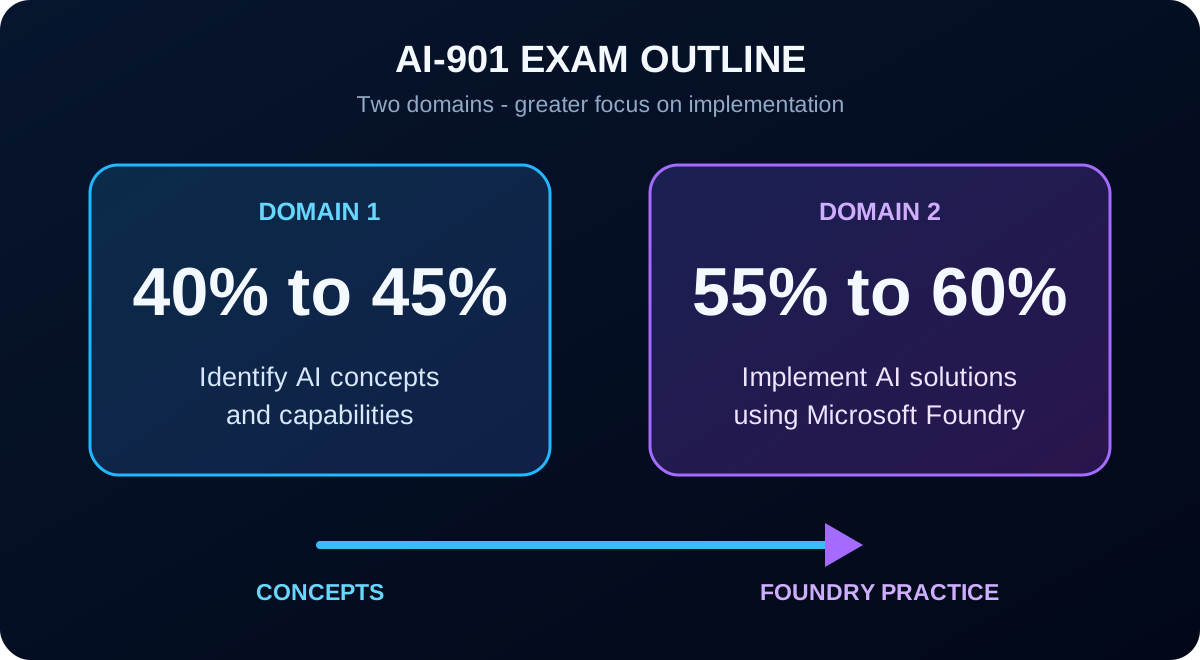
The matrix in force since April 15, 2026 divides the assessment into two large areas. The first checks whether the candidate understands AI concepts, capabilities and scenarios. The second evaluates the basic implementation of solutions in . The percentages represent the approximate proportion of questions assigned to each area and show where study effort should be concentrated.
AI-901 exam domains and weights.
Domain
Evaluated area
Weight
1
Identify AI concepts and capabilities
40% to 45%
2
Implement AI solutions using
55% to 60%
The AI-901 outline assigns 55% to 60% of the exam to implementing solutions with .
The minimum score reported by Microsoft is 700. This value should not be interpreted as a direct percentage of correct answers, because Microsoft uses a scoring scale. The official page also states that most questions address general availability features, although Preview features may appear when they are widely used.
As of the date this article was checked, the exam page only displayed English and did not show a retirement date. Microsoft also advises that when an exam is not available in the candidate's preferred language, additional time may be requested. Registration fees vary depending on the country or region in which the exam is taken and must be confirmed when scheduling.
Another relevant administrative point is the recommendation to register for the exam with a personal Microsoft account. Microsoft warns that credential records associated only with an organizational account may be lost if the user leaves the institution or company.
7. Domain 1 - Identify AI concepts and capabilities (40% to 45%)
This domain assesses whether the candidate can understand the fundamentals that guide the choice and use of AI solutions. It’s not enough to memorize product names. It is necessary to recognize risks, capabilities, limitations and the type of model or workload appropriate for a business need.
7.1 Responsible AI Principles
AI solutions can impact people, processes and decisions. Therefore, the matrix requires that the candidate knows how to describe six dimensions of responsible AI. Questions can present a scenario and ask what consideration should be prioritized, what risk is present, or what action reduces a particular problem.
Equity: assessing whether the system treats groups and individuals unfairly differently. In a credit model, for example, it must be verified whether characteristics correlated with protected groups produce discriminatory results.
Reliability and security: ensuring that the solution works consistently, is tested under realistic conditions, handles failures, and avoids dangerous or unexpected results.
Privacy and Security: Protect data, credentials, prompts, outputs and personal information. This involves controlled access, adequate storage, data minimization and prevention of undue exposure.
Inclusion: designing solutions that can be used by people with different abilities, contexts, languages and needs, preventing technology from excluding part of the public.
Transparency: Allow users to understand when they are interacting with AI, what the limitations of the solution are, and, where appropriate, how a result was produced.
Responsibility: define who is responsible for the system, implementation decisions, monitoring and problem correction. The final decision should not be abstractly attributed to the model.
In practice, these dimensions overlap. A CV analysis application can have equity, privacy and transparency risks at the same time. The exam may require the candidate to identify the concern most directly associated with the scenario presented.
7.2 AI Model Components and Settings
The matrix requires the candidate to describe how generative models work, select models based on capabilities, and recognize deployment options and configuration parameters. The expected level is conceptual and operational: understanding what changes when choosing another model, another modality or another configuration.
Among the aspects that must be understood are:
Generative models take an input, process the context, and produce new outputs such as text, code, image, audio, or multimodal content.
Different models can vary in quality, speed, cost, context size, supported modalities, reasoning ability, and suitability for a task.
A deployment makes the model available for consumption by applications, typically through an endpoint, credentials, and parameters defined in the environment.
Generation parameters influence response behavior, such as degree of variability, output limit and preference for more or less likely alternatives.
The choice of model must start from the scenario: classifying text, chatting, analyzing an image, generating a figure, responding to audio or executing an agentic task are not identical needs.
The exam may present two or more alternatives and ask which model or type of deployment best meets multimodality, cost, latency, or capacity requirements. The candidate does not need to memorize all the models available in the catalogue, but must understand the selection criteria.
7.3 AI workloads
The third part of the conceptual domain involves recognizing scenarios for common workloads. The core skill is to transform a need described in business language into the most appropriate technical type of solution.
Generative AI
Content creation or transformation. Examples include answering questions, summarizing documents, producing text, generating images, and assisting in writing code. The candidate must distinguish content generation from deterministic analysis or structured extraction.
agentic AI
Solutions where an agent is given a goal, uses instructions and context, can invoke tools, and takes steps to complete a task. The agent is not just a chatbot: it can plan actions, consult sources and interact with services.
Text analysis
Processing textual content to identify keywords, entities, sentiment, topics, language, summary and other semantic characteristics.
He speaks
recognition to convert speech to text and synthesis to transform text to speech. Spoken interaction scenarios with multimodal models may also appear.
Computer vision
Interpretation of images and visual content, including description, analysis, element recognition, and use of visual input in multimodal prompts.
Image generation
Production of new visual elements from textual instructions or other inputs, distinguishing generation from visual analysis.
Information extraction
Transformation of documents, forms, images, audio or video into useful data and fields. The focus is on getting structure from unstructured or semi-structured content.
8. Domain 2 - Implement AI solutions using (55% to 60%)
This is the most important domain and the most striking characteristic of AI-901. The candidate needs to recognize how a solution is created, configured, tested and consumed. The word “implement” should be interpreted at the fundamental level: executing guided tasks on the portal, understanding small snippets of code and assembling lightweight applications, without requiring advanced production architecture.
8.1 The role of
serves as a central platform for exploring models, organizing projects, deploying resources, creating agents, testing prompts, and integrating AI capabilities into applications. In the context of the exam, it represents the unified environment in which different workloads are developed and consumed.
The candidate must understand the relationship between the portal and code. The portal allows resources to be configured and tested visually; the SDK and endpoints allow an application to use those same resources programmatically. In a question, an activity may be described as configuration in the Foundry portal or as consumption by a small Python client.
8.2 Generative AI applications and agents
The matrix lists five specific skills for generative AI and agents: crafting effective prompts, deploying a model, interacting with it in the portal, creating a lightweight chat client, building and testing a solution with a single agent, and creating a client for that agent.
System and user prompts: the system prompt establishes general behavior, rules, role and limits; the user prompt contains the concrete request. The candidate must know how to separate standing instructions from the current task and formulate clear, contextualized and verifiable requests.
Model deployment: Select a model, make it available in the project, define a deployment, and obtain the necessary elements for integration. Deployment turns a catalog option into a consumable resource.
Portal interaction: Use a testing experience to send prompts, observe responses, and adjust instructions or parameters before integrating the solution into code.
Chat client with SDK: initialize a client, authenticate, reference the deployment, send messages and handle the response. The code tends to be short, but the candidate must understand the flow.
Single agent: define instructions, resources and behavior of an agent; test it on the portal; then create a client application that sends requests and tracks responses or executions.
What does “light client” mean?
It is a small application, created to demonstrate integration with the service. In general, it involves few steps: configuring endpoint and authentication, instantiating a client, sending input, receiving output, and presenting or processing the result. It's not about building a complete production platform.
8.3 Text and speech
The candidate must know how to build a simple application that performs text analysis, respond to spoken commands through an implemented multimodal model and use Azure in Foundry Tools.
In text analysis, the study must include the identification of keywords, entities, sentiment and summaries. The question may ask for the appropriate resource, the basic integration sequence, or the interpretation of the returned result. It's important to understand that general-purpose models can perform textual tasks, while specialized tools offer structured capabilities for certain scenarios.
In speech, there are two main paths. A specialized service can recognize and synthesize voice; a multimodal model may accept audio or spoken instructions as part of the interaction. The candidate must recognize when to use transcription, synthesis, conversational interaction, or a combination of these capabilities.
8.4 Computer vision and imaging
The matrix asks the candidate to interpret visual inputs into prompts with multimodal models, create new visual outputs with generative models, and develop a lightweight application with vision capabilities.
Interpreting an image means sending visual content along with instructions and requesting an analysis, description, comparison, identification or contextual response. Generating an image means creating new visual content from a prompt. These processes use different modalities and may require different models and endpoints.
In a lightweight vision application, the flow typically includes preparing the image or its reference, sending the input to the model, defining the analysis instruction, and processing the response. The candidate must be aware of accepted formats, input limits, content security and suitability of the model for the objective.
8.5 Extracting information with Azure Content Understanding
Information extraction is one of the areas that most highlights the expansion of AI-901. The matrix explicitly mentions Azure Content Understanding in Foundry Tools to extract data from documents and forms, images, audio and video.
The goal is to convert complex content into usable information. In a form, this might mean identifying fields and values; in an image, locate elements or data; in audio, recognize segments and relevant information; in video, combine visual and sound signals. The client application receives input, requests analysis, and uses the structured output in the business process.
The candidate must understand the difference between simply generating a free description and extracting data with structure. In many corporate scenarios, the value is in transforming unstructured content into fields that can feed systems, searches, validations or automations.
9. What may appear in practical and scenario questions
Microsoft does not publish the exact format of all questions in advance, but the matrix allows you to predict the types of reasoning the candidate will need to apply. Instead of just studying isolated definitions, it is more efficient to practice decisions and implementation sequences.
Workload Choice: A company wants to identify names of organizations and locations in customer reviews. The candidate must recognize text analysis with entity detection, not image generation or speech synthesis.
Responsible AI: A system has very different error rates between groups of users. The main concern is equity, although reliability and responsibility can also play a part in the solution.
Multimodal model: an application needs to receive a photograph and answer questions about the visual content. The choice must fall on a model with vision capabilities, not on an exclusively textual model.
Prompting: an application must always respond in a certain format and avoid revealing sensitive data. Persistent rules belong at the system prompt; the specific question belongs to the user prompt.
Agent: An assistant needs to consult a source or perform an action to accomplish a goal. The scenario suggests an agentic solution with tools, not just a response generated without access to external resources.
Content Understanding: An organization wants to extract fields from contracts, attached images, and meeting recordings. The solution must consider multimodal extraction and generation of structured outputs.
Python Client: A code snippet creates a client, uses endpoint and credential, and sends a request. The question may ask which element is missing, which method initiates the interaction, or how the answer is retrieved.
As the guide informs that the candidate must know REST APIs, SDKs and CLIs, questions may appear that compare access methods or show small fragments of commands and code. The objective is not to memorize an extensive application, but to understand the role of endpoint, authentication, parameters, payload, deployed model and response.
10. The expected Python level
AI-901 is not a Python programming exam, but Python appears as a base skill. This means that the candidate must be able to read and understand a simple AI client, identify its components and make small adaptations.
It is recommended to master:
Creation of variables, strings, lists and dictionaries.
Import of packages and classes.
Client instantiation and parameter passing.
Reading values in objects or JSON responses.
Use of basic conditional functions and structures.
Simple error handling and input validation.
Secure use of credentials, preferring environment variables or identity mechanisms over hard-coded secrets.
It is not necessary to study advanced algorithms, in-depth data science libraries, or manual training of neural networks to meet the scope described. The priority is to understand the integration between the application and the resources deployed in Azure.
11. How to interpret the mention of machine learning
The summary description on the exam page even mentions “fundamental principles of machine learning in Azure”. However, the current study guide organizes skills into two domains and does not feature a stand-alone machine learning section as existed in AI-900. In the current matrix, model-related knowledge appears mainly in generative model operation, model selection, deployment options, and workload recognition.
For the study, the skills guide measured since April 15, 2026 should be treated as the main reference. It is still useful to know basic concepts of models, data, training, and inference, but the candidate should avoid dedicating most of their time to classical algorithms that do not appear explicitly in the current matrix. The practical focus is to use capabilities available in the .
Priority rule for study
When a general description and detailed matrix seem to have different emphases, prioritize the most recent study guide and its “Skills measured” topics. It is the document that details how skills are being assessed.
12. Official preparation itineraries
Microsoft offers two six-module learning paths. They complement each other: the first develops the conceptual basis; the second takes the candidate to practice on Azure and .
12.1 AI concepts for developers and technology professionals
This learning path is introductory and requires only a basic understanding of computing and mathematics. It covers general AI concepts and terminology before exploring the most important workloads:
Introduction to the concepts of AI and responsible AI.
Generative AI, large language models, prompts and agents.
Natural language processing and text analysis.
recognition and synthesis.
Computer vision.
Extracting information from documents, images and other unstructured sources.
12.2 Get started with AI applications and agents on Azure
This learning path assumes basic computing concepts and Python. It shows how to get started with workloads and solutions in and includes hands-on activities:
Get started with AI on Azure and using Foundry endpoints.
Generative models and agents in .
Text parsing and building a lightweight Python client.
recognition and synthesis with Azure .
Visual analysis and generation of images or videos with multimodal and generative models.
Extracting information with Azure Content Understanding.
The most coherent sequence is to study the concepts first and then revisit each area in its practical version. For example, understand NLP and text analysis, then complete the text analysis module in Azure. This pairing reduces the distance between definition and implementation.
13. Recommended study strategy
Effective preparation must reflect the exam weighting. Because the implementation domain represents 55% to 60%, it is inappropriate to dedicate almost all the time to memorizing concepts. The candidate should combine reading, portal practice, and short Python examples.
Map the matrix: turn each official bullet into a verifiable study objective. Avoid using only old AI-900 summaries.
Build the conceptual foundation: Study responsible AI, workload types, generative models, multimodality, text analysis, speech, vision, agents, and information extraction.
Practice in Foundry: Create or explore a project, test a model, adjust prompts, observe endpoints, understand deployments, and experiment with a simple agent.
Reproduce lightweight clients: read and run small examples of chat, text analysis, speech, vision, and information extraction. Focus on the common structure of these integrations.
Practice architecture decisions: for each scenario, answer which workload, model type, tool, input, output, and responsible AI risk apply.
Use the official practice assessment: Microsoft provides Practice Assessment on AI Skills Navigator. Access requires authentication and can help identify gaps before the exam.
Review the guide close to the exam: exams are updated periodically. Confirm the current date and skills outline before scheduling or taking the assessment.
14. For whom AI-901 may not be enough
Certification validates fundamentals. It does not replace experience in real projects and does not demonstrate, in isolation, the ability to lead complex AI solutions. Some professional goals require additional studies:
Training, evaluating, and optimizing machine learning models requires deep dives into data, statistics, experimentation, and .
Building AI applications in production requires architecture, security, observability, costs, performance, testing, governance, and integration with enterprise systems.
Developing advanced agents requires tools, memory, grounding, evaluation, protection against malicious instructions, coordination of flows and control of actions.
Implementing regulated solutions requires additional knowledge of privacy, compliance, auditing, risk management, and organizational policies.
Thus, AI-901 should be understood as a starting point. Its value lies in creating common language, organizing fundamentals and proving initial contact with the platform. Professional consolidation occurs when this knowledge is applied in laboratories, projects and real functions.
15. Conclusion
The AI-901 exam updates the Azure AI Fundamentals certification for a phase in which generative artificial intelligence, multimodality, agents, and content extraction are part of software development. It retains a beginner-level scope, but expects a more technical candidate than the former AI-900: someone capable of understanding concepts and performing basic implementations in .
The assessed content is concentrated in two blocks. The first covers responsible AI, models, and workloads. The second, with greater weight, covers the implementation of generative and agentic applications, text, speech, computer vision, image generation, and information extraction with Content Understanding. The explicit presence of Python, SDKs, REST APIs, and CLIs reinforces that preparation must include practice.
The certification is primarily aimed at students, developers, and technology professionals beginning their journey into AI solutions on Azure. For this audience, AI-901 offers an up-to-date foundation for understanding the platform, talking to technical teams, and later moving on to more in-depth projects and credentials.
Note: Certification pages and exam objectives may be changed by Microsoft. Before taking the exam, check the official page and the most recent study guide again.