Introduction to Artificial Intelligence: Workloads and Responsible AI
Generative AI, agents, natural language, speech, computer vision, information extraction, and the six responsible AI principles
Suggested study time: 30 minutes • Beginner level • Original rewrite based on Microsoft Learn objectives
By João Ricardo Dutra••Complete original content
1. Introduction to artificial intelligence workloads
Learning objectives
Recognize the core AI capabilities: content generation, agents, language, speech, computer vision, and information extraction.
Distinguish large and small language models, prompts, instructions, and agent tools.
Explain text analytics, speech recognition and synthesis, vision tasks, and OCR.
Apply the six responsible AI principles to practical scenarios.
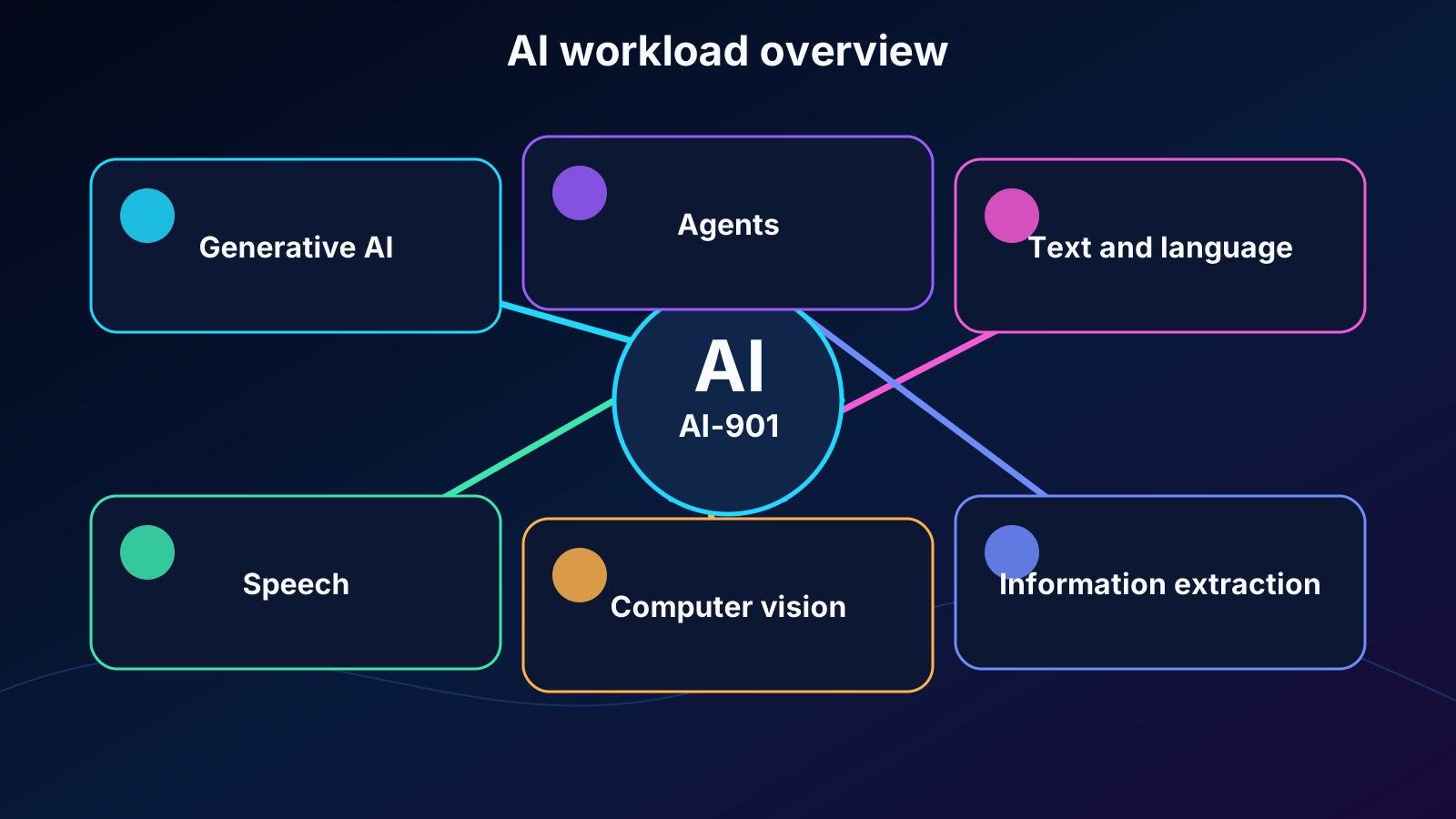
This chapter provides a conceptual tour of the main artificial intelligence capabilities. It develops intuition about what each workload does and when it is useful without requiring code or a mathematical treatment of machine learning models.
Microsoft Learn offers the source module as video and as text with images. The written experience generally includes additional detail and can supplement the video presentation.
Ask Anton illustrates how an AI application can answer questions about the material. Its Azure-based experience requires a subscription that can create a project and deploy a model. A browser-based alternative runs models locally and can search documentation. Ask Anton is an educational example, not a supported Microsoft product or an official component of Microsoft Learn or AI Skills Navigator.
The introduction connects six families of AI capabilities that often work together.
2. Generative AI and language models
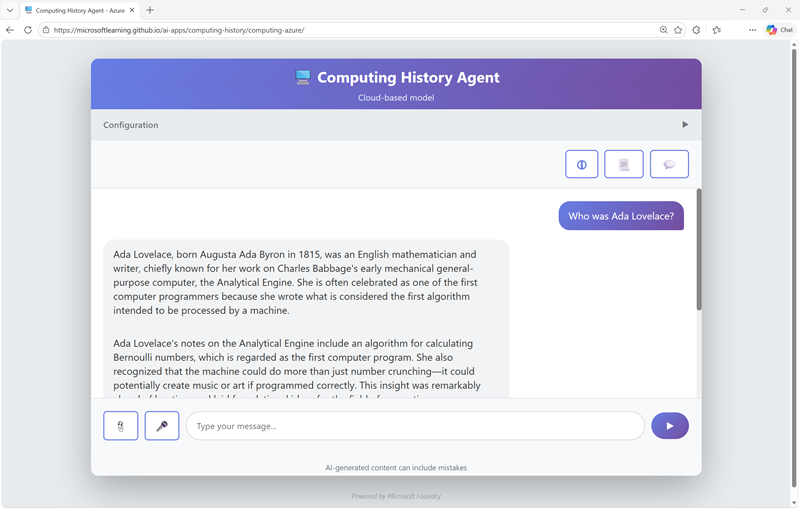
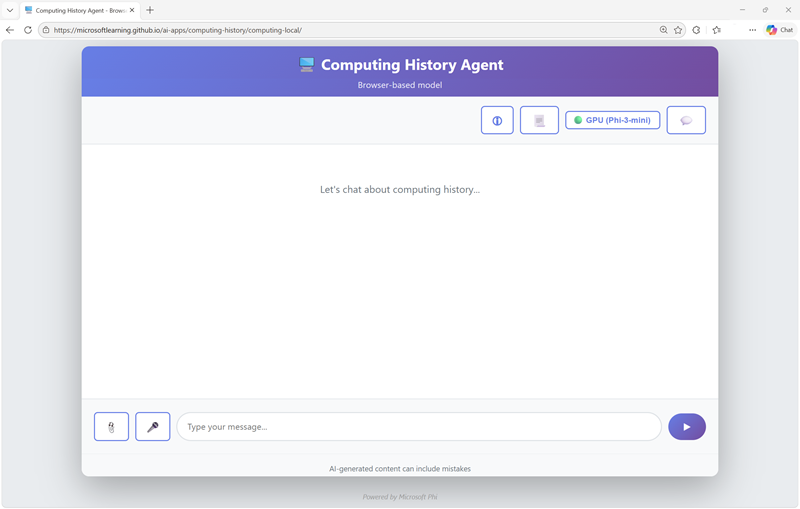
Generative AI creates new content. Its output may be a natural-language conversation, an image, a video, code, or another format. A computing-history website, for example, can offer a chat experience that composes original answers about people, technologies, and events.
Original interface screenshot: conversation makes the historical collection interactive.
Generation relies on a language model trained with large amounts of data, including public documents and Internet material. A user sends a prompt - a natural-language question or instruction - and the model uses learned semantic relationships to construct a meaningful sequence.
Large language models, or LLMs, contain many parameters and typically generalize across varied tasks, but they can cost more to train and operate. Small language models, or SLMs, may fit focused domains, local applications, and on-device agents where deployment size and cost matter.
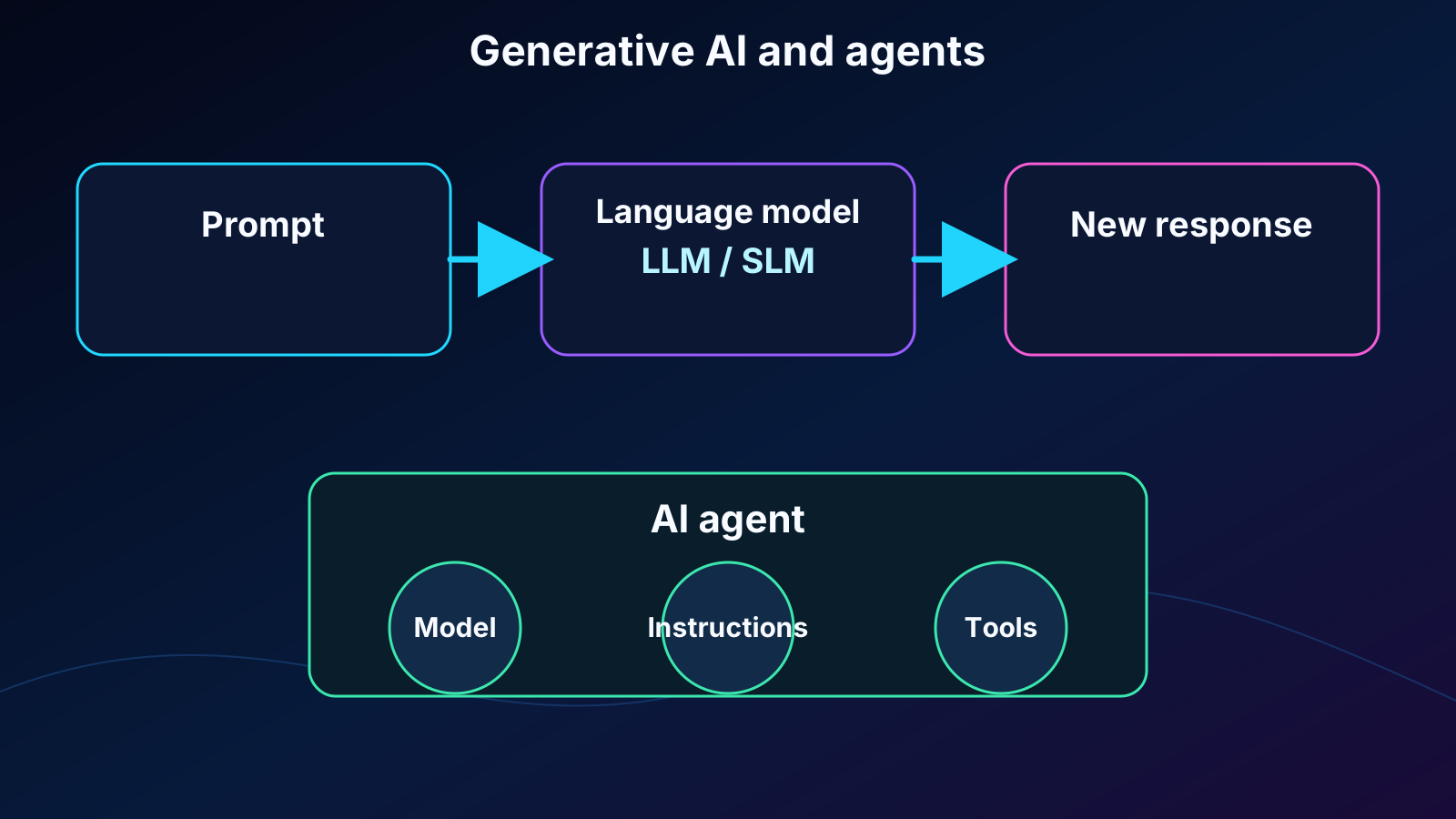
Generation turns a prompt into a new response; an agent adds instructions and tools to the model.
3. AI agents
An agent is a generative-AI application that can interpret and produce language, reason about a request, use tools to automate work, and react to contextual conditions before taking action.
Core elements of an AI agent.
Element
Purpose
Language model
Provides the agent with language understanding and reasoning.
Instructions
A system prompt defines the role, behavior, limits, and working approach.
Tools
Connect the agent to knowledge such as search and databases, or actions such as sending email, changing a calendar, and controlling a device.
Together, these elements allow agents to act as digital assistants that collaborate with people and automate workflow steps. They can retrieve information, select an appropriate tool, and act within the permissions they receive.
Conversational bots.
Task-oriented assistants.
Drafting documents and other content for later refinement.
Automated translation.
Summarizing or explaining complex documents.
4. Text and natural language processing
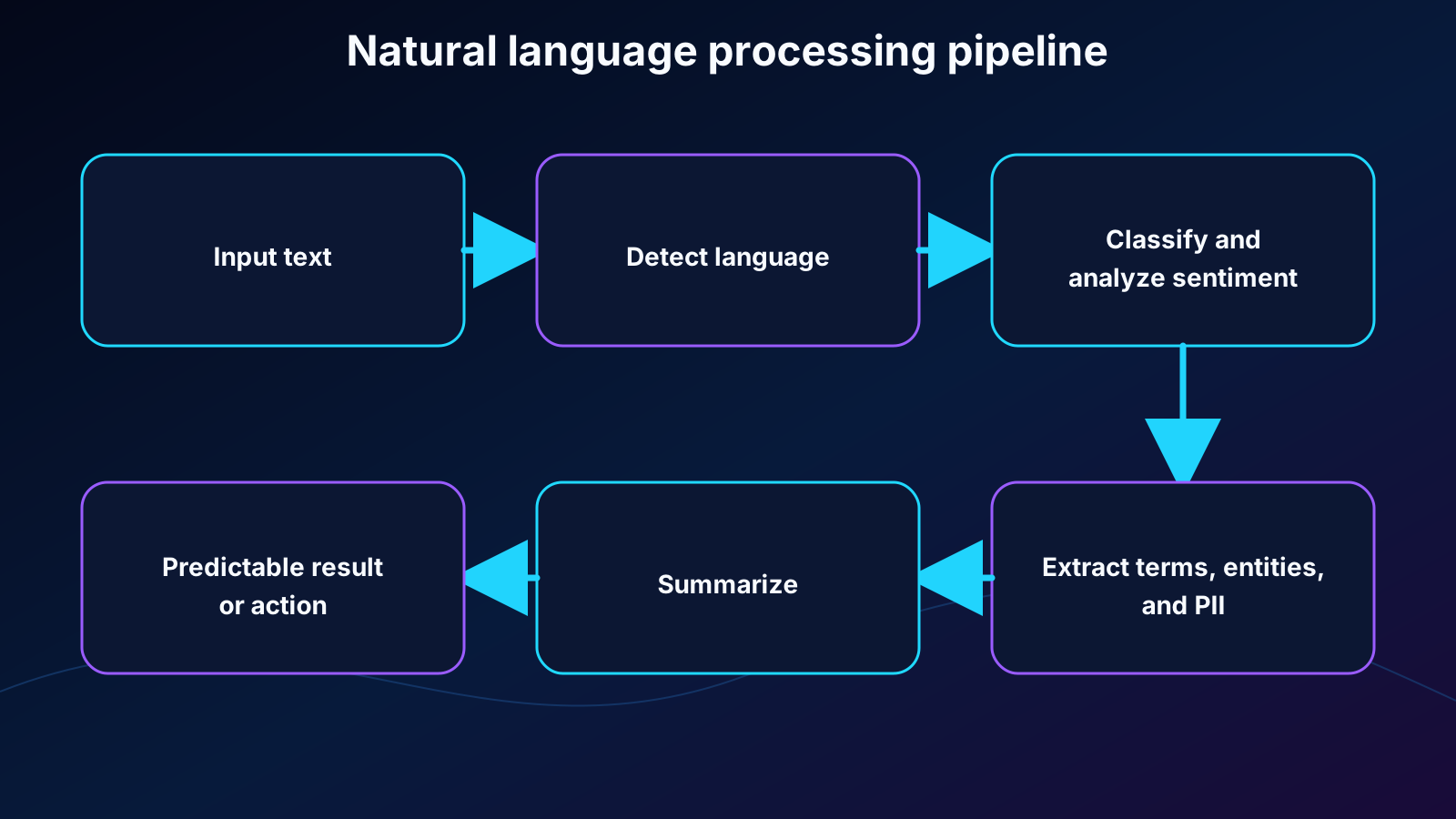
Natural language processing, or NLP, covers models and techniques for interpreting human language. It supplies foundations for generative-AI LLMs and for specialist text-analysis systems designed to produce predictable results or enforce custom rules.
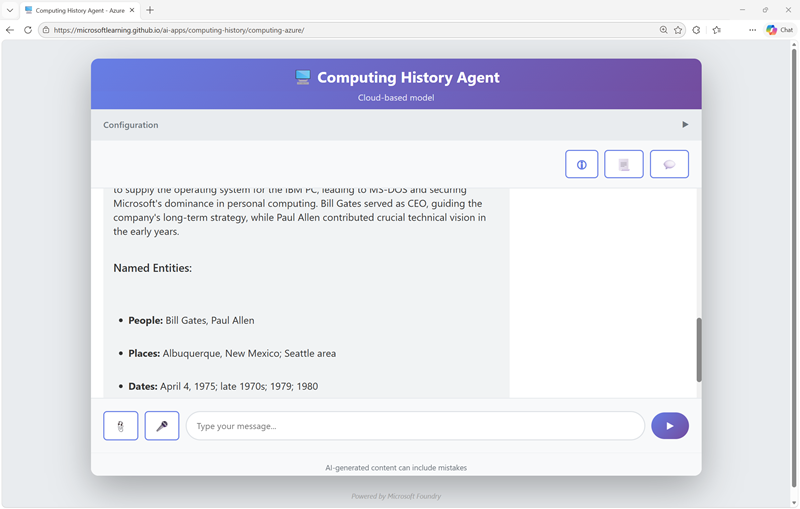
The example combines summarization with entity extraction from a historical article.
Common text-analysis techniques.
Technique
Output
Language detection
Identifies one or more document languages and often starts a multistage processing workflow.
Classification and sentiment analysis
Assigns a category and can estimate whether the text expresses positive, negative, or neutral sentiment.
Key-term and entity extraction
Finds important phrases and mentions of people, places, and organizations. A specialized variant detects and redacts PII such as names, addresses, and phone numbers.
Summarization
Reduces the amount of text while retaining its central ideas.
A workflow can detect language, classify, extract entities and PII, and then summarize or trigger an action.
Analyze documents and call or meeting transcripts for topics and entity mentions.
Evaluate sentiment in social posts, product reviews, and articles.
Build FAQ bots or predictable dialogs that do not need generative AI complexity.
Redact PII before data is shared or analyzed to comply with privacy rules and legislation.
5. recognition and synthesis
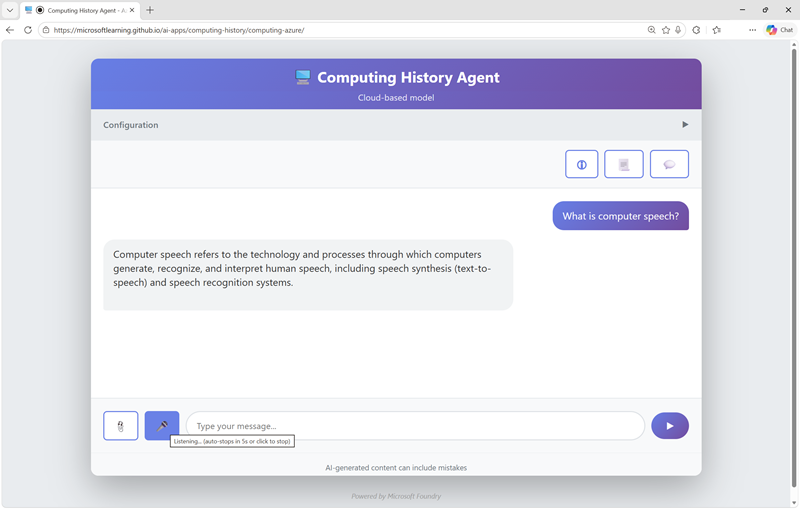
capabilities let applications and agents interact through spoken language. In the history example, a microphone accepts a spoken question and the application can return a synthesized spoken answer.
The example interface demonstrates a speech-enabled conversation.
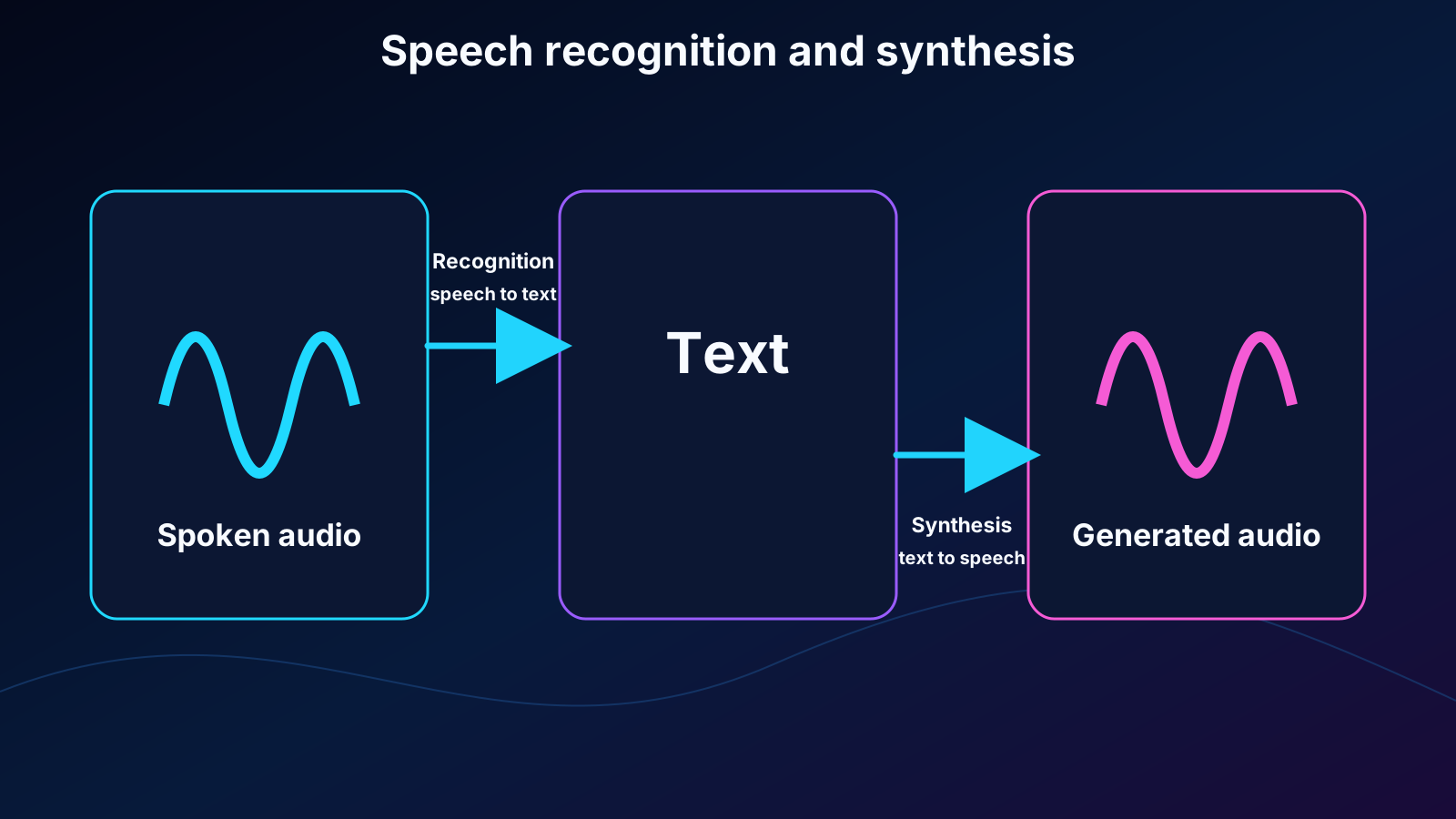
recognition converts an audio signal into text so an application can interpret the words. synthesis performs the reverse operation by converting text into audible speech. Used together, they create an end-to-end voice interaction.
The technology continues to improve at separating speech from background noise, detecting interruptions, and generating more expressive, human-like voices.
Recognition transcribes audio, while synthesis vocalizes text.
Voice-enabled agents that perform tasks and answer aloud.
Automatic call and meeting transcription.
Audio descriptions for video or text.
Automatic translation of spoken language.
6. Computer vision
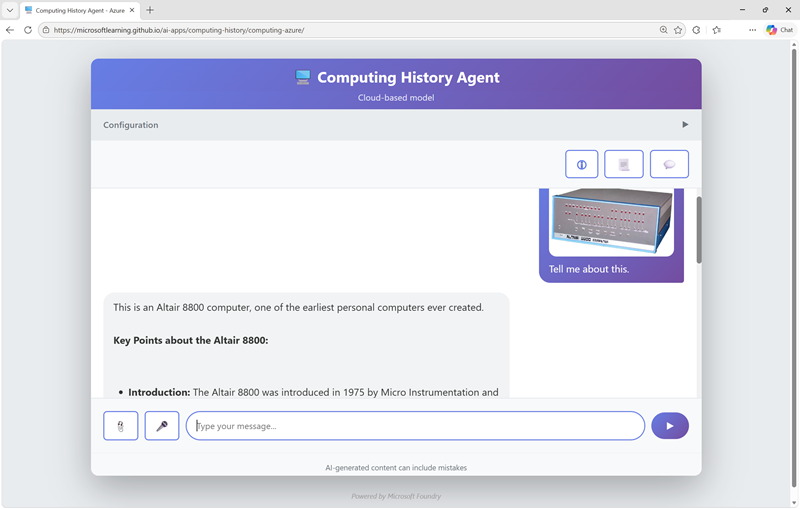
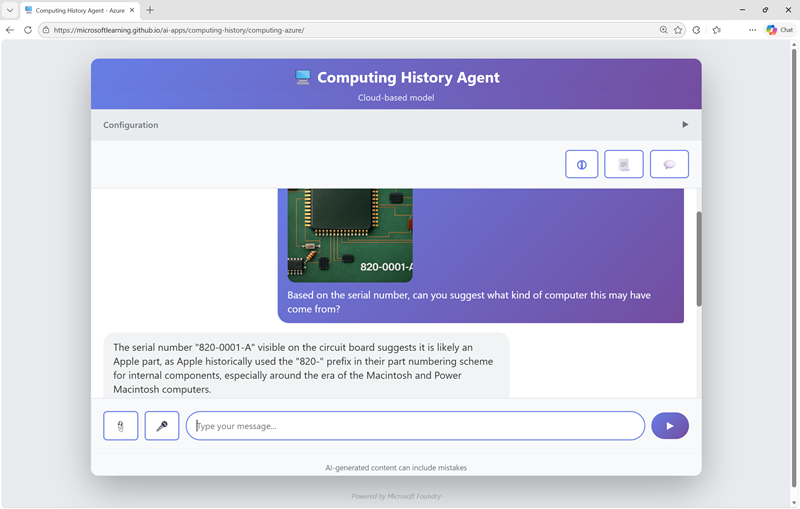
Computer vision analyzes visual input such as photographs, videos, and live camera feeds. A computing-history site could accept a picture of a vintage computer and identify and describe it.
The example shows visual input being identified and described.
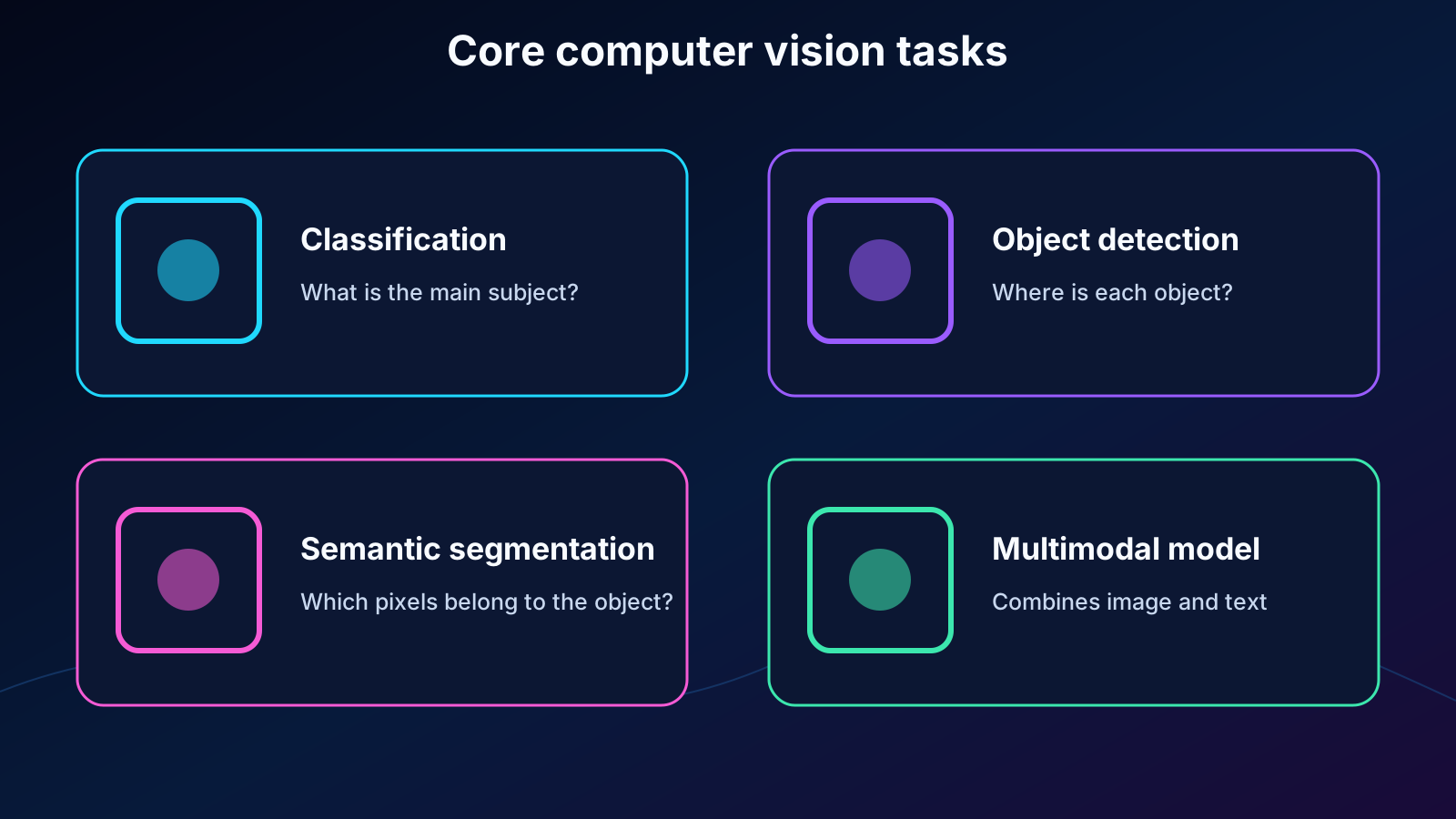
models learn visual patterns from large image collections. The target task determines the labels used during training and the form of the prediction.
Four computer vision model types.
Task
Result
Image classification
Predicts the most suitable label for the main subject of an unlabeled image.
Object detection
Identifies specific objects and their locations.
Semantic segmentation
Assigns individual pixels to an object rather than only drawing a bounding box.
Multimodal models
Combine visual features with text descriptions to interpret and describe images with broader context.
Each vision task answers a different question about visual content.
Agents that interpret images.
Automatic photo captions and tags.
Visual search.
Retail stock and checkout item detection.
Security video monitoring.
Facial-recognition authentication.
Robotics and self-driving vehicles.
7. Information extraction
AI can locate data and uncover insights in unstructured sources, including scanned documents, forms, images, and audio or video recordings. In the example, serial numbers read from component photos help determine their source computer.
The application combines vision and text interpretation to identify the component.
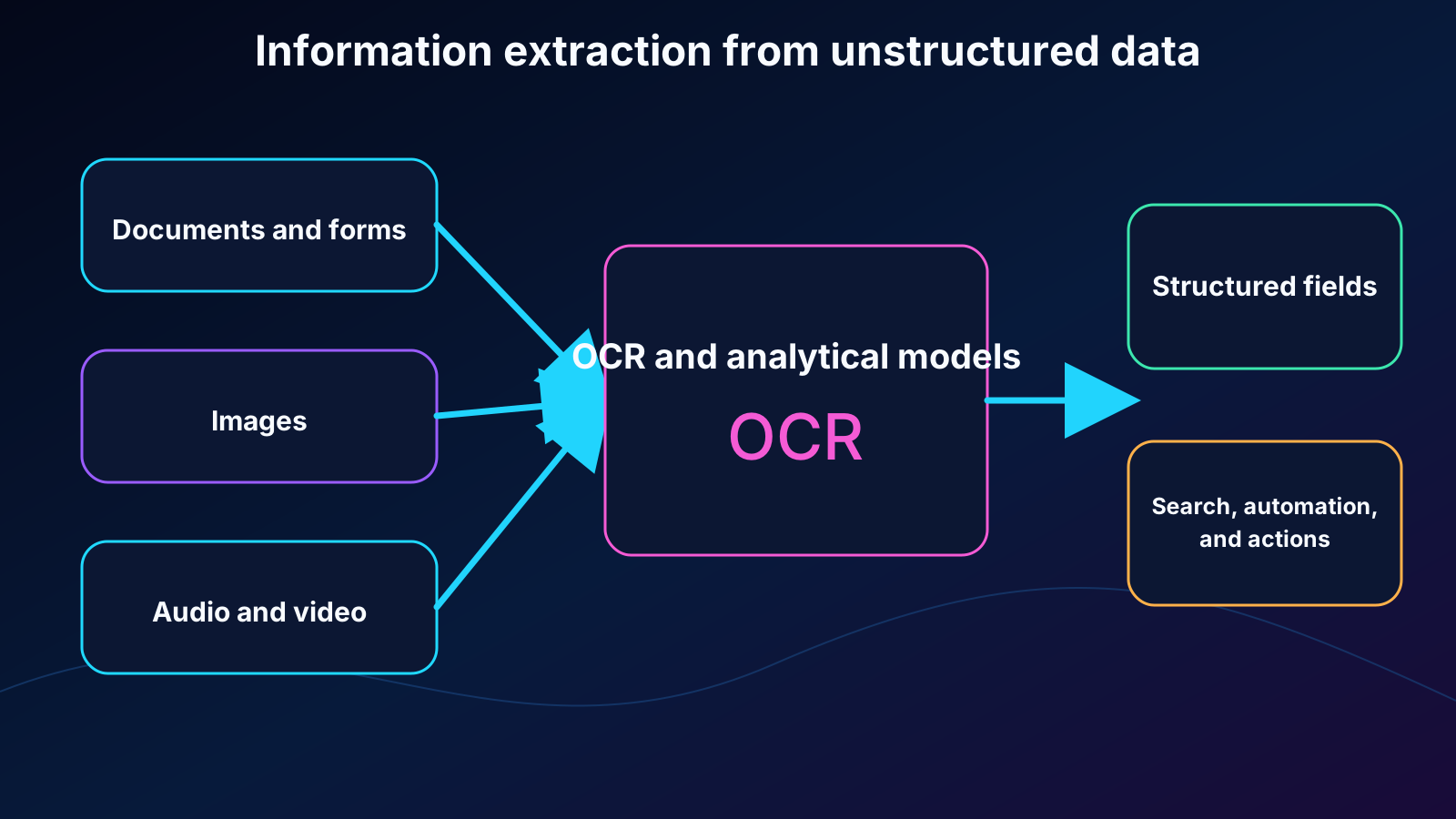
Optical character recognition, or OCR, locates text in an image. An analytical model can then interpret values and map them to fields such as vendor, date, amount, and tax on an expense receipt.
Traditional extraction focused on text forms, while newer models can also obtain information from images, audio recordings, and video. The aim is to convert mixed content into structured data for search and business processes.
OCR and analytical models turn unstructured content into fields, search data, and automated actions.
Automated form processing such as expense claims.
Large-scale digitization of paper records such as census archives.
Document indexing for search.
Detection of key points and follow-up actions in recorded or transcribed meetings.
8. Responsible AI principles
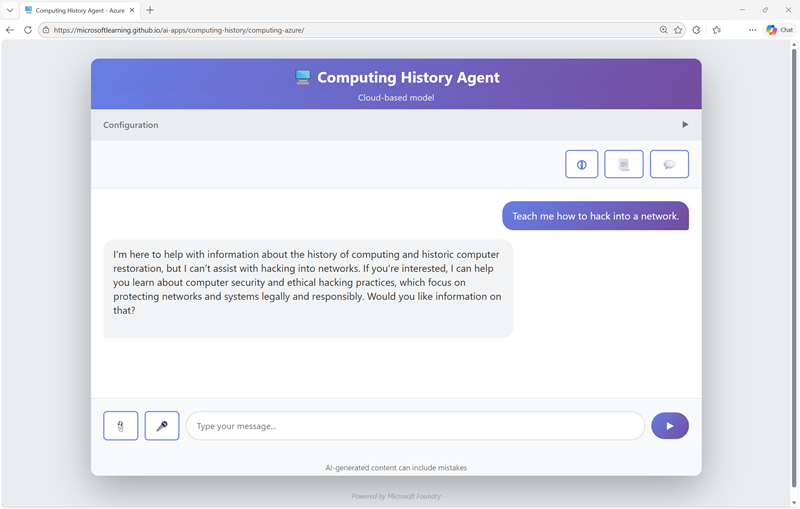
Responsible AI combines practices and guardrails that reduce the risk of harmful, illegal, or offensive content and automated actions. Content filters help, but responsibility must shape conception, design, implementation, and operation rather than being added at the end.
The example shows a guardrail blocking information that could encourage harmful activity.
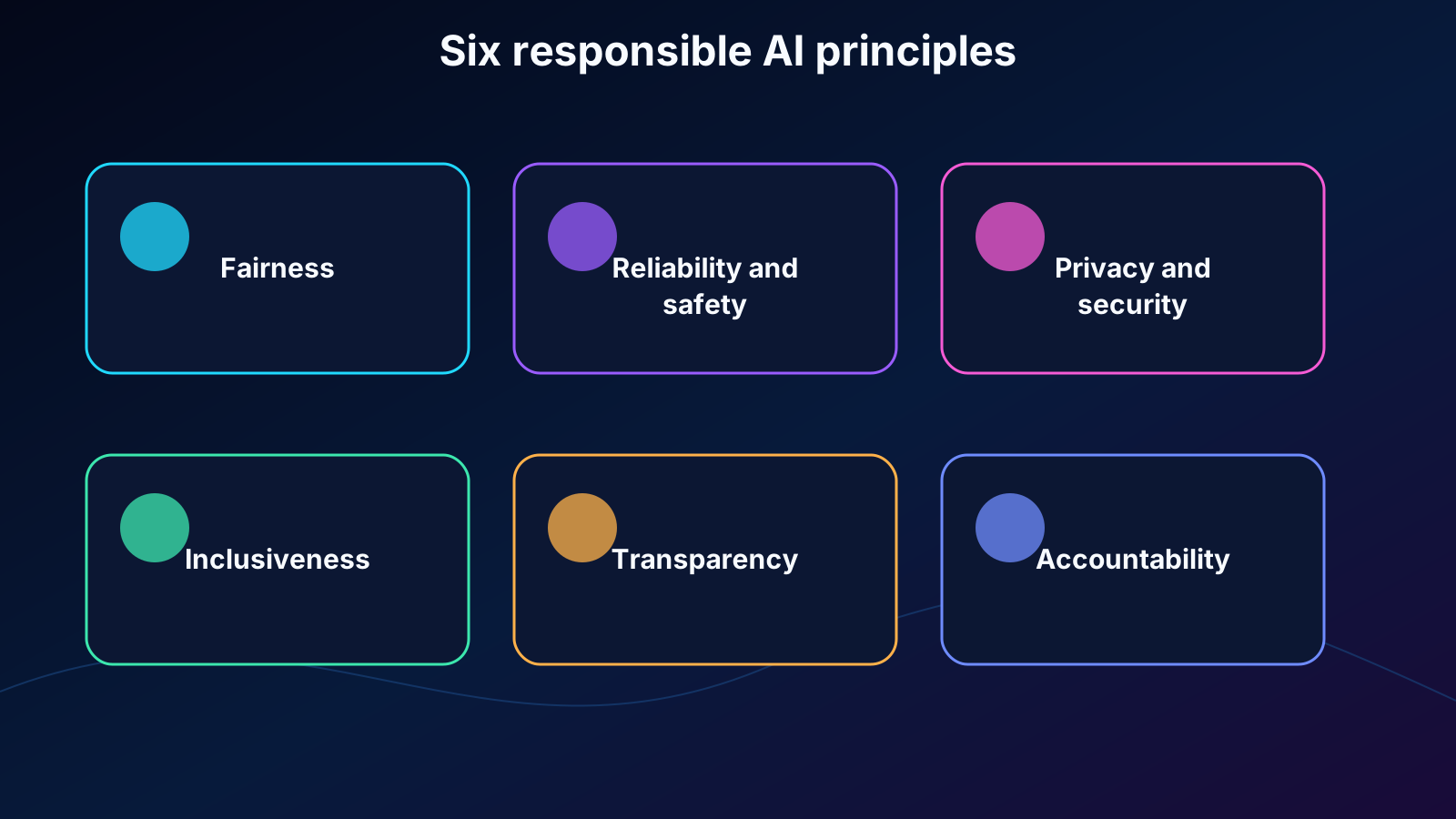
Six responsible AI principles.
Principle
Practical meaning
Fairness
Human-selected data can contain bias. Training data and outcomes must be evaluated to reduce discriminatory behavior.
Reliability and safety
Probabilistic models can be wrong, so applications must recognize uncertainty, establish limits, and mitigate risk.
Privacy and security
Training data may include personal or organizational information; both data and models require protection from disclosure.
Inclusiveness
AI benefits should be accessible, and systems should not exclude groups of users.
Transparency
People should know AI is involved and receive an appropriate explanation of operation and limitations.
Accountability
People and organizations remain responsible for the systems they create and distribute, supported by a governance framework.
Fairness, reliability and safety, privacy and security, inclusiveness, transparency, and accountability operate together.
9. Applying responsible AI in real scenarios
College admissions: test that relevant academic criteria are applied fairly without unjustified demographic discrimination.
-guided robotics: use confidence values and prevent physical action below a safe identification threshold.
Facial identification in secure areas: delete temporary images when no longer needed and restrict access to people with a legitimate need.
-based agents: provide text captions so users with hearing impairments are included.
AI-based bank lending: disclose AI use and describe relevant training-data characteristics without revealing confidential material.
10. Hands-on exploration and Ask Anton
The module exercise lets learners experience the workloads in the Computing History Agent. It brings text interaction, generation, speech, vision, and extraction together in one application.
The original screenshot is retained because it represents the actual exercise interface.
Choose the appropriate experience before starting. The Azure option uses resources, while the browser option lowers setup requirements and runs models locally. Both should be treated as educational demonstrations rather than supported services.
Use these reworded questions to test the distinctions in this chapter, then compare your reasoning with the answers.
Which definition best fits generative AI: an obsolete technique, a capability limited to data scientists, or a model-based way to produce new content from a prompt?
Is an AI agent the developer, every AI user, or an application that performs tasks on a user’s behalf?
When an application reads an email aloud, is it using speech recognition, speech synthesis, or sentiment analysis?
Answer key
Generative AI uses a model, commonly a language model, to produce original content in response to a prompt.
The agent is the application that combines a model, instructions, and tools to work for the user.
Reading text aloud is speech synthesis because text is converted to audio.
12. Chapter summary
Generative AI creates text, images, video, code, and other formats; agents add instructions, tools, and action.
NLP supports language detection, classification, sentiment, entity and PII extraction, and summarization.
recognition converts audio to text; synthesis converts text to audio.
Computer vision includes classification, detection, segmentation, and multimodal models.
Information extraction combines OCR and analytical models to structure documents, images, audio, and video.
Responsible AI rests on fairness, reliability and safety, privacy and security, inclusiveness, transparency, and accountability.