Benefits of Cloud Services: Availability, Scale, and Governance
High availability, scalability, reliability, predictability, security, governance, manageability, and sustainability in the cloud
Suggested study time: 32 minutes • Beginner level • Aligned with the cloud concepts domain of AZ-900
By João Ricardo Dutra••Complete original content
1. Cloud benefits and the purpose of this chapter
Cloud computing is valuable not only because resources can be provisioned quickly, but because it changes how teams design for demand, interruptions, security, cost, operations, and environmental efficiency. This chapter connects those benefits to the decisions tested in AZ-900.
Learning objectives
Explain how and address uptime and changing demand.
Differentiate from and relate both to workload design.
Describe how cloud capabilities support security, , compliance, and maintenance.
Distinguish management of cloud resources from management through cloud interfaces.
Recognize operational practices that improve and reduce waste.
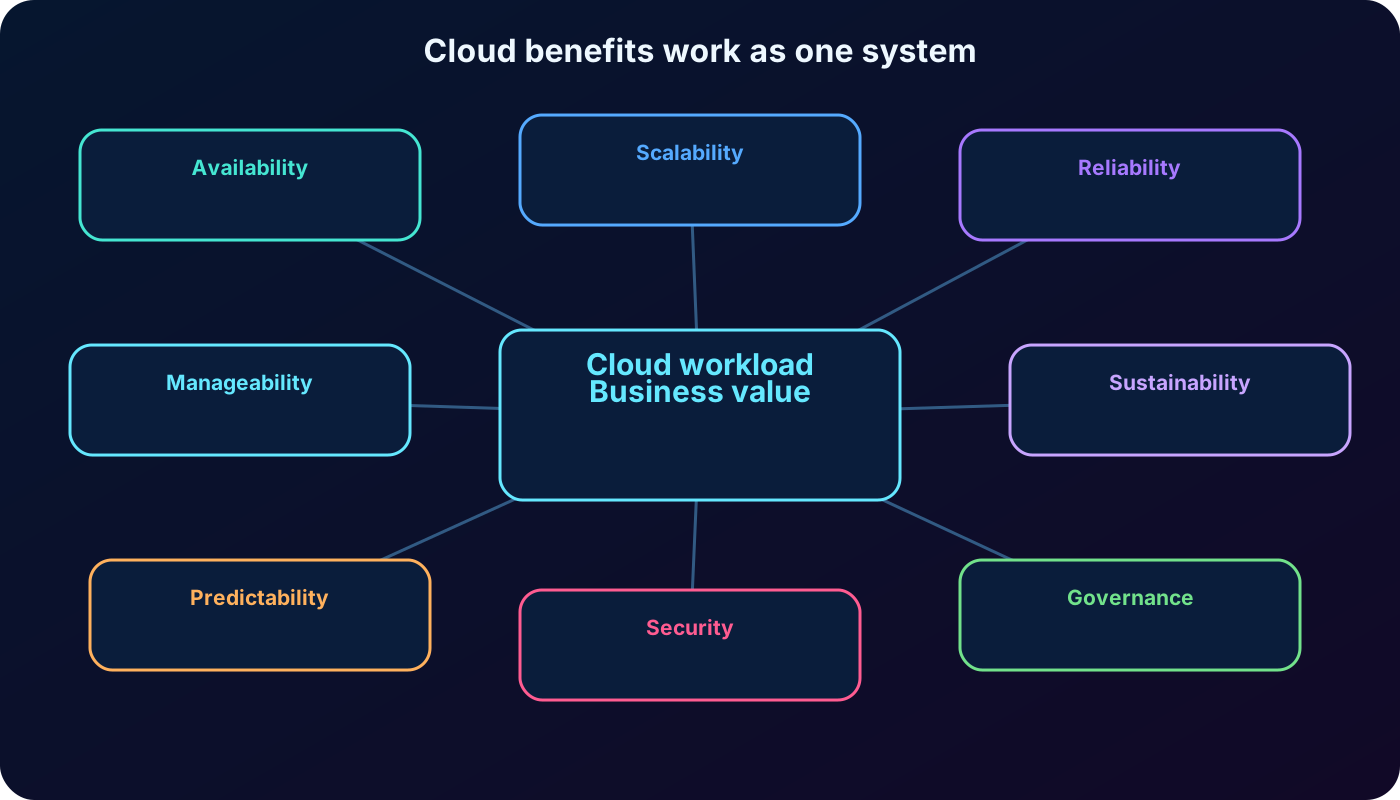
Map of the chapter linking availability, scale, ,, security, ,, and .
The benefits reinforce one another. Autoscaling can protect performance and lower waste; monitoring supports , cost forecasts, , and ; templates improve repeatability while also helping teams enforce standards.
2. and service commitments
is the design goal of keeping an application, service, or infrastructure resource accessible for as much time as its business requirement demands, including when components fail or planned work occurs.
Azure services publish availability commitments in service-level agreements (SLAs). An expresses the promised service level and the conditions that apply, but it does not replace workload architecture. A solution may need redundant components, health checks, failover, and tested recovery procedures to meet its own target.
Availability percentages represent different amounts of possible downtime. The closer a target gets to 100%, the less interruption it permits, which normally requires additional engineering and can increase cost. The correct target is driven by business impact rather than by choosing the largest number automatically.
Remove single points of failure when the workload cannot tolerate their loss.
Use health signals to stop sending traffic to an unhealthy instance.
Match redundancy and recovery investment to the impact of an outage.
Read the applicable , including scope, exclusions, and architecture requirements.
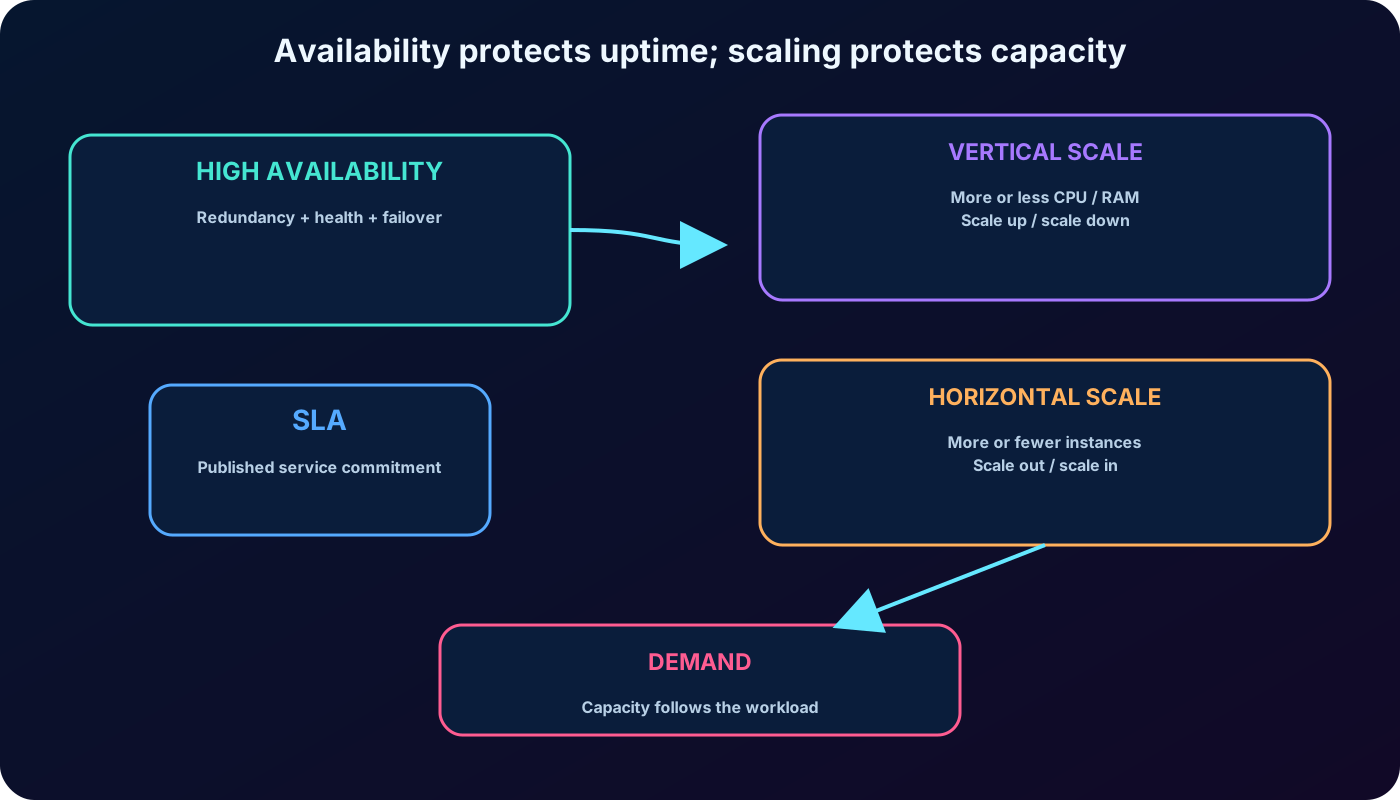
protects uptime while vertical and adjust capacity to demand.
3. : matching capacity to demand
is the ability to increase or decrease resources so that capacity follows demand. When traffic rises, a scalable solution can obtain more processing, memory, or instances; when demand falls, it can release capacity instead of paying for idle resources.
changes the capability of an existing resource. Scaling up can assign more CPU or RAM to a virtual machine, while scaling down selects a smaller configuration. The number of resources does not have to change, and every service has practical size limits.
changes the quantity of resources. Scaling out adds virtual machines or containers, manually or automatically; scaling in removes instances after demand subsides. Applications designed to distribute work across instances benefit most from this approach.
Two forms of cloud scaling.
Form
Increase
Decrease
Typical clue
Vertical
Scale up: give one resource more CPU or memory
Scale down: choose a smaller size
The capability of each resource changes
Horizontal
Scale out: add instances
Scale in: remove instances
The number of resources changes
and the consumption model work together. Capacity can track a peak without being purchased permanently, but cost control still depends on limits, monitoring, and rules that scale back when the extra capacity is no longer useful.
4. and recovery from failure
is a system’s ability to recover from a failure and continue delivering its intended function. It is one of the pillars of the Azure Well-Architected Framework and combines resilient design, recovery planning, monitoring, and operational discipline.
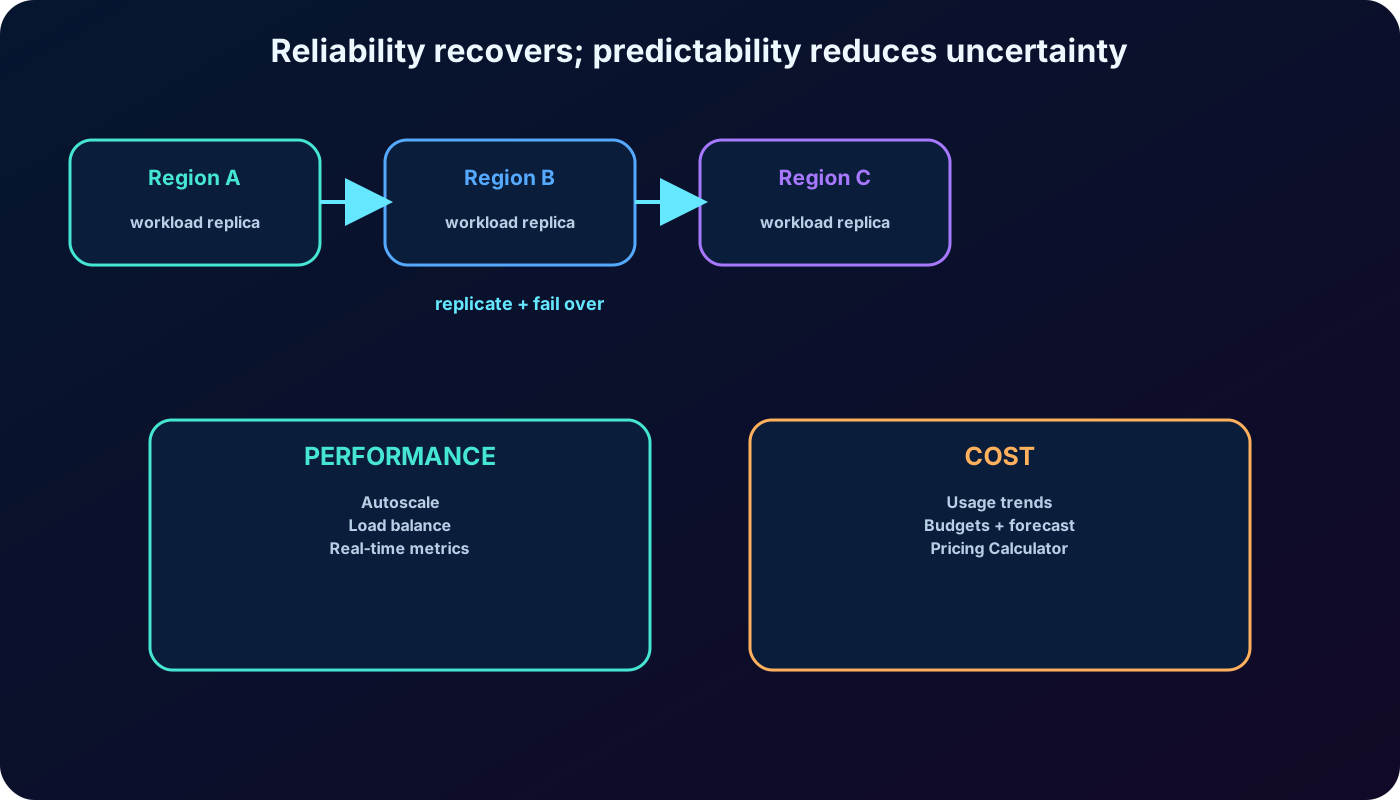
Cloud platforms are distributed across physical infrastructure and geographic regions. A workload can use that reach to avoid depending on one location. If a severe event affects a region, properly designed services can continue elsewhere or recover according to defined objectives.
Some managed services handle parts of failover automatically; other workloads require the customer to configure replication, routing, backup, and recovery. is therefore a shared outcome: the platform provides capabilities, while the workload team selects and tests the architecture.
A distributed multi-region design supports recovery, while performance and cost signals improve .
5. of performance and cost
means reducing uncertainty about how a workload will perform and how much it will cost. The Azure Well-Architected Framework helps teams make explicit tradeoffs and build repeatable practices for both dimensions.
Performance
Autoscaling, load balancing, , capacity tests, and real-time metrics help estimate and maintain the resources required for a good user experience. Load balancing redistributes work away from overloaded instances, while scaling adds capacity when thresholds are reached.
Cost
Usage data, budgets, monitoring, and analytics reveal patterns that support forecasts and better deployment decisions. The Azure Pricing Calculator provides an estimate before deployment; actual spending must still be observed because utilization, region, service tier, data transfer, and architecture can change the result.
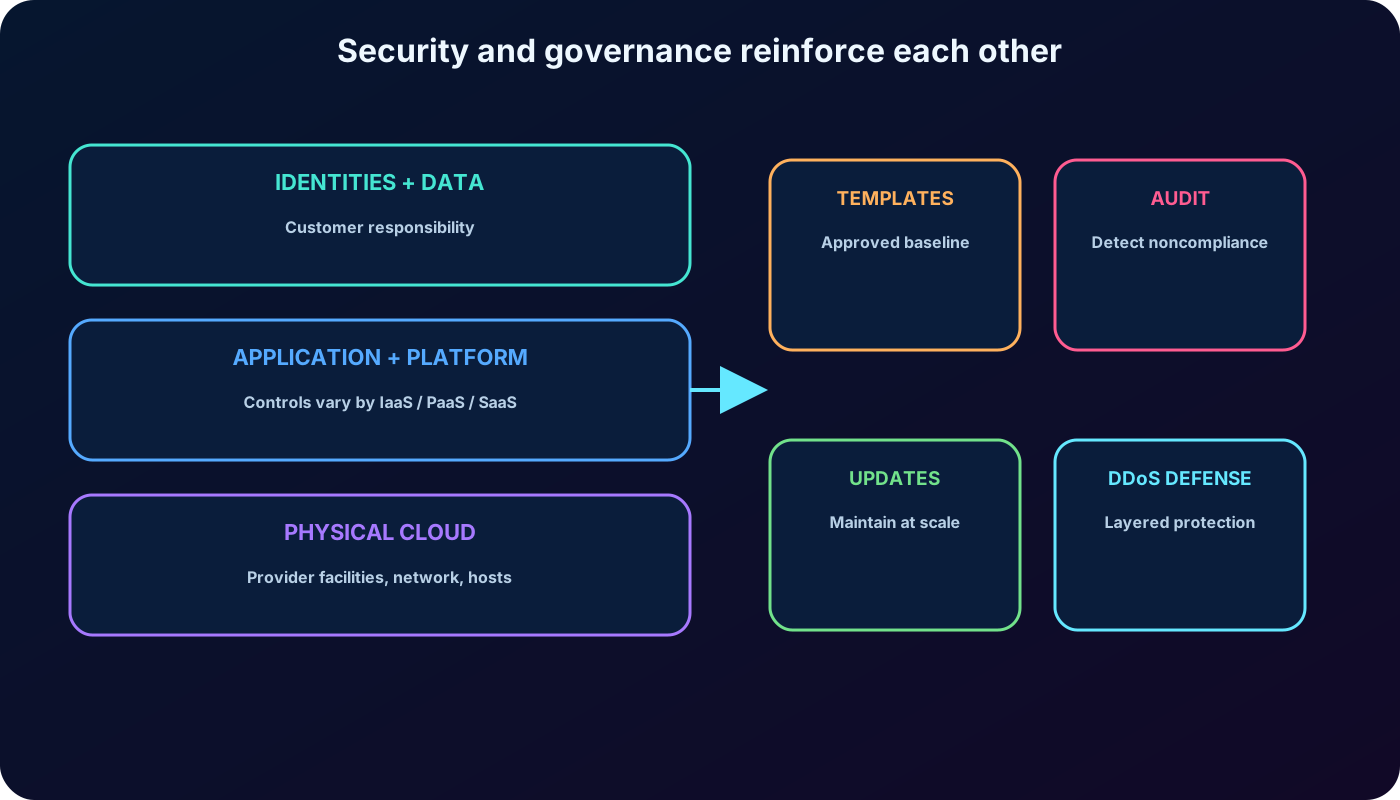
Cloud service models let an organization choose how much direct security control and maintenance it wants to retain. The security responsibility never disappears, but the boundary changes between infrastructure as a service (IaaS), platform as a service (PaaS), and software as a service (SaaS).
IaaS gives the customer greater control of guest operating systems and installed software, including configuration, patches, and maintenance. PaaS and SaaS move more platform maintenance to the provider, which can reduce operational effort but still leaves the customer responsible for identities, data, access, and allowed configurations.
Large cloud providers also operate defenses at a scale that individual organizations may find difficult to reproduce, including protections against distributed denial-of-service (DDoS) attacks. Customers must still configure their workloads securely and apply defense in depth.
Security controls and standards work together through templates, audits, updates, and layered protection.
7. , compliance, and consistent standards
establishes the rules for creating, configuring, operating, and retiring resources. Starting with a clear baseline helps keep a growing cloud environment consistent, secure, traceable, and aligned with technical or regulatory obligations.
Templates can encode approved configurations so deployments follow the same baseline. Azure Policy can evaluate resources against organizational rules, identify noncompliance, and support remediation at scale. As requirements evolve, centrally managed definitions can be updated instead of relying on many manual changes.
Cloud auditing provides evidence about configuration and activity. Depending on the selected service model, patches and platform updates may also be automated by the provider. does not mean preventing all change; it creates controlled, observable, and repeatable change.
Define standards before the environment grows.
Deploy repeatably with templates and automation.
Audit actual state against the approved baseline.
Correct drift and update controls when requirements change.
8. Management of cloud resources
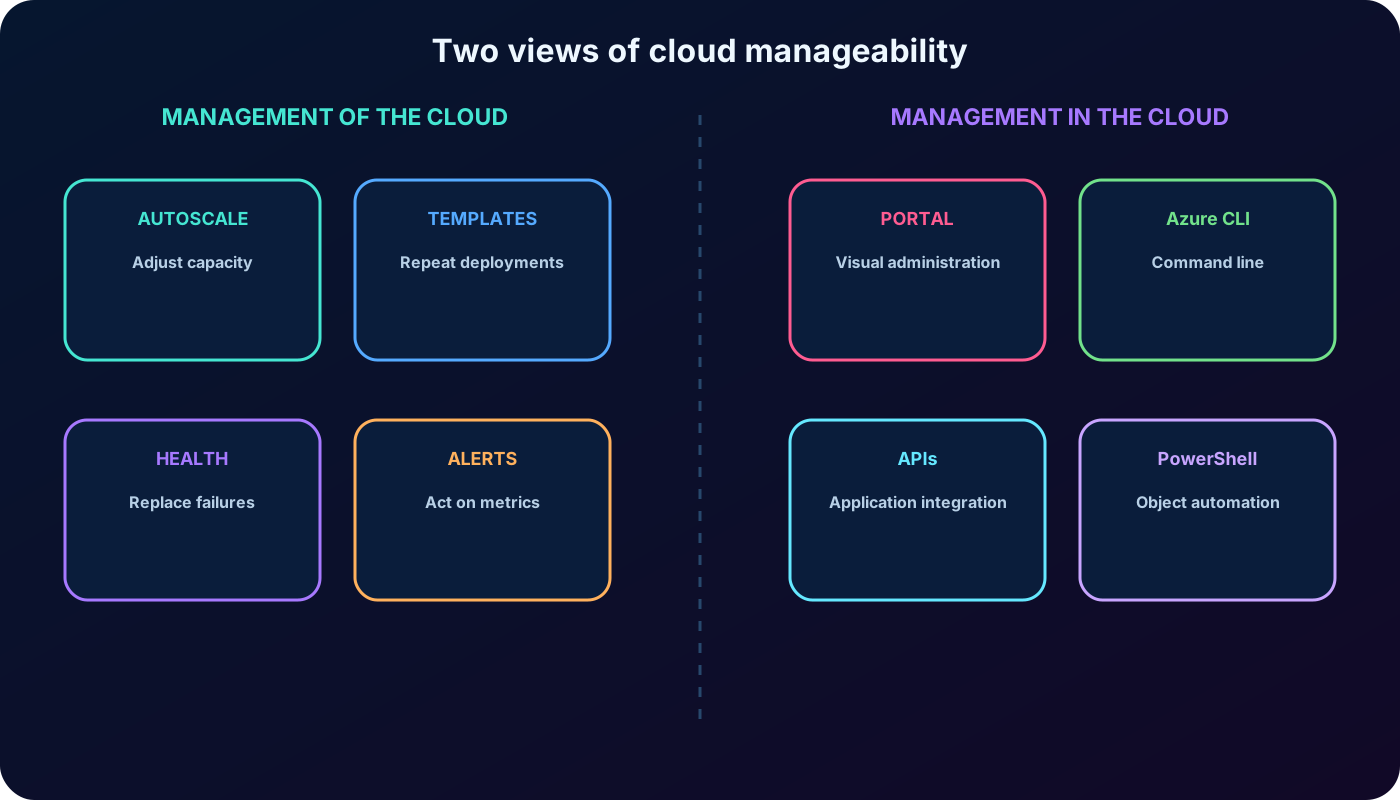
Management of the cloud is concerned with what happens to cloud resources throughout their lifecycle. Automation can provision capacity, monitor health, replace failed instances, and notify operators without waiting for repeated manual action.
Scale deployments automatically according to workload demand.
Create resources from a preconfigured template to reduce inconsistent setup.
Monitor health and replace or restart unhealthy resources.
Generate alerts from metrics so teams can respond while an issue is developing.
Azure Monitor collects and analyzes operational signals, while Azure Advisor can highlight opportunities involving , security, performance, operational excellence, and cost. These services support decisions; teams still own priorities and remediation.
Management of the cloud automates resource operations; management in the cloud uses the portal, CLI, APIs, and PowerShell.
9. Management in the cloud
Management in the cloud describes the interfaces used to control the environment. The same resource can be managed interactively or through automation, allowing people, scripts, pipelines, and applications to use the method suited to the task.
Common cloud management interfaces.
Interface
Best fit
Example
Microsoft Azure portal
Visual discovery and interactive administration
Inspect health and change a setting
Azure CLI
Cross-platform command-line automation
Deploy resources from a script
PowerShell
Object-oriented administration and automation
Apply a repeatable operational task
APIs
Integration with applications and platforms
Create resources from an internal system
A typical operations flow might deploy from a template, inspect health in the portal, and automate recurring work through Azure CLI or PowerShell. Using several interfaces is not duplication when each one serves a different operational need.
10. and efficient cloud operation
Cloud computing can contribute to goals when teams actively optimize resource use. Provider scale can improve utilization compared with many isolated environments, while elastic services let customers match deployed capacity more closely to actual need.
Scale resources down after demand decreases.
Stop or deallocate resources that are not being used.
Choose efficient services and configurations instead of habitual overprovisioning.
Use and monitoring to find usage trends and improvement opportunities.
Automate schedules for temporary environments, such as development systems used only during business hours.
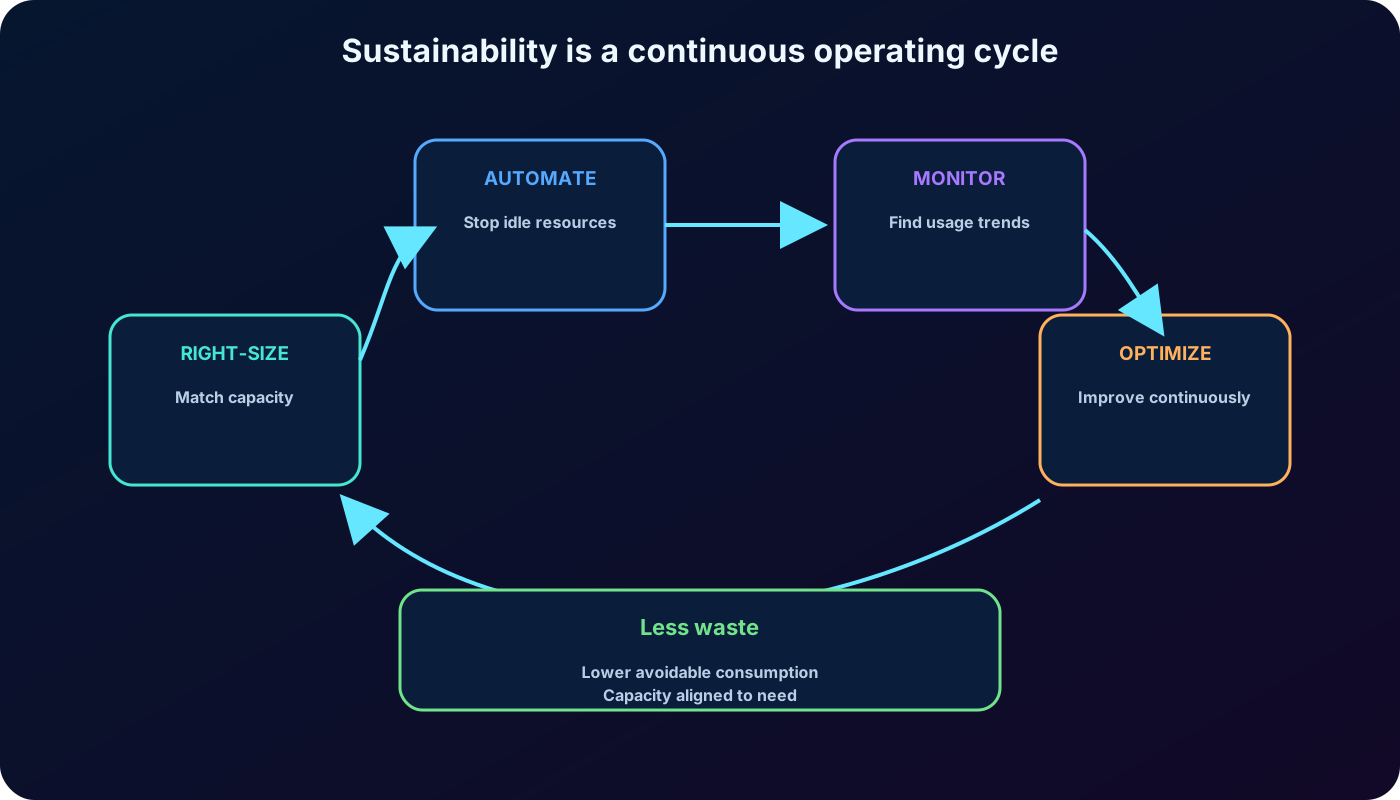
At the fundamentals level, sustainable cloud operation is a continuous cycle: right-size, automate, monitor, and optimize. The same practices often reduce cost, but a low bill alone does not prove that every environmental or business goal has been met.
optimization cycle: right-size, automate, monitor, and continuously optimize resource use.
11. Scenario review and knowledge check
Use the following scenarios to test whether you can identify the benefit being described rather than matching a single keyword.
Paraphrased knowledge check with explained answers.
Scenario
Best answer
Why
A traffic surge requires adding container instances, followed by removing them after the campaign.
The quantity of resources changes: scale out for the peak and scale in afterward.
A workload must resume its function after a component or location fails.
The requirement is recovery from failure and continued operation.
A development environment should not consume resources overnight or on weekends.
Schedule shutdown or deallocation
Removing unused capacity reduces waste and supports cost and goals.
A team wants every deployment to follow the same regulatory configuration.
Governed templates and policy
A repeatable baseline plus compliance evaluation controls configuration at scale.
An operator wants to automate recurring tasks from a cross-platform terminal.
Azure CLI
The command-line interface is suited to repeatable cross-platform automation.
12. Chapter summary
protects access to services, while adjusts capacity. changes the power of a resource; changes how many resources are deployed.
addresses recovery and continued function. uses architecture, monitoring, analytics, and pricing information to reduce uncertainty about performance and cost.
Security and combine technical protection with consistent standards, audit, maintenance, and remediation. covers both automated resource operations and the interfaces used to control the environment.
depends on operational habits that reduce unnecessary consumption: right-size, automate, monitor, and optimize continuously.
Availability asks whether the service can be reached.
asks whether capacity can follow demand.
asks whether the workload can recover and continue.
asks whether performance and cost can be forecast and controlled.
and make growth consistent and operable.
13. Explore with Copilot Chat
Use Copilot Chat as a review partner and verify its suggestions against the diagrams and official references. Prompts that force comparisons and tradeoffs are more useful than requests for isolated definitions.
Evaluate an on-premises workload and map improvements in availability, scale, , security, , and .
Design measurable indicators that show whether a cloud migration is delivering its expected technical and business benefits.
Explain tradeoffs in a case where maximum availability, minimum cost, and minimum resource consumption cannot all be optimized at once.
14. Essential glossary
Key terms for this AZ-900 objective.
Term
Definition
Design objective that maximizes service access during failures or maintenance.
Published commitment that defines an expected service level and applicable conditions.
Ability to adjust capacity to demand.
Increase or decrease the capability of an individual resource.
Add or remove resource instances.
Ability to recover from failure and continue functioning.
Ability to forecast and control expected performance or cost.
Rules and processes that keep resources consistent, compliant, and controlled.
Operational capability to control resources through automation and management interfaces.
Practice of meeting current needs while reducing waste and improving long-term efficiency.
15. Official references
These Microsoft sources confirm the module objectives, current terminology, and the related architecture and pricing guidance.