Operation, risks, storage, rotation, and controlled use of static credentials in enterprise APIs
In-depth edition - study material and professional reference
By João Ricardo Dutra••Complete material
Chapter presentation
The previous chapter separated authentication and authorization and showed that an identity only becomes useful when there is a proof, a principal and an access decision. Now the course delves into three historically important mechanisms still found in corporate APIs: HTTP Basic, HTTP and API Keys. They appear in legacy integrations, automations, SaaS products, gateways, appliances and internal systems that need simple onboarding.
Operational simplicity is the main reason for its persistence, but it also creates pitfalls. sends a reusable credential on every call and relies entirely on TLS for confidentiality. avoids transmitting the password directly and uses challenge-response, but remains sensitive to weak passwords, poorly controlled , and interoperability limitations. API Keys identify applications and consumption plans, but are often treated as if they were a strong user identity or as sufficient authorization for any operation.
The three mechanisms are static or long-lived credentials when compared to short tokens. Therefore, security cannot be limited to the header format. It is necessary to consider generation, storage, log exposure, rotation, revocation, scope, quotas, segregation by environment, auditing and incident response. A leaked strong key remains a valid credential until the platform detects and revokes it.
This chapter presents the HTTP authentication framework, the detailed Basic and flow, the API Keys management architecture and the application in API Gateways. The goal is to allow the reader to recognize when these mechanisms are acceptable, which compensatory controls are indispensable, and when migration to OAuth 2.0, mTLS, or workload identities should be prioritized.
How to study this chapter
For each mechanism, track the credential from issuance to revocation. Ask where the secret exists in the open, who gets to reuse it, how the gateway identifies the consumer, how the backend receives context, and how long an exposure would remain valid.
Learning Objectives
Explain the HTTP framework of challenges and the role of 401, and Authorization.
Describe encoding and differentiate from encryption.
Analyze risks of exposure, , sharing and storage of passwords.
Understand the HTTP challenge-response and its main parameters.
Explain ,,,,,, algorithm and .
Recognize practical and security limitations of in modern APIs.
Distinguish from user identity, OAuth token and signature.
Design key generation, storage, scope, quota, rotation and revocation.
Apply credential validation to API Gateways without propagating secrets to the backend.
Plan migration from static credentials to short-lived or proof-of-possession mechanisms.
Chapter structure
15.1 Static credentials in the context of APIs
15.2 HTTP Authentication Framework
15.3 : format and flow
15.4 is not encryption
15.5 over TLS and intermediaries
15.6 Password storage and validation
15.7 Hardening and migration from Basic
15.8 : motivation and challenge-response
15.9 parameters and calculation
15.10 ,, and limitations
15.11 API Keys: purpose and threat model
15.12 Generation, format and distribution
15.13 Storage, lookup and metadata
15.14 Scopes, quotas and authorization
15.15 Rotation, revocation and leak detection
15.16 request signing and related mechanisms
15.17 Use in API Gateways
15.18 Comparison, troubleshooting and case studies
Summary, checklist, exercises, glossary and references
15.1 Static credentials in the context of APIs
A static credential is a value that remains valid for a relatively long time and can be reused across multiple calls. Passwords and API Keys fall into this category. The problem is not just duration: because the same value proves access repeatedly, any copy obtained by log, repository, compromised station, proxy, or configuration leak can be used until expiration or revocation.
Static credentials offer simple deployment. A consumer receives a username and password or a key, adds a header and calls the API. There is no authorization server, token obtaining flow, or renewal. This simplicity may be appropriate in labs, tight integrations, and legacy systems, but it shifts responsibility to operational processes that many teams neglect.
In a secure architecture, each credential has an individual identity, owner, environment, purpose, scope, creation date, expiration, last use, status and rotation history. Sharing the same credential across multiple systems destroys traceability and makes coordinated revocation difficult. The fundamental principle is that simplicity of protocol cannot mean the absence of governance.
Table 1 - Secure static credential depends on explicit lifecycle.
Property
Operational question
Risk if absent
Individualization
Which application or person controls the credential?
Inability to assign traffic and incident.
Scope
What APIs and operations can be used?
Commitment expands lateral access.
Expiration
When does the value stop being accepted?
Abandoned secret remains active.
Rotation
How to exchange without unavailability?
Credential is never renewed.
Revocation
How long to block a leak?
Long window of abuse.
15.2 HTTP Authentication Framework
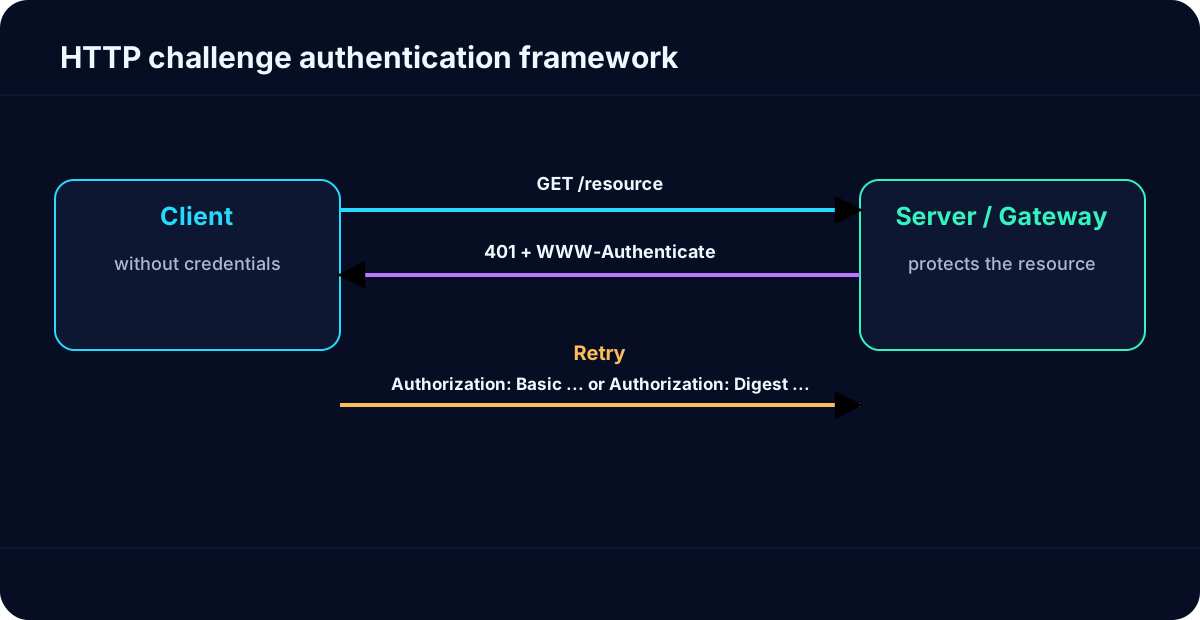
HTTP defines a general challenge-based authentication framework. When a resource requires authentication and the client does not present an acceptable credential, the server may respond 401 Unauthorized accompanied by one or more headers. Each challenge reports the required schema and parameters, such as . The client chooses a supported schema and repeats the request with Authorization.
The name 401 Unauthorized is historically confusing: in practice, it represents the absence or failure of authentication. Once the identity is authenticated, a denial for lack of permission typically uses 403 Forbidden. This separation preserves semantics, facilitates troubleshooting and prevents consumers from trying to exchange credentials when the real problem is authorization.
A gateway may advertise more than one challenge or hide details to reduce enumeration. In APIs, it is also common to receive credentials preemptively, without the first 401. Still, understanding the challenge model is essential for Basic and , as well as helping with the interpretation of logs, HTTP clients, and libraries.
Figure 1 - Basic and use the challenge framework defined by HTTP.
HTTP Basic uses a user identifier and password combined in the form user-id:password. The resulting byte sequence is encoded and sent in the Authorization header with the Basic prefix. The server decrypts the value, finds the account, and verifies the password. In machine-to-machine integrations, the user-id can represent an application or technical account, but this does not automatically transform the mechanism into a strong workload identity.
The client can expect a 401 challenge or send the header on the first call. Many SDKs and tools hide this detail. In both cases, the credential is transmitted in all requests, including when different connections are opened. This increases the exposure surface compared to a password used only to obtain a short-lived token.
The allows the server to indicate the protection space. Clients can use this information to decide which credentials to resend. In environments with multiple hosts, redirects and proxies, the configuration needs to prevent Authorization from being forwarded to an untrusted destination.
Conceptual example of
# Logical text before encoding
billing-integration:ExamplePassword
# HTTP header
Authorization: Basic aW50ZWdyYWNhby1mYXR1cmFtZW50bzpTZW5oYURlRXhlbXBsbw==
15.4 is not encryption
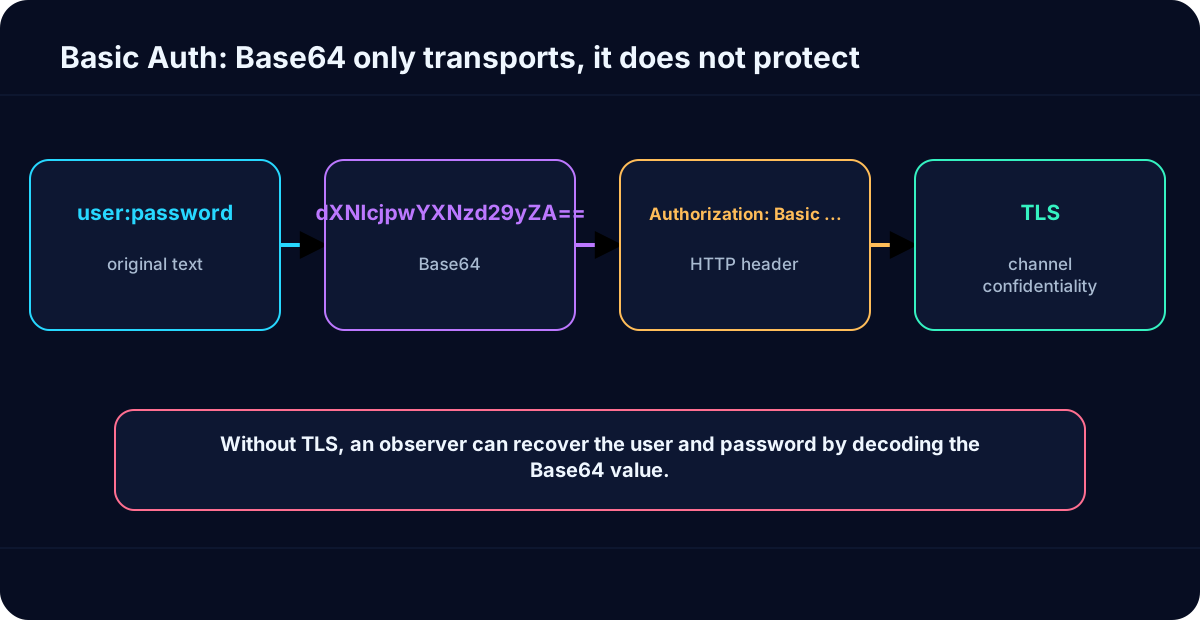
is an encoding for representing bytes in characters safe for textual transport. It does not use a key, does not offer confidentiality and can be reversed by any person or tool. Treating the value as a hash or encryption is a serious error. It only protects against impersonation problems, not traffic observation.
For this reason, should only be used over correctly validated TLS. Without TLS, username and password are exposed to whoever captures the communication. Even with TLS, the credential can appear in debug logs, memory dumps, observability tools, command history, environment variables, and configurations. The protected channel does not correct leakage at endpoints or intermediary terminators.
Coding also does not prevent . If an attacker obtains the full header, he can reuse it as long as the password remains valid. Protection relies on strong secrecy, rotation, anomaly detection, retry limiting, and least privilege.
Figure 2 - The only element that protects the confidentiality of in transit is the TLS channel.
Operating rule
Never put in URL, query string, logs, tickets or examples with real credentials. Visual redactions in screenshots do not remove the value of configuration files or terminal histories.
15.5 over TLS and intermediaries
When there is reverse proxy or API Gateway, TLS can finish before the backend. The client-gateway leg and the gateway-backend leg are independent connections. If the gateway passes the original Authorization to the backend, the password continues to circulate internally and may appear in more observation points. A better architecture validates the credential at the edge and forwards restricted internal identity or short-lived token.
Redirects also deserve attention. Secure HTTP clients avoid forwarding Authorization to another host, but behaviors vary by library and configuration. An authenticated endpoint should not respond with redirection to an untrusted domain. Proxy rules need to remove external identity headers before inserting validated context.
The server must apply protection against brute force and . Rate limiting by account, source and device, progressive blocking, leaked password detection, monitoring and alerts help. Permanent blocking after a few attempts may cause denial of service; policy needs to balance security and availability.
15.6 Password storage and validation
The server should not store reversible password just to compare with the received value. Human user passwords need to be protected by specific derivation functions, with individual salt and appropriate cost parameters. The check recalculates the derivative and compares in constant time. Technical accounts can be migrated to keys, certificates or workload identities, avoiding treating application secrets as human passwords.
Basic requires the server to obtain the password presented on each call and validate it. This does not mean that the password needs to be clear at the bank. However, some legacy systems delegate authentication to directories or store reversible credentials for integration. These cases increase the impact of compromise and must have a migration plan.
Authentication logs must record identifier, result, categorized reason, origin, correlation and applied policy, but never the password or the Authorization header. Messages to the client should avoid differentiating a non-existent user from an incorrect password when this allows enumeration.
Table 2 - Secure storage reduces the impact of credential store leaks.
Element
Best practice
Avoid
Password bank
Individual salt and appropriate bypass function.
Clear password or reversible encryption without need.
Comparison
Constant routine and consolidated library.
Home comparisons and value logs.
Technical account
Individual identity and owner.
User shared by multiple jobs.
Observability
Result, origin and correlation.
Authorization and password in log.
15.7 hardening and migration
Basic can be tolerated in controlled integration when TLS is required, the account is individual, the password is random and long, access is limited, and there is rotation. There must also be a replacement plan. The mechanism is unsuitable for human credentials in high-risk APIs or for distributed applications that cannot protect static secrets.
A common migration introduces OAuth 2.0 Client Credentials, mTLS, or managed identity. During coexistence, the gateway accepts Basic only for registered consumers, records usage by client_id and communicates withdrawal deadline. The new mechanism is activated in parallel; After telemetry confirms migration, the old password is revoked.
It is not enough to replace with a long-lived token copied in configuration. The objective is to reduce reuse and surface area: short tokens, specific audience, minimum scope, auditable issuance and client credentials protected by vault or asymmetric proof.
Migration criteria
Prioritize consumers with shared credentials, lack of rotation, privileged access, running on untrusted devices, or public exposure. These factors increase the impact and probability of compromise.
15.8 : motivation and challenge-response
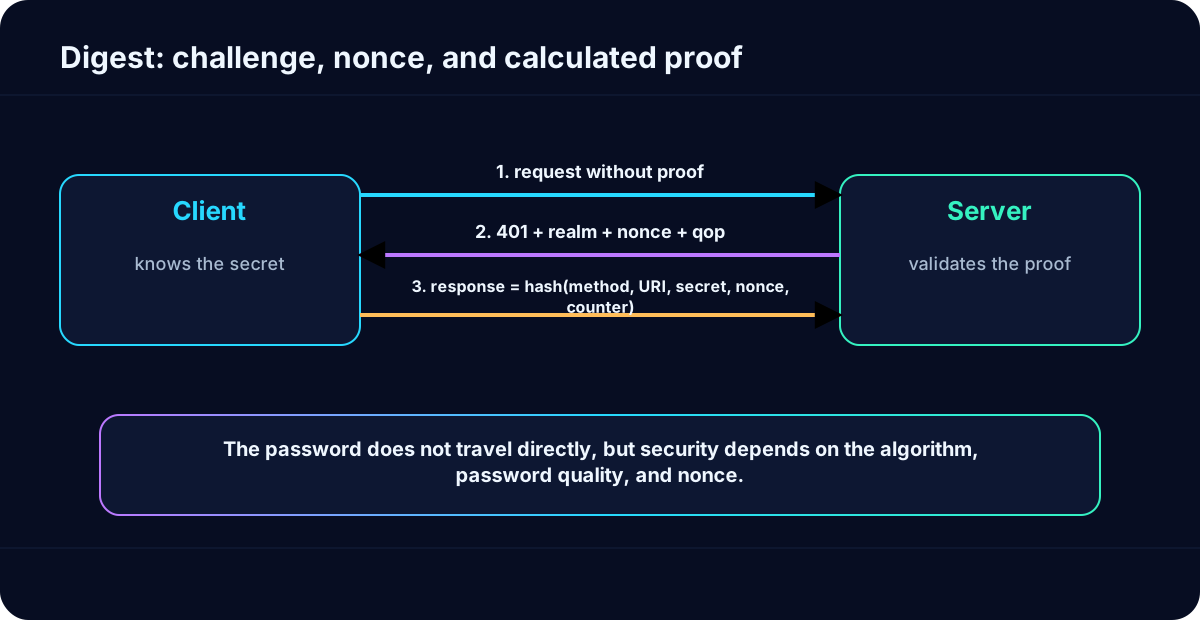
HTTP was created to prevent the password from being sent directly to the server with each request. The server sends a challenge with ,, algorithm and protection quality options. The client combines these values with username, password, method, and URI to calculate a hashed response. The server performs equivalent calculation and compares the result.
The is a value issued by the server to limit reuse. Customer can also send and counter. With =auth, method and URI enter the test, linking the response to the request. In =auth-int, the entity body also participates, although the operational support is more complex.
improves a specific property in relation to Basic: the password does not appear directly in the wire. However, it does not replace TLS. Metadata and content remain exposed without channel encryption, and downgrade, manipulation or capture-for-offline attacks still need to be considered.
Figure 3 - The client proves knowledge of a secret without sending the password directly.
15.9 parameters and calculation
The separates protection spaces and participates in the calculation. The is generated by the server; is a value that the client returns without interpreting. algorithm reports the hash function and possible variants with -sess. selects the protection quality. is the usage counter, and is a random value produced by the client.
In a simplified form with =auth, is calculated from user, and password; from the HTTP method and request-target; and response from ,,,, and . The implementation must strictly follow the specification and use tested libraries. Small differences in encoding, URI, charset, or parameters produce faults that are difficult to diagnose.
Algorithms and parameters need to be negotiated securely. Implementations should not accept silent downgrades for weak options when policy requires stronger algorithms. It is also important to validate that the client responds to the same ,, and URI associated with the challenge.
Table 3 - parameters need to be validated as a coherent set.
Parameter
Origin
Function
Server
Defines the protection space and participates in the calculation.
Server
It makes the test dependent on a challenge and temporal validity.
Server
state returned by customer.
Server/client
Select auth or other supported quality.
Customer
Adds client-controlled randomness.
Customer
Counts uses and helps detect .
response
Customer
Hash proof calculated for the request.
15.10 ,, and limitations
A secure needs to be unpredictable or authenticated, have a validity window and be linked to the necessary context. The server can maintain state or encode timestamp and MAC into the value. When the expires, the challenge can indicate =true, allowing the client to repeat the operation with a new without assuming that the username or password is wrong.
The counter must grow for each use of the same and . The server can detect , but this requires state or window logic. Distributed clusters and gateways need to consistently share or validate this information. An implementation that only checks the hash and ignores counter and validity loses an important part of protection.
remains subject to offline attacks when an attacker captures challenge and response and the password has low entropy. It also does not offer payload confidentiality, does not resolve authorization, does not replace MFA, and has uneven interoperability across clients, proxies, and gateways. In modern APIs, it is often maintained for compatibility, not as a first choice for new projects.
Safety limit
protects the password in transit differently than Basic, but does not transform a weak password into a strong credential. Capturing a response can allow you to test candidates offline without interacting with the server again.
15.11 API Keys: purpose and threat model
is a value assigned to a consumer, application, project or product subscription. It allows you to identify who is using the API, apply quotas, rate limiting, billing, analytics and policies. In some environments it is also used as application authentication. However, possession of the key does not prove human identity or establish, in itself, business authorization.
A key is normally a bearer: anyone who knows the value can use it. Therefore, it should not be embedded in a public JavaScript, distributed mobile application, repository, or easily extractable firmware when the associated access is sensitive. In public clients, the key can only serve as a product identifier, without being treated as a strong secret.
The threat model includes leaks in logs, query strings, analytics tools, browser history, referrer, pipelines, containers, notebooks, messages and support. It also includes intentional sharing between teams, copying to the wrong environment and remaining after the owner is terminated.
15.12 Generation, format and distribution of API Keys
An must be generated with a cryptographically secure source and sufficient entropy to prevent guessing. Human-readable formats may include a non-secret prefix that identifies product or environment, followed by random material. The prefix facilitates routing, support, and detection of test key used in production without revealing the full secret.
The key must only be displayed to the consumer at the time of creation or via a secure channel. Then, the platform stores a protected representation. Email, spreadsheet and ticket are not safes. Applications must receive the value via , protected pipeline or bootstrap mechanism, and never via code commit.
Production, staging, and development keys need to be different. Segregation reduces the spread of leaks and allows for different policies. The platform can also limit network origin, certificate, host, API, or operation, but these controls complement and do not replace key protection.
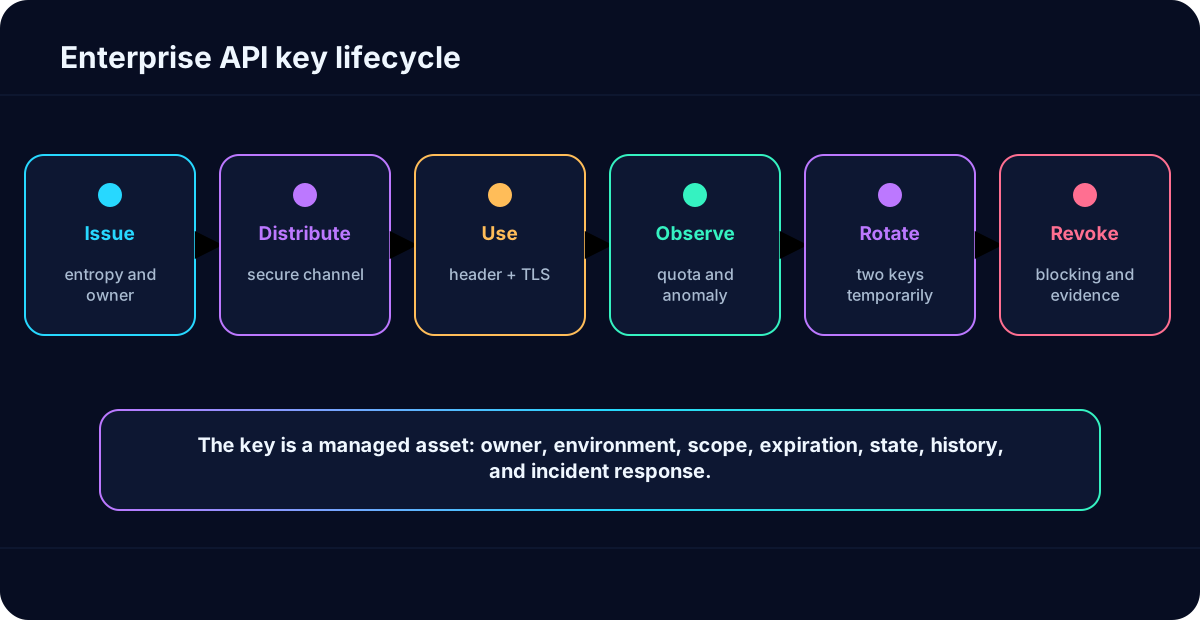
Figure 4 - Issuance is just the beginning of the life cycle of an .
15.13 Storage, lookup and metadata
When the key only functions as a bearer, the server does not need to store the value in the clear. Can store hash or MAC and compare presentation. For efficient lookup, formats with public identifier and separate secret are useful: the prefix locates the record and the secret is validated securely. This avoids scanning the entire hash base with each request.
The key record must contain owner, application, product, environment, scopes, quotas, state, creation, expiration, last rotation, last use and revocation reason. Metadata allows decisions without exposing the secret. It also supports inventory, orphan key reporting, and rotation campaigns.
If the platform needs to retrieve the value to sign requests on behalf of the consumer, the key is no longer just a verification key and requires reversible storage in a vault or HSM, with stronger access and audit controls. This case must be distinguished from a key used only to authenticate incoming calls.
Table 4 - Separating identifier, secret, and metadata improves operation and incident response.
Component
Content
Exhibition
key id/prefix_
Public identifier for lookup.
It may appear in logs and portals.
secret
Random material presented on the call.
Consumer only and validation process.
Hash or MAC of the secret.
Protected bank; does not allow direct use.
metadata
Owner, scope, quota, status and dates.
Management and policy services.
15.14 Transmission, scopes, quotas and authorization
API Keys must preferably be transmitted in a dedicated header or Authorization with a scheme defined by the platform. Putting them in a query string increases leaks in access logs, history, analytics, caches and Referer headers. TLS remains mandatory because a captured key can be reused.
Each key must have a minimum scope: product, APIs, operations, environment and, when possible, specific data or tenant. Quota and throttling limit consumption and reduce the impact of abuse, but are not equivalent to authorization. A key with a quota of a thousand calls can still access an improper object if the backend does not validate ownership.
For username operations, the can identify the application while another mechanism authenticates the user. This separation allows traffic to be assigned to two subjects: technical customer and end user. The gateway must preserve both in context and in logs without confusing them.
Methods of transmitting API Keys
# Dedicated header
X-API-Key: pk_live_7F2A...secret...
# Or an Authorization scheme defined by the provider
Authorization: ApiKey pk_live_7F2A...secret...
# Avoid
GET /v1/customers?api_key=pk_live_7F2A...
15.15 Rotation, revocation and leak detection
Rotation without downtime typically requires overlap period. The consumer creates or receives a second key, updates their applications, validates traffic with the new value and only then revokes the old one. Platforms may allow two active keys per subscription. The coexistence period must be short and monitored to avoid permanent duplication.
Revocation needs to be quick and global. Gateway caches must respect risk-compatible status and TTL. In incidents, the team needs to find all environments and dependencies that use the key. This is only possible when each consumer has their own credentials and reliable inventory.
Leak detection can use repository scanners, prefix patterns, origin monitoring, sudden volume increase, geographic change, and after-hours usage. Honeytokens or deliberately unused keys can generate immediate alerts when they appear in traffic.
Table 5 - The answer depends on inventory, individualization and revocation capacity.
Event
Immediate action
Further action
Suspected leak
Disable or reduce privilege; preserve evidence.
Investigate origin and issue new key.
Planned rotation
Activate new key in parallel.
Confirm use and revoke old.
Owner offline
Suspend associated credentials.
Reassign or remove integration.
Unused key
Confirm with owner and block in test.
Delete orphan asset.
15.16 request signing and related mechanisms
signing of requests is different from simply sending an . The client uses a secret to calculate a signature over the method, path, timestamp, headers and body hash. The server recalculates and compares. The key can identify the consumer, while the signature links the proof to a specific request and reduces when timestamp and are validated.
This model is used by some financial and cloud APIs, but requires strict canonicalization. Differences in encoding, header order, path and body normalization produce failures. Security depends on strong secrecy, short temporal window, secure comparison, clock protection, and reuse prevention.
does not replace TLS: without TLS, content and metadata remain visible and can be manipulated before verification. It also does not provide non-repudiation, because client and server share the same secret. Asymmetric signatures or mTLS may be more appropriate when separation of responsibility and proof of ownership are important.
Important distinction
An is typically presented directly. In signing, the secret does not travel; it produces a specific signature for the request. The two models require different life cycles and controls.
15.17 Use in API Gateways, Axway and Azure
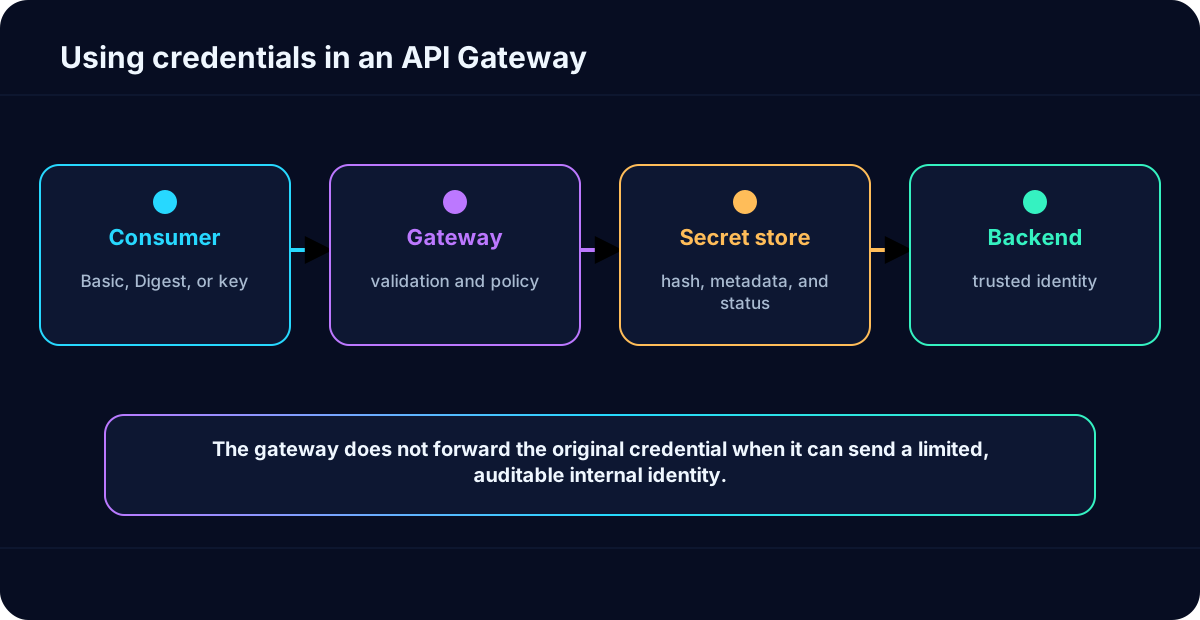
The API Gateway is a natural point to validate Basic, or API Keys, apply rate limiting, record consumption and block revoked credentials. The policy must occur before routing to the backend and must distinguish authentication failure, suspended key, quota exceeded, and lack of authorization. The gateway must also remove original credentials before forwarding the request, whenever the backend does not need them.
In corporate products, the key can be associated with an application, contract, product or subscription. The gateway queries the local repository, cache, or management service. Caches improve performance, but make revocation dependent on propagation. For critical credentials, the TTL needs to be short or the platform must offer active invalidation.
Integration with Axway API Gateway, Azure API Management and other products must be validated according to the version deployed. Policies can extract headers, validate subscription keys, query vaults, apply quotas and transform context. The design needs to prevent direct bypass to the backend and ensure that identity headers inserted by the gateway cannot be forged externally.
Figure 5 - The gateway validates the credential and forwards trusted context, not the original secret.
15.18 Comparison between Basic, and API Keys
The three mechanisms share simplicity and lack of complex token issuance flow, but solve different problems. Basic transports username and password. creates proof based on the password and a challenge. identifies an application or subscription with a random value. None of them, in isolation, provide fine-grained authorization, federated identity, or delegated consent.
The choice must consider where the credential can be protected, who is the subject, duration, need for rotation and client support. For new high-risk services, short-lived credentials, mTLS, OAuth 2.0, or workload identities tend to offer better properties. Basic, , and keys remain useful when applied with limited scope and clear compensating controls.
Table 6 - No mechanism eliminates the need for TLS, scope, rotation and authorization.
Criterion
Secret travels directly
Yes, within and TLS.
Not as a password, but there is reusable proof in context.
Yes, normally as a bearer.
TLS Dependency
Total.
It remains necessary.
Total.
Typical subject
User or technical account.
User or technical account.
Application, project or subscription.
after capture
Possible as long as password is valid.
Mitigated by / when correct.
Possible as long as key is valid.
Operation
Simple, but password needs protection.
More complex and less interoperable.
Simple, it requires a robust life cycle.
Recommended use
Controlled and temporary legacy.
Specific compatibility.
Identification and control of applications.
15.19 Evidence-driven troubleshooting
When Basic fails, confirm that the header reached the correct point, that was produced from the expected charset, that the password contains special characters, and that the proxy or redirect removed Authorization. Differentiate between 401 for invalid credential and 403 for lack of permission and 429 for quota.
In , compare ,,, algorithm, URI and method used in the calculation. Check synchronization between nodes, validity, counter and request-target canonicalization. Intermittent cluster failures often indicate unshared state or different keys to authenticate the challenge.
In API Keys, investigate header name, environment, prefix, status, expiration, scopes, quota, and revocation cache. A valid portal key may fail at runtime if the product, subscription, or deployment are inconsistent. Always correlate logs from the gateway, management service and backend.
Table 7 - Diagnosis requires identifying the point that produced the response.
Symptom
Hypotheses
Evidence
Basic returns 401
password changed, incorrect, or header removed
masked header, account, node and authentication logs.
fails after a while
expired , repeated or unhandled
challenge, timestamp, counter and cluster node.
works in staging
key or product from the wrong environment
prefix, metadata, deployment and subscription.
Repealed still works
cache or directly accessible backend
TTL, invalidation and bypass route.
429 unexpected
shared quota or reused key
owner, counters and consumers by key.
15.20 Case studies and labs
Case 1 - password shared by ten integrations
Ten jobs use the same Basic user. A secret appears in a repository and the organization is unable to attribute usage. The response creates individual accounts, restricts scopes, migrates to application credentials, and revokes the shared user after telemetry confirms the transition.
The case shows that the biggest problem was not , but the lack of individualization and rotation. Even regarding TLS, the leak had a broad impact and low traceability.
Case 2 - Intermittent cluster
Two nodes issue nonces with different keys and the balancer distributes calls without affinity. The client receives a challenge from one node and sends the proof to the other, which rejects the . The fix shares the authentication key or uses consistent validation across nodes.
Captures and logs show successive 401s with different nonces. The error looked like incorrect password, but the cause was in the distributed state of the engine.
Case 3 - exposed in query string
An integration sends the key in query. The value appears in proxy logs and analytics tool. The team revokes the key, removes parameters from the logs, changes transmission to header, adds scanners, and reviews all consumers.
The investigation also identifies that the same key was used in production and test. Segregation by environment reduces the impact of future leaks.
Suggested labs
Encode and decode a lab Basic value and note that is reversible.
Configure an authorized local server with Basic challenge and inspect 401, and Authorization.
Simulate the calculation with controlled and change method or URI to verify the failure.
Model an with public prefix, random secret and stored .
Implement rotation with two active keys and confirm revocation of the old one.
Compare logs for a key in header and query string, using only dummy values.
Chapter summary
encodes username and password in and sends the credential on each call. does not protect the secret; TLS, adequate storage, individualization, rotation and limitation of attempts are essential. On gateways, the credential should be validated at the edge and removed before the backend when possible.
HTTP uses challenge-response with ,, algorithm, , and counter. It avoids transmitting the password directly, but relies on strict implementation, strong password, control, and TLS. Its complexity and interoperability mean that it is adopted mainly for compatibility.
API Keys identify applications, projects or subscriptions and support quotas and analytics. As they are normally bearers, they need high entropy, header transmission, protected storage, metadata, scope, rotation and fast revocation. They do not replace user identity or authorization for a resource.
Static mechanisms must be evaluated for the complete life cycle. For new high-risk cases, short tokens, mTLS, OAuth 2.0, and workload identities offer superior properties. Migration must be based on telemetry and controlled coexistence.
Next step of the course
Chapter 16 will delve into the complete OAuth 2.0: roles, grants, authorization code with PKCE, client credentials, refresh tokens, scopes, security and application in API Gateways.
Static credentials checklist
Basic, and API Keys are only accepted over correctly validated TLS.
Each consumer has an individual credential, owner and defined environment.
Secrets do not appear in URLs, logs, source code, tickets, or analytics.
Passwords are protected by appropriate storage mechanism and never recorded.
Nonces have validity, integrity and control.
algorithms and follow explicit policy and are not silently downgraded.
API Keys have sufficient entropy, secure prefix and distribution over a protected channel.
Verifiers and metadata are separate from the presented secret.
Scopes, quotas and rate limits do not replace object and domain authorization.
Rotation allows for short overlap and telemetry-confirmed revocation.
Gateway caches respect revocation and do not create excessive windowing.
The backend is not directly accessible to bypass the gateway policy.
Alerts detect anomalous usage, unexpected origin, and orphaned keys.
There is a migration plan for short or asymmetric credentials when the risk requires it.
Exercises
Explain why does not protect .
Describe the 401, and Authorization flow.
List risks of sharing a Basic user between applications.
Explain the role of ,,, and in .
Describe how =true changes client behavior.
Explain why still needs TLS.
Differentiate between , access token and user identity.
Propose a format with public key_id and random secret.
Describe storage with and metadata.
Create a rotation plan without downtime.
Compare direct and request signature.
Describe troubleshooting for revoked key that still works on the gateway.
Glossary
Table 8 - Essential vocabulary of the chapter.
Term
Definition
Value associated with the application, project, product or API subscription.
Reversible byte encoding for textual characters.
HTTP scheme that transmits encoded user-id and password.
created by the client in HTTP .
Automated use of credentials obtained from previous leaks.
Hash-based HTTP challenge-response scheme.
Value derived from user, and password in .
Value derived from method and request-target in .
Hash-based message authentication code and shared secret.
Public identifier used to locate the record for a key.
Counter of use of a in .
Value used once or within a limited window to reduce .
challenge value returned without interpretation by the customer.
Quality of protection negotiated in the .
Protection space announced by an HTTP challenge.
Unauthorized reuse of a captured credential or evidence.
Service for storing, distributing and auditing secrets.
Indication that the has expired, not necessarily the password.
Protected representation used to validate a secret without storing it in the clear.
Response header that announces HTTP authentication challenges.
Annex A - Decision matrix
Table 9 - The appropriate option depends on the ability to protect secrecy and the risk of the operation.
Scenario
Home option
Conditions
Temporary legacy integration
TLS, individual account, strong password, vault and migration deadline.
Equipment with restricted support
Secure algorithm, consistent , TLS and interoperability testing.
Application ID and quota
Individual key, scope, rotation and separate authorization.
Modern in-house service
OAuth 2.0 client credentials, mTLS or federation
Short credential, audience, and workload identity.
Public mobile client or browser
Do not trust as a secret
Intermediate backend, user authentication and abuse controls.
Request that requires specific proof
or asymmetric signature
Canonicalization, timestamp, and key protection.
Technical references
IETF. RFC 9110 - HTTP Semantics. 2022.
IETF. RFC 7617 - The Basic HTTP Authentication Scheme. 2015.
IETF. RFC 7235 - HTTP/1.1 Authentication, later consolidated in RFC 9110.
OWASP. Authentication Cheat Sheet.
OWASP. Password Storage Cheat Sheet.
OWASP. REST Security Cheat Sheet.
OWASP. Secrets Management Cheat Sheet.
NIST. SP 800-63B - Authentication and Authenticator Management.
Microsoft Learn. Azure API Management subscription keys and policies.
Axway Documentation. , HTTP Basic and authentication policies in API Gateway.
Update note
Protocols and products have specific implementation and support details. Before adopting Basic, or API Keys, validate the official documentation of the deployed version and run tests in an authorized environment.