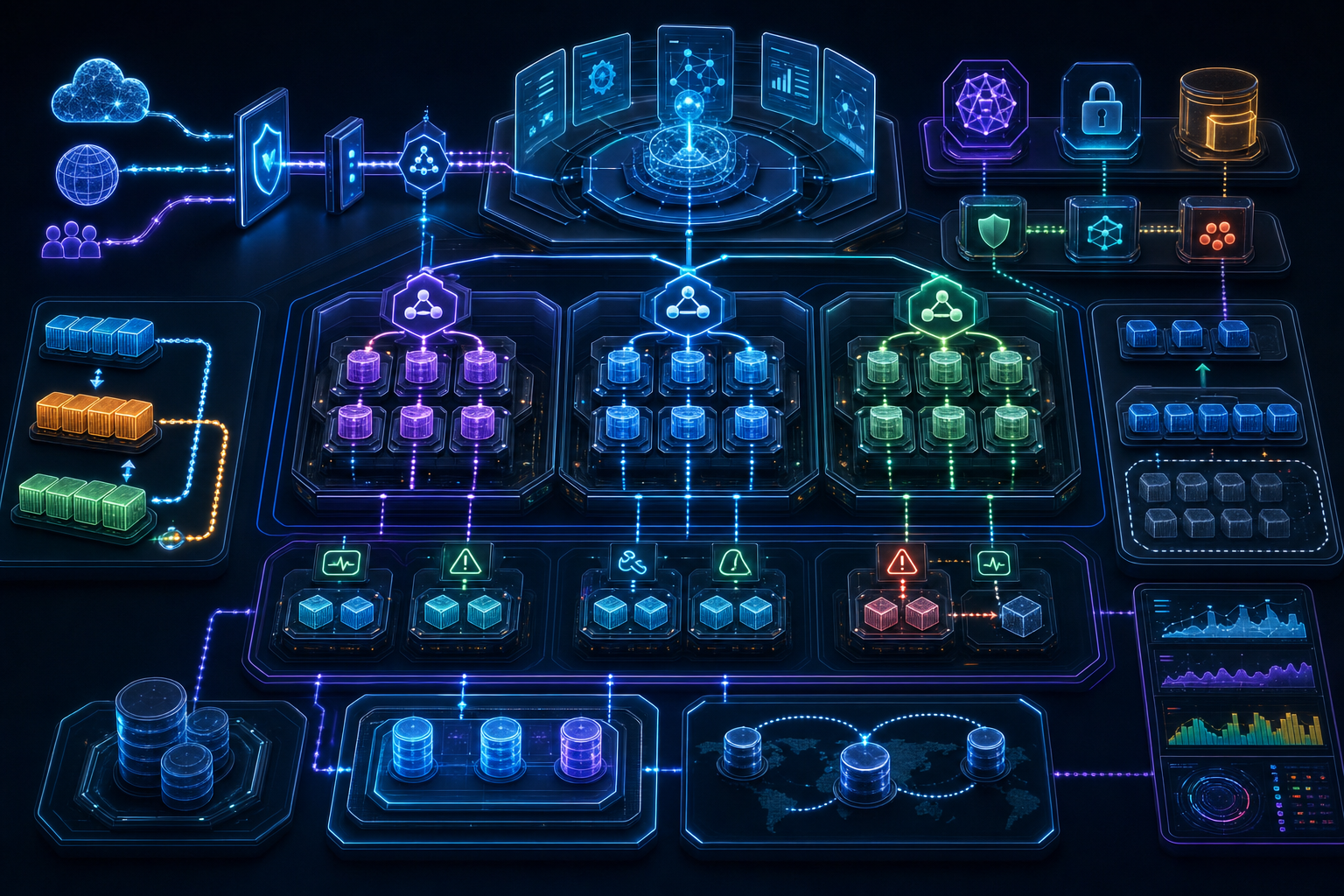
Workloads, Services, Gateway API, configuration, autoscaling, security, observability, and API operations in clusters
In-depth edition - study material and professional reference
By João Ricardo Dutra••Complete material
Chapter presentation
The previous chapters presented microservices, messaging, mesh and observability. Kubernetes is the platform that often brings these elements together in production: schedules workloads, distributes configurations, exposes services, runs rollouts, enforces policies, and provides a declarative API for automation. For API teams, however, just knowing kubectl commands is not enough. It is necessary to understand how each abstraction interferes with the request path, resource consumption, workload identity and behavior during failures.
Kubernetes does not automatically transform an application into a resilient system. The cluster can restart a container, but it does not know if a business operation is idempotent. You can create more replicas, but you don't know the database's connection limit. It can balance traffic between Pods, but does not fix a shallow readiness probe. The platform automates mechanisms; architecture needs to provide coherent signals, contracts, limits, and policies.
This chapter walks through the cluster from control plane to and connects the concepts directly to the API lifecycle. Deployments, Services, EndpointSlices, DNS, API Gateway, resources and limits, probes, autoscaling, scheduling, configuration, secrets, identity, RBAC, , storage, observability, GitOps and troubleshooting will be studied. The focus is to build an operational mental model: given a symptom observed by the consumer, what objects and evidence should be examined?
The approach considers managed and self-managed clusters, without depending on a specific provider. Examples use stable features and widely adopted standards. Additional features, controllers, and CRDs can extend Kubernetes, but must be evaluated as software with its own lifecycle, compatibility, permissions, and operational impact.
How to study this chapter
For each object, differentiate spec (desired state), status (observed state), responsible , generated events and external dependencies. This reading is more useful than memorizing isolated commands.
Learning Objectives
Explain the cluster architecture and the function of the main components of the control plane and nodes.
Relate the declarative model and the reconciliation loop to the operation of APIs.
Distinguish , ReplicaSet, ,, DaemonSet, Job and CronJob.
Understand Services, DNS, EndpointSlices, Ingress and API Gateway.
Configure requests, limits, probes and rollout strategies coherently.
Explain , VPA and node autoscaling, including their dependencies and conflicts.
Apply ServiceAccounts, RBAC, Security Standards, NetworkPolicies and Secrets protection.
Relate namespaces, quotas, scheduling and topology to isolation and availability.
Integrate logs, metrics, tracing and events into cluster troubleshooting.
Design a declarative, auditable, and secure delivery chain for APIs.
Chapter structure
33.1 Kubernetes as a reconciliation system
33.2 Cluster architecture
33.3 Pods and container lifecycle
33.4 Workload Controllers and Deployments
33.5 Services, DNS and EndpointSlices
33.6 Ingress and API Gateway
33.7 ConfigMaps, Secrets and configuration
33.8 Requests, limits and QoS
33.9 Startup, readiness and liveness probes
33.10 Autoscaling and capacity
33.11 Scheduling, topology and availability
33.12 Security, identity and network
33.13 Storage and stateful workloads
33.14 Observability, delivery, troubleshooting and laboratories
33.1 Kubernetes as a reconciliation system
Kubernetes is a declarative platform. The user creates or changes objects in the API, describing a desired state. Controllers observe these objects and the actual state of the cluster, calculate differences, and take actions to reduce divergence. A with three replicas is not a command to start three processes; is a persistent statement that will continue to be reconciled when Pods fail, nodes are drained, or a new version is published.
This model produces an important change in reasoning. In imperative systems, automation executes steps and considers the work complete when the commands return success. In Kubernetes, accepting a manifest simply indicates that the object has passed through the API and been persisted. Actual availability depends on scheduling, image download, initialization, probes, dependencies and status. Therefore, pipelines need to observe conditions, not just the return of the apply.
The Kubernetes API is extensible. CustomResourceDefinitions allow registering new types and controllers can implement their own semantics, forming operators. This capacity enables banks, gateways, certificates and internal platforms, but also increases the operational surface. Each needs ownership, upgrade policy, RBAC, backups and understanding of what happens when its becomes unavailable.
Mental model
Accepted object does not mean ready workload. Read generation, observedGeneration, conditions, events and status to know if the desired state was actually achieved.
33.2 Cluster architecture
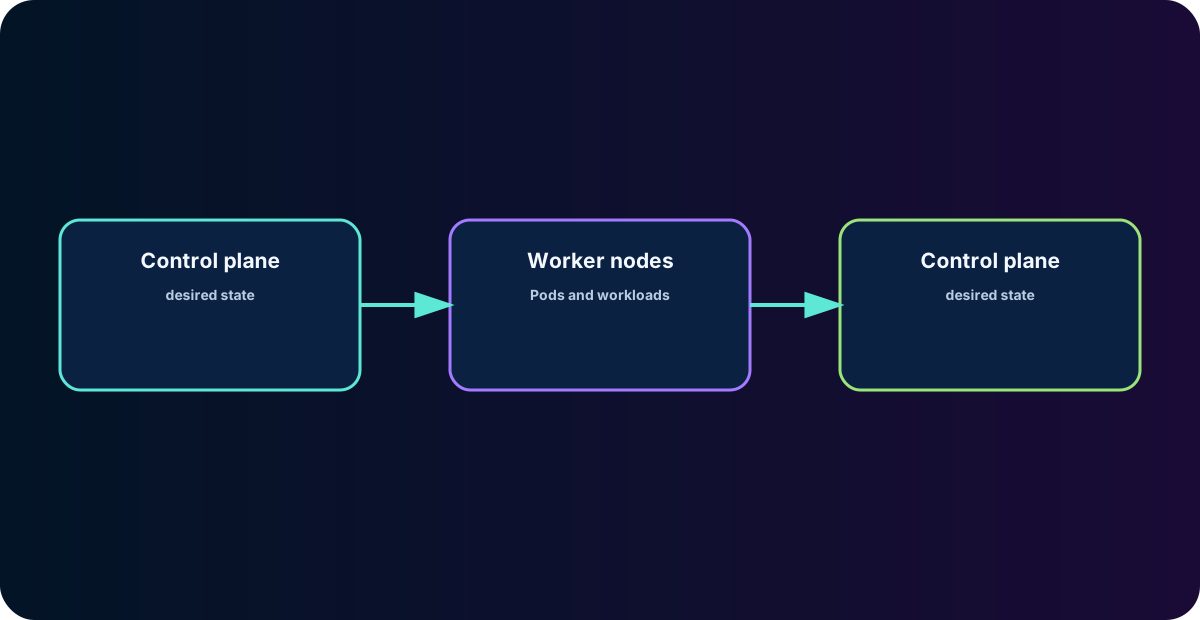
A cluster has control plane and worker nodes. The kube-apiserver exposes the API and centralizes authentication, authorization, admission and persistence. etcd stores the state of the cluster. The scheduler chooses a node for Pods not yet scheduled considering resources, affinities, restrictions and plugins. The kube--manager runs reconciliation loops for native objects. Providers can add cloud--manager and other controllers.
On nodes, the kubelet ensures that the containers described in the PodSpecs are running through a compatible container runtime. The network is implemented by plugins; persistence uses ; Device integration can use specific plugins. The proxy component or an equivalent implementation maintains Services forwarding rules. In managed clusters, some of these components are operated by the provider, but their responsibilities remain diagnostically relevant.
The cluster API is a critical frontier. Every automation, operator and person with credentials can potentially change the state of the environment according to their permissions. Control plane availability affects changes and reconciliation, although existing workloads may continue processing traffic for some time. Etcd backups, access policies, auditing and recovery procedures belong to the design of the platform.
Figure 1 - The control plane maintains the state and coordinates the nodes; workloads run on worker nodes.
33.3 Pods and container lifecycle
is the smallest deployable unit of Kubernetes. A contains one or more co-located containers, sharing network and volumes defined in the PodSpec. Containers in the same communicate via localhost and are scheduled together. This coupling is suitable for sidecars or auxiliaries that belong to the same life cycle; it is not a mechanism for putting multiple independent microservices on the same unit.
Pods are disposable. A new typically receives a new UID and IP address. Applications should not depend on the identity of a specific instance. Durable state must be on external systems or persistent volumes, and discovery must use or equivalent mechanisms. Kubernetes restarts containers in the same according to the restartPolicy, but replacements performed by controllers generate new Pods.
The cycle includes creation, scheduling, image pull, execution of init containers, container startup, probes, hooks and termination. When removing a , the kubelet sends a termination signal, respects the grace period and forcefully terminates when necessary. APIs need to respond to SIGTERM, stop accepting new requests, complete work in progress on time, and close resources. Ignoring this cycle causes errors during rollouts and node drains.
Table 1 - Containers in the same share operational destination and life cycle.
Element
Function
Use in APIs
Init container
Runs before main containers.
Short and deterministic preparation; it should not replace coordinated migration.
Sidecar
Auxiliary container in the same .
Mesh proxy, agent, or tightly coupled adaptation.
Ephemeral container
Temporary diagnosis.
inspection without tools, under access control.
Lifecycle hook
Action on container events.
Drainage, registration or controlled closure.
33.4 Workload Controllers and Deployments
Applications should not create isolated Pods for production. Workload controllers manage replicas and replacements. is the common choice for stateless APIs: it maintains ReplicaSets and performs declarative updates. provides stable identity and ordering for workloads that really need these properties. DaemonSet performs one copy per eligible node, while Job and CronJob represent finite, scheduled work.
In rolling update, gradually creates Pods of the new revision and removes old replicas. maxSurge controls additional temporary capacity; maxUnavailable limits unavailability during rollout. These values need to be compatible with quotas, node capacity, and probe behavior. A rollout can be blocked by invalid image, lack of resources, failing readiness, or restrictive PDBs and scheduling policies.
Rollback restores a previous revision of the template, but does not undo changes to the database, topics, contracts or external dependencies. Secure strategies separate schema changes, maintain compatibility during the coexistence window, and use telemetry for promotion. Canary and blue-green typically require a delivery or routing that divides traffic and evaluates metrics; Pure Kubernetes provides the blocks, not the entire decision policy.
provides a stable logical endpoint for a set of Pods selected by labels or explicit configuration. ClusterIP creates internal access; NodePort publishes a port on nodes; LoadBalancer requests integration with an external balancer when the platform offers this feature. ExternalName creates a DNS alias and does not act as a proxy. The choice should reflect topology, not momentary convenience.
The cluster DNS creates names for Services. An application in the same can only use the short name; in other namespaces, it uses a qualified name such as cliente-api.pagamentos.svc. The TTL, resolver behavior, connection pools, and EndpointSlices updates influence how long consumers keep old destinations. An already established connection is not automatically moved when the set changes.
EndpointSlices represent backend addresses associated with Services and include conditions such as ready, serving and terminating. Proxies and controllers use this information to schedule traffic. If a readiness probe fails, the may continue Running, but no longer appear as a ready target. This detail explains why looking at the phase alone is insufficient during incidents.
Table 2 - abstracts destinations, but network implementation remains relevant.
Type of
Exhibition
Note
ClusterIP
Cluster network only.
Standard for internal communication.
NodePort
Port on each node.
Often used as a block for balancers; requires network control.
LoadBalancer
External or internal address of the provider.
Cost, health checks and customer origin depend on the implementation.
ExternalName
CNAME in the cluster's DNS.
No native selector, proxy or health check.
33.6 Ingress and API Gateway
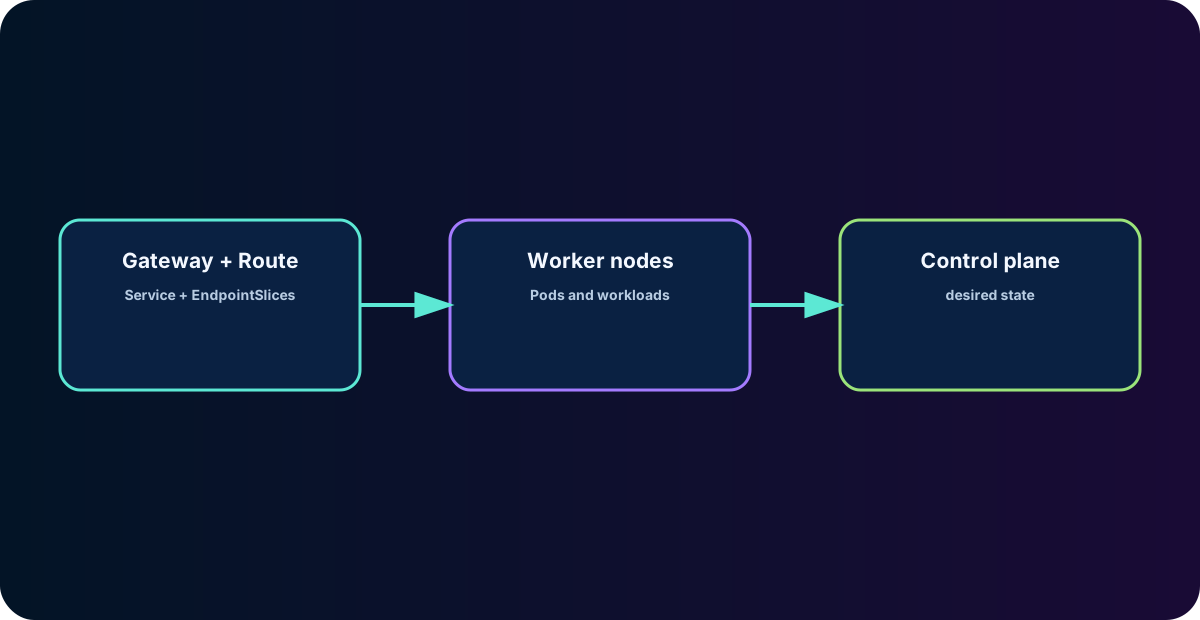
Ingress is a consolidated resource for exposing HTTP and HTTPS, but its model is limited and several behaviors depend on specific annotations for each . API Gateway evolves this area with explicit separation of responsibilities. GatewayClass represents an implementation; Gateway requests listeners and infrastructure; Routes, like HTTPRoute, describe how traffic is associated with Services.
The separation allows the platform team to manage classes, addresses and listeners, while application teams control authorized routes. HTTPRoute offers matches by hostname, path, headers and other criteria, as well as filters and multiple backends as supported by the implementation. ReferenceGrant controls references between namespaces and reduces implicit coupling.
For enterprise APIs, API Gateway can organize inbound traffic without replacing a full API Gateway. OAuth authentication, consumer quotas, monetization, advanced transformation, and developer portal can all remain on one API Management platform. The design must decide where TLS ends, where identity is validated, how the source address is preserved, and what policies are applied at each layer.
Figure 2 - Gateway and Route select the ; EndpointSlices route traffic to eligible Pods.
ConfigMap stores non-sensitive data decoupled from the image. It can be consumed as environment variables, arguments or files on volumes. Changes to variables do not update existing processes; Projected volumes may reflect changes after some time, but the application needs to reload the file. Configuration hash-controlled restarts are common to make the effective version explicit.
Secret represents a small amount of sensitive data, but its existence does not guarantee complete protection. Data can simply be base64 encoded in the manifest, persisted in etcd and exposed to users with read permissions or create Pods capable of mounting it. Best practices include encryption at rest, minimal RBAC, integration with KMS or providers, rotation, and preventing accidental logs.
Configuration must be versioned and validated as part of the operational contract. Timeouts, URLs, flags, certificates and limits need schema, ownership and rollback strategy. Placing large files, binary artifacts, or long-lived secrets in generic objects increases risk. For APIs, invalid configuration should cause clear initialization failure, not partially functional behavior.
Secret is not identity
Mounting a static credential across all Pods creates difficult distribution and rotation. When possible, prefer workload identity and temporary credentials tied to the or provider.
33.8 Requests, limits and QoS classes
Requests express resources used by the scheduler to position Pods and are the basis for various autoscaling and capacity mechanisms. Limits restrict consumption depending on the resource and runtime. CPU above limit tends to be throttled; Memory exceeding the limit can lead to OOMKill. Too low a request causes overcommit and competition; Too high prevents scheduling and wastes reserved capacity.
Kubernetes classifies Pods into QoS classes according to requests and limits. Guaranteed requires equal requests and limits for CPU and memory for all containers. Burstable covers the other Pods with some reserve. BestEffort has no requests or limits and tends to be the first candidate under resource pressure. QoS does not replace priority, or capacity; is just one of the signals used in pressure situations.
For APIs, value must come from testing and telemetry. CPU usually follows throughput, while memory can depend on heap, cache, buffers, connections and payloads. Sidecars also consume resources and need to be included in the calculation. Hard limits can increase latency through throttling; Absence of limits can allow a failure to affect the entire node. The decision needs to balance isolation, efficiency, and runtime behavior.
Table 3 - Requests and limits are engineering parameters, not decorative values.
Configuration
Main effect
Common fault
CPU request
Logical reservation for scheduling.
Too low creates contention; too high leaves Pending.
CPU limit
CPU time ceiling.
Throttling and high latency.
memory request
Scheduling and capacity basis.
Underestimation produces pressure and evictions.
Memory limit
Container memory ceiling.
OOMKill and restart.
33.9 Startup, readiness and liveness probes
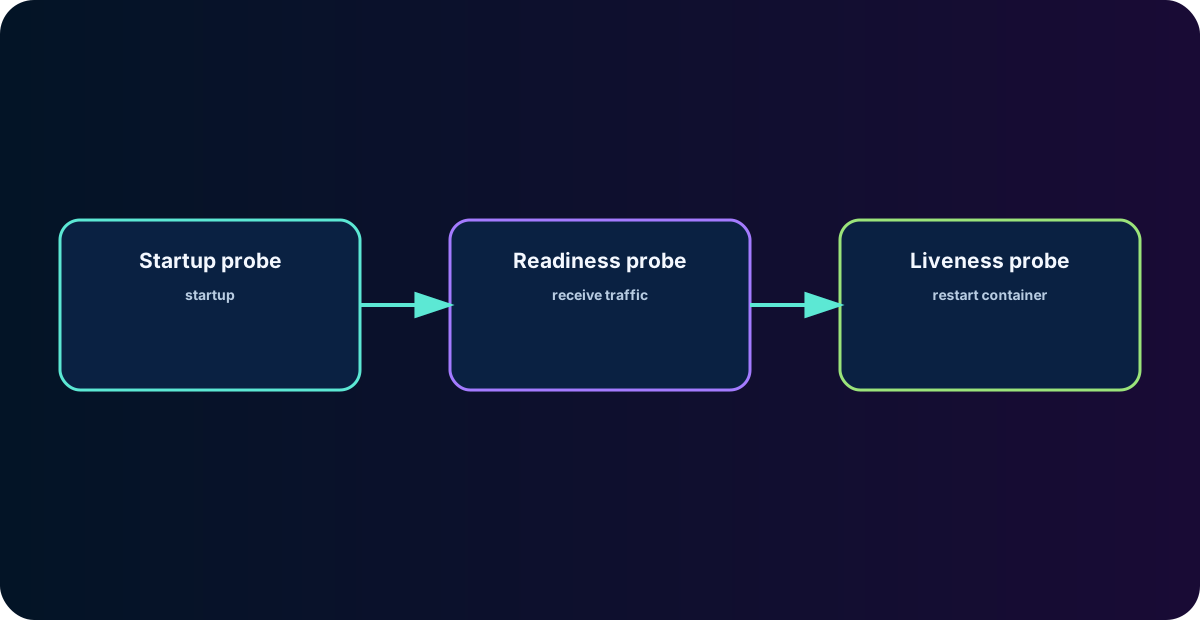
Startup probe indicates whether the application has finished starting. While it is unsuccessful, liveness and readiness can be suppressed, preventing a slow application from being restarted before it is ready. Readiness determines whether the endpoint should receive traffic; failure removes the from ready targets. Liveness signals that the process is irretrievably stuck and must be restarted.
Mixing these responsibilities is dangerous. A liveness probe that queries the database, DNS, or external can restart all replicas during a downstream failure, magnifying the incident. Readiness can consider essential dependencies, but needs to avoid flapping and cascading effects. The probe response must be cheap, deterministic and have a timeout shorter than the period.
During termination, the application needs to fail readiness before closing connections, allowing the balancer to stop sending new requests. preStop can help, but should not depend on arbitrary time without observation. The grace period must cover drain, long requests and telemetry flush. WebSocket, gRPC streaming and messaging consumers require their own termination logic.
Figure 3 - Startup, readiness and liveness control different moments and decisions.
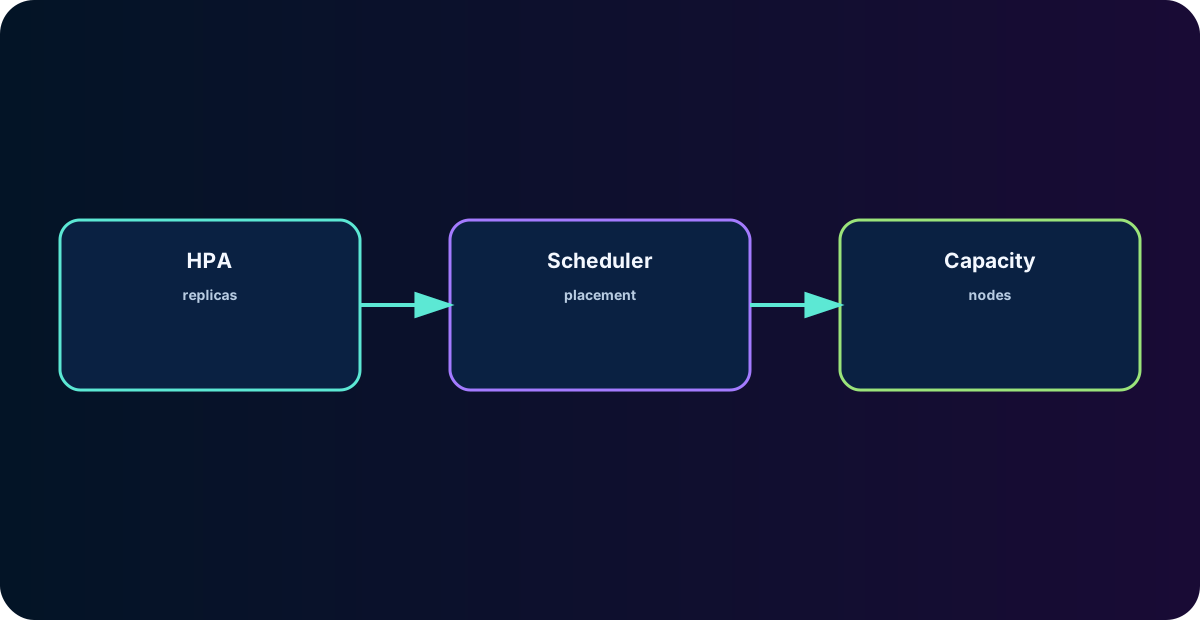
HorizontalPodAutoscaler adjusts the desired number of replicas of a scalable target based on metrics. CPU and memory can come from the resource metrics API; Custom and external metrics require adapters. The calculation uses requests as a reference in several scenarios, so missing or incorrect requests impair the behavior. ScaleUp, scaleDown, stabilizationWindow and tolerance policies reduce oscillations.
VerticalPodAutoscaler recommends or applies new requests and limits according to history, depending on the mode and installed implementation. Changes may require recreating Pods. and VPA can compete when they both act on the same metric, so the architecture needs to define responsibilities. Node autoscaling adds or consolidates nodes when Pods cannot be scheduled or there is idle capacity.
Horizontal scaling does not remove external limits. If all replicas use the same database pool, increasing Pods may saturate connections sooner. RPS, queues, latency, or concurrency metrics often represent API demand better than CPU alone. Boot time, cache warm-up, and node provisioning speed need to factor in for peak scaling.
Coordinated scaling across multiple layers
Figure 4 - , scheduler and node capacity form a coupled system.
33.11 Scheduling, topology and availability
The scheduler filters and scores nodes according to resources, selectors, affinity, taints, tolerances and topology restrictions. nodeSelector is simple; node affinity expresses mandatory or preferred rules. affinity approximates workloads, while anti-affinity and topology spread constraints distribute replicas across nodes and zones. Excessive restrictions can leave Pods Pending during crashes or expansion.
Taints repel Pods without corresponding tolerance and are useful for dedicated nodes, GPUs, critical workloads or special conditions. Toleration only allows scheduling; does not guarantee preference or exclusivity. PriorityClass influences preemption, potentially removing lower priority Pods to accommodate critical work. This mechanism needs governance to not make every application a top priority.
PodDisruptionBudget limits simultaneous voluntary interruptions, such as draining and maintenance, but does not protect against node or application failure. A that is incompatible with the number of replicas can block upgrades. True availability combines replicas, cross-zone distribution, probes, capacity, timeouts and dependency redundancy. Having three Pods on the same node does not provide node loss tolerance.
Table 4 - Scheduling translates isolation and availability requirements into restrictions.
Mechanism
Question answered
Caution
Affinity / anti-affinity
Which Pods or nodes should be close together or separate?
Mandatory rules may reduce eligible capacity.
Topology spread
How to distribute replicas per domain?
Topology labels need to be reliable.
Taints/tolerances
Which workloads can use a given node?
Toleration does not create affinity.
How many voluntary interruptions are allowed?
Does not cover unintentional failures or replace replicas.
33.12 Security, identity and network isolation
provides identity to processes in Pods when they access the Kubernetes API or integrated systems. Projected tokens are temporary, have an audience and can be linked to the 's lifecycle. Each workload must have a specific and automountServiceAccountToken must be disabled when the token is not needed. Workload identity should not be shared between applications without reason.
RBAC controls actions on API resources through Roles, ClusterRoles and bindings. Permissions such as creating Pods, updating Deployments, reading Secrets or linking roles can allow indirect escalation. The principle of least privilege requires reviewing verbs, resources, subresources, namespaces, and impersonation capabilities. Human and automation access must be audited and separated.
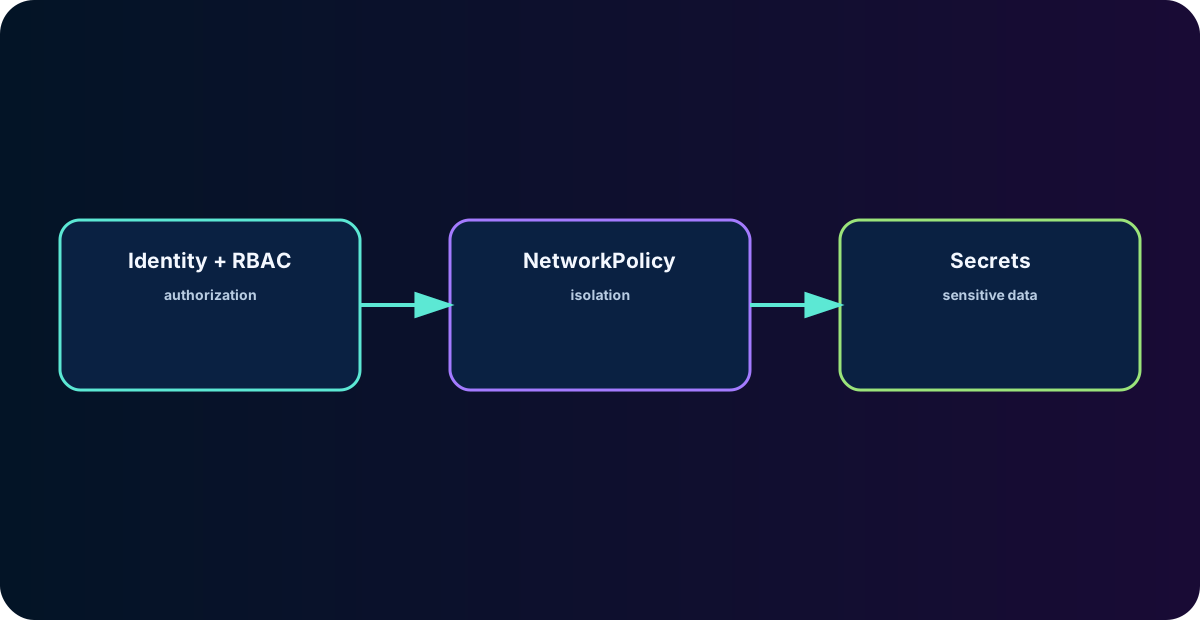
Security Standards define Privileged, Baseline, and Restricted levels for security properties. Admission can apply policies per . controls allowed communication between Pods and network entities, as long as the plugin implements the feature. Default-deny policies, explicit egress, execution without root, read-only filesystem, seccomp and minimum capabilities reduce the impact of compromise.
Table 5 - Each control protects a different surface.
Control
Scope
Example for APIs
Workload identity.
API uses temporary credential to access cloud .
RBAC
Kubernetes API.
Runtime cannot list Secrets or change Deployments.
Security
Configuration.
Without root, without privilege escalation and with seccomp.
L3/L4 traffic between workloads.
Only gateway accesses the API port; limited egress.
33.13 Namespaces, quotas and multi-tenancy
Namespaces organize names and policies, but they are not an absolute security boundary in and of themselves. Many resources, such as Roles, ResourceQuotas, and NetworkPolicies, are -scoped, which allows you to delegate parts of the cluster to teams. Cluster-scoped resources, nodes, CRDs, and shared components continue to require central governance.
ResourceQuota limits aggregate consumption of CPU, memory, storage and number of objects in a . LimitRange defines defaults and limits per object. Quotas prevent a team from consuming all capacity, but rigid values without an adjustment process can block rollouts and incident response. Shared environments also need network isolation, RBAC, admission and tenant observability.
Strong multi-tenancy may require separate clusters, virtualization, or additional mechanisms depending on risk. isolation is often suitable for teams from the same organization with partial trust; should not be assumed to be equivalent to physically independent environments. The decision needs to consider data, regulatory requirements, blast radius, cost and operating capacity.
33.14 Stateful storage and workloads
Volumes solve data needs within the cycle, while PersistentVolume and PersistentVolumeClaim abstract storage with its own life cycle. StorageClass describes classes and dynamic provisioning. Access modes, reclaim policy, expansion, snapshots, zones and performance vary depending on the driver and provider. A Bound PVC does not guarantee that the application has consistency or adequate backup.
provides stable identity, ordering and volume templates per replica, but does not transform any database into a secure distributed system. Bank operators can automate members, failover and backup, but add critical dependency on a . For most stateless APIs, data must remain in external services designed for persistence, while Pods can be freely replaced.
Backups need to include data, metadata, and tested restore capability. Copying manifests does not recover volumes or external state. Schema changes must be compatible with rollouts and rollback. Migration jobs need locking, idempotence and observability; Running them as each replica's init container can produce concurrency and unavailability.
33.15 Observability of the cluster and APIs
Kubernetes produces multiple sources: component and node metrics, container and system logs, object events, audit logs, and resource status. Events are useful for scheduling, pulls, probes and admission, but they have limited retention and do not replace centralized logs. Logs need cycled storage independent of Pods and nodes to survive restarts and evictions.
The application must continue emitting structured logs, metrics and traces as studied in the previous chapter. Resource attributes such as cluster, ,, container and allow correlation. kube-state-metrics exposes state of objects; metrics-server supports the resource metrics API and autoscaling, it is not a replacement for a full observability platform. Collector can be deployed as an agent per node and as a central gateway depending on volume and requirements.
Alerts should relate user symptoms to cluster signals. Increase of 5xx may coincide with Pods not ready, OOMKills, throttling, DNS, or external backend. CPU-only dashboards do not explain this chain. Traces with identity, logs with trace_id and metrics per revision reduce the time to separate platform failure from application failure.
Table 6 - Trustworthy diagnostics combines declarative state and execution telemetry.
Evidence
Question
Tool or object
Status and conditions
Did the achieve what was desired?
kubectl get/describe and object API.
Events
What recent decision occurred?
Scheduling, pull, probe and volume events.
Logs
What did the process record?
Container, sidecar and component logs.
Metrics and traces
What impact and path?
Prometheus/OpenTelemetry and observability backend.
33.16 Declarative delivery, images and supply chain
A secure chain starts with the image. The build must be reproducible, use a minimum and updated base, produce SBOM, run scanners and sign the artifact. Mutable tags make auditing difficult; digests identify exact content. The runtime must restrict registries, verify signatures according to policy, and prevent privileged containers or unapproved images.
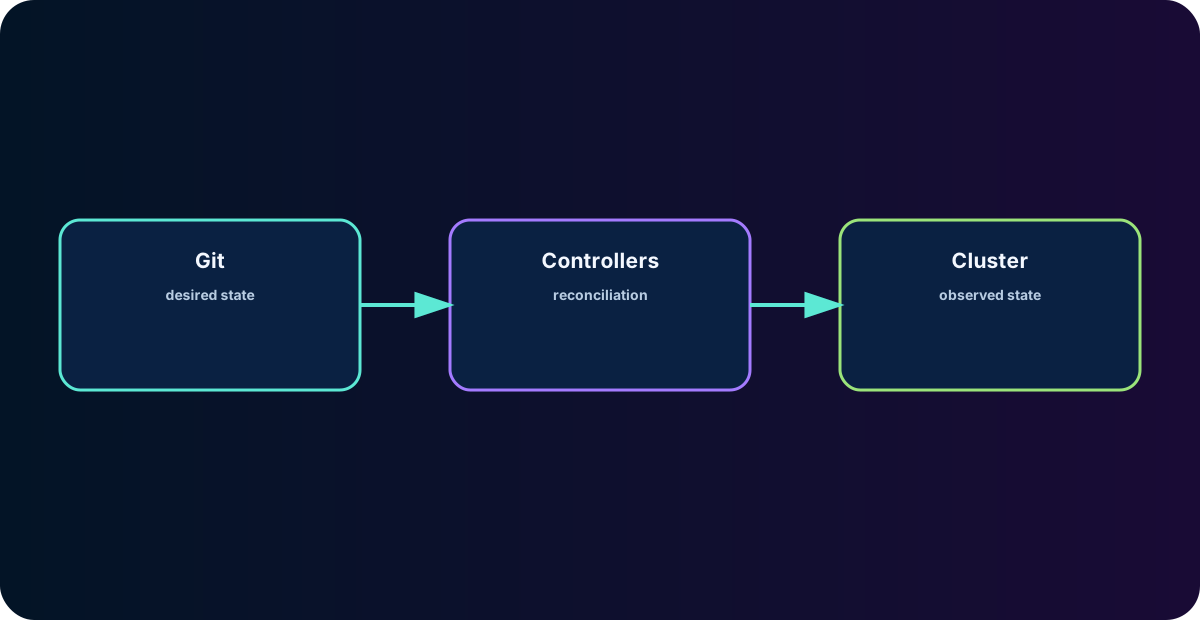
Manifests can be managed with YAML, Kustomize, Helm or equivalent tools. GitOps maintains the desired state in the repository and a reconciles the cluster, creating an auditable trail. This does not eliminate validation: pull requests need schema, policy-as-code, diff, testing and segregation of functions. Secrets should not be committed in clear text.
Rollouts need readiness, surge strategy, temporary capacity and success metrics. Progressive delivery can pause, analyze SLOs, and promote gradually. Rollback must consider bank and contracts. A technically successful , but with a functional error, will only be stopped if telemetry and promotion criteria represent the real consumer experience.
Declarative Delivery: From Artifact to Reconciled State
Figure 6 - GitOps makes the desired state auditable; controllers remain responsible for convergence.
33.17 API Gateways, mesh and Kubernetes
In Kubernetes, ingress or takes care of ingress and routing to Services, while an API Management platform can provide catalog, authentication, quotas, policies and analytics. The gateway can run outside, at the edge of the cluster or as an internal workload. The decision affects latency, blast radius, certificate management and dependence on the cluster itself to receive traffic.
mesh operates mainly on east-west traffic and provides workload identity, mTLS, telemetry and policies. It must not duplicate retries, timeouts and circuit breakers already existing on the client or gateway in an uncoordinated manner. The consumer - edge - API Gateway - mesh - chain can have multiple TLS endpoints and observability; the drawing needs to document the authority of each layer.
Gateways and proxies also need requests, limits, probes, PDBs and zone distribution. The fact that they are shared infrastructure increases their impact. Updates must preserve connections, routes, and policies. Distributed rate limiting counters, caches and session stores need their own architecture; they should not depend solely on the number of gateway replicas.
33.18 Troubleshooting APIs in Kubernetes
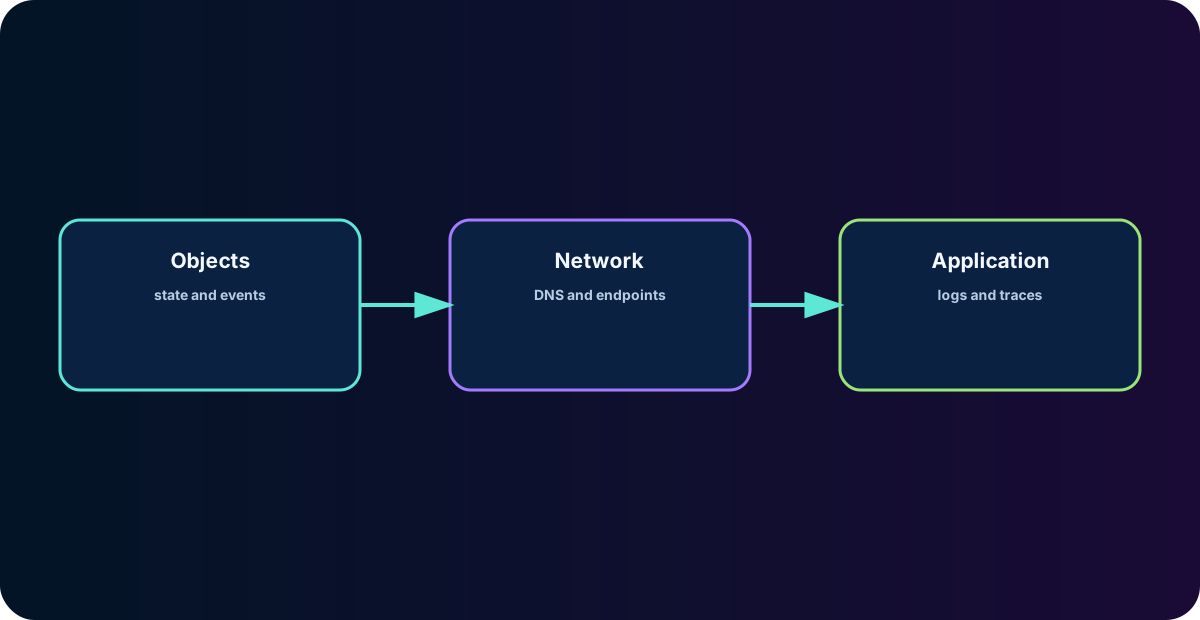
The diagnosis starts with the external symptom and goes through layers. If the name does not resolve, investigate DNS and gateway address. If there is a connection timeout, validate the load balancer, listeners, NetworkPolicies and endpoints. If the gateway responds 503, examine Route, , EndpointSlices, and readiness. If the restarts, see container status, lastState, exit code, events, limits and previous logs.
Pending usually points to scheduling: insufficient resources, PVC, affinity, taints or quotas. ImagePullBackOff indicates access, name, tag, credential or registry. CrashLoopBackOff is a wait policy after repeated crashes, not the cause; the cause is in the process, configuration, probe, or dependency. OOMKilled relates to memory, while CPU throttling appears in metrics and latency without necessarily restarting the container.
Tools must be used with hypothesis. kubectl describe shows events and conditions; logs --previous retrieves the previous run; port-forward isolates network path; ephemeral containers help when the image has no utilities. Captures, DNS and connectivity tests must respect authorization. Changing probe, policy or limit without evidence can hide the problem and create another incident.
Layer-oriented troubleshooting
Figure 7 - The investigation progresses from the declared object to the application behavior and its dependencies.
Table 7 - Known states reduce trial and error troubleshooting.
Symptom
Early evidence
Hypotheses
Pending
Events and scheduler message.
Resources, affinity, taint, PVC, quota.
CrashLoopBackOff
Current/previous logs and exit code.
Configuration, process, probe or dependency.
without endpoints
EndpointSlices and readiness.
Incorrect selector or Pods not ready.
503 on gateway
Route, , endpoints and upstream logs.
Backend unavailable, policy or timeout.
OOMKilled
lastState, limits and metrics.
Heap, leak, cache, payload or low limit.
33.19 Case studies and labs
Case 1 - rollout with 503: a new version starts in 70 seconds, but liveness starts after 10 seconds and restarts the container. never gets ready replicas. The fix separates startup and liveness, adjusts the grace period, and adds per-revision monitoring. The cause was not in , although the consumer observed 503.
Case 2 - increases bank error: scales from 5 to 40 Pods per CPU, but each opens 20 connections. The bank only supports 300 connections. The correct answer includes coherent global pool, scale limit, queue metric, and backend protection; simply increasing the cluster would magnify the failure.
Case 3 - API inaccessible after default-deny: a ingress allows the gateway , but the selector does not match the actual labels. EndpointSlices are still ready, but packages are blocked by the . The investigation compares labels, policy and traffic, without removing the entire policy permanently.
Suggested labs
1) Deploy an API with , and HTTPRoute. 2) Simulate readiness failure and observe EndpointSlices. 3) Configure requests/limits and trigger OOM in an isolated environment. 4) Apply and track metrics. 5) Create , minimum RBAC and default-deny. 6) Perform rollout and rollback with review observability.
Chapter summary
Kubernetes provides a declarative API and controllers that reconcile the desired state. This abstraction allows you to automate replicas, rollouts, scheduling, configuration and exposure, but does not replace decisions about contracts, dependencies and consistency. For APIs, each object needs to be related to the request path and the signals used for operation.
Pods are ephemeral; Deployments control revisions; Services and EndpointSlices provide discovery; organizes input and routes. Requests, limits, probes, autoscaling and scheduling form a coupled system. Incoherent configurations create unavailability even when all objects appear individually valid.
Security combines ServiceAccounts, RBAC, Security, , secrets, supply chain and isolation. Observability combines state, events, logs, metrics and traces. Secure delivery uses immutable artifacts, validation, reconciliation, and promotion criteria. Effective troubleshooting starts from the observed state and advances through layers.
Next step of the course
The next chapter delves deeper into Zero Trust applied to APIs, connecting workload identity, least privilege, segmentation, continuous verification, and distributed policies.
Checklist for APIs in Kubernetes
uses immutable image, rollout and rollback strategy compatible with banks and contracts.
Requests and limits were defined by testing and telemetry, including sidecars.
Startup, readiness and liveness answer different questions.
and Route have validated selectors, ports, hostnames and references.
uses representative metrics and respects capacity dependencies.
Replicas are distributed across nodes and zones, with coherent .
and RBAC follow least privilege; token is disabled when unnecessary.
Security and NetworkPolicies reduce privileges and network paths.
Secrets use encryption, rotation, and minimal access.
Logs, metrics, traces, events and status are correlated by revision and .
Pipeline validates manifests, policies, images and rollout conditions.
Runbooks cover Pending, pull, crash, OOM, empty endpoints, DNS and 503.
Exercises
Explain the difference between applying a manifesto and achieving the desired state.
Compare ,,, DaemonSet, Job and CronJob.
Describe the path DNS/Gateway/Route///.
Explain why a Running might not receive traffic.
Propose requests, limits and probes for a Java API with lazy initialization.
Compare , VPA and node autoscaling and identify possible conflicts.
Design minimal RBAC and for an API accessible only through the gateway.
Explain how a can block maintenance and why it does not protect against node failure.
Describe a canary rollout with SLO-based promotion criteria.
Build a runbook to investigate intermittent 503s after a deploy.
Glossary
Table 8 - Essential vocabulary of the chapter.
Term
Definition
Step that validates or modifies objects before persistence.
Plugin interface that implements a network of containers and Pods.
Loop that reconciles observed and desired state.
API extension that registers a new resource type.
Interface for integrating storage drivers.
Declarative update for generally stateless workloads.
Resource that represents network endpoints of a .
Feature family for L4/L7 routing with separate roles.
that adjusts replicas horizontally by metrics.
Logical scope for names, policies, and delegation.
communication policy implemented by the .
Limit simultaneous voluntary interruptions.
Smallest deployable Kubernetes unit.
Stable network abstraction for a set of backends.
Kubernetes identity intended for workloads.
for Pods with stable identity and ordering.
Technical references
Kubernetes Documentation. Concepts, Cluster Architecture and Components.
Kubernetes Documentation. Pods, Deployments, Services and EndpointSlices.
Kubernetes Documentation. ConfigMaps, Secrets and Persistent Volumes.
Kubernetes Documentation. Probes, Workload Autoscaling and Node Autoscaling.
Kubernetes Documentation. Accounts, RBAC Good Practices and Security Standards.
Kubernetes Documentation. Network Policies, Multi-tenancy, Logging and Observability.
Kubernetes . API Overview, HTTPRoute, Security and Versioning.
Cloud Native Computing Foundation. Kubernetes project and ecosystem documentation.
Update note
Kubernetes, API Gateway, / plugins and managed services continually evolve. Before applying examples, validate the cluster version, implementation support, and stability state of each feature in the official documentation.