Professional Scrum Master I (PSM I) Certification Study
Introduction to the PSM I Certification
What Professional Scrum Master I validates, how to reason from Scrum without confusing the framework with company habits, and the complete 62-chapter roadmap from Agile foundations to professional practice
Complete introductory article and syllabus overview
By João Ricardo Dutra••Complete article
Chapter objective
By the end of this chapter, you should understand what the certification represents, who maintains it, what level of knowledge it expects, why the Scrum Guide is the primary reference, and why successful preparation requires learning to reason from itself rather than from local organizational habits.
Introduction: Why Is More Than an Vocabulary Test
The fastest way to misunderstand is to treat as a list of meetings. The fastest way to understand it is to see the framework as a system for learning in complexity.
The certification, usually shortened to , is often introduced as an entry-level certification. That description is useful, but incomplete. It can create the wrong expectation: that the assessment is mainly about memorizing a diagram, remembering the names of the , or learning which accountability is associated with which activity. Those facts matter, but becomes much easier to understand when you see it as a test of a more important capability: can you reason consistently from the when the situation is ambiguous, uncomfortable, or different from the way your organization currently works?
That distinction matters because was created to help people work in complex environments, where the correct path is not fully knowable in advance. Ken Schwaber and Jeff Sutherland developed in the early 1990s, and they publicly presented a formal description of it at the OOPSLA conference in 1995. Over time, spread far beyond its roots in software product development. The Scrum Guide was first published in 2010 to provide a common definition, and the current official version remains the November 2020 edition. Today, is used across many forms of complex product and knowledge work, not because it predicts the future, but because it creates a disciplined system for learning from reality and adapting as new information appears.
sits inside that history. .org, founded in 2009 by co-creator Ken Schwaber, maintains the certification program. The certification is therefore closely connected to the as described in the Scrum Guide. This has an important consequence for your preparation: the exam is not asking, “How does your company run sprints?” It is asking whether you understand well enough to identify what the framework requires, what it allows, what it intentionally leaves open, and how a should help people use it professionally.
For a candidate, that changes the entire learning strategy. Instead of collecting isolated facts, you begin building a mental model. You ask why transparency matters before inspection. You ask why inspection without adaptation is incomplete. You ask why a is accountable for establishing as defined in the Scrum Guide, rather than for acting as a project coordinator who assigns tasks. You ask why the is one person, why the is , why the is essential to transparency, and why a is more than a decorative sentence placed in a tracking tool. Once these relationships become clear, many exam questions stop looking like trivia and start looking like consequences of the same underlying system.
This chapter builds that foundation. It is deliberately not a catalog of every rule; later chapters can explore the framework in greater detail. The goal here is to establish the lens through which the rest of your preparation should be viewed. If you get that lens right, you will study faster, recognize misleading answer choices more easily, and - more importantly - become better prepared to use in real organizations where old habits, hierarchy, deadlines, and local process rules constantly compete with empirical ways of working.
What the Certification Actually Validates
validates a fundamental level of mastery. .org describes the certification as evidence that the holder understands the , the accountabilities of the , and how to apply within Teams. The word “fundamental” should not be confused with “superficial.” At this level, the expectation is not that you have solved every organizational transformation problem or coached executives through years of product complexity. The expectation is that your foundation is correct enough that more advanced experience can be built on top of it.
The certification therefore tests two layers at the same time. The first layer is framework knowledge: , the , the and its accountabilities, the events, the artifacts, and the commitments associated with those artifacts. The second layer is interpretation: how those elements work together, what problem they are designed to address, and what a should do when a situation threatens ,, focus, transparency, or value delivery.
This is why a candidate who has memorized definitions can still struggle. Consider a simple statement such as “The is a 15-minute event for the .” Memorizing the sentence is useful. Understanding it is more powerful. If a question describes a manager using the as a status meeting where each Developer reports progress to the , your deeper model should immediately detect tension. The event exists to inspect progress toward the and adapt the as necessary. It is not designed as a reporting ceremony for managerial control. The more clearly you understand the purpose, the likely you are to be distracted by answer choices that sound familiar but contradict the framework.
Being a therefore means more than possessing a certificate. The idea of emphasizes disciplined use of , commitment to its values, and an ability to help people solve complex problems through rather than through mechanical ceremony. The is not simply the person who schedules meetings, updates a board, or removes every obstacle personally. The accountability is broader: help establish as defined, increase the effectiveness of the , support , coach the and where needed, and help the wider organization interact with more effectively.
For the candidate, this creates a useful rule: whenever you read a scenario, look beyond the visible activity and identify the underlying purpose. Ask what is being made transparent, what is being inspected, what could be adapted, what commitment is at risk, who is accountable, and whether the proposed action strengthens or weakens . This reasoning pattern is far more reusable than memorizing hundreds of disconnected practice questions.
Who Should Pursue - and What Knowledge Is Expected
is relevant to a wider audience than people who already hold the job title “.” It is especially useful for aspiring Masters, existing Masters who want to validate and correct their understanding, coaches, consultants, managers, team members, , Product Owners who want a stronger view of the accountability, and professionals involved in product delivery using . Official .org training is also positioned for people in industries where teams solve complex problems, which reflects 's broader use beyond software.
A candidate does not need to arrive with years of experience. .org does not require an official training course before taking the assessment. This makes the certification accessible to self-directed learners, but accessibility increases the importance of disciplined preparation. Without a trainer correcting misunderstandings in real time, the learner must be especially careful to distinguish official from popular practices that are merely compatible with .
The expected knowledge starts with the architecture of the framework. You should be able to explain and the three pillars of transparency, inspection, and adaptation. You should know the five - commitment, focus, openness, respect, and courage - not only as a list but as behavioral conditions that help the framework work. You should understand the as one cohesive, unit consisting of one , one , and . You should know the purpose of each event and how the events create a cadence for inspection and adaptation.
You should also understand the three and their commitments. The is connected to the . The is connected to the . The is connected to the . These commitments are not decorative additions. They provide focus and transparency so that inspection has a meaningful reference point. A candidate who knows the names but does not understand the relationships will be vulnerable to situational questions.
Beyond the core framework, .org's learning objectives and competency areas include topics such as teams, facilitation, coaching and mentoring, product value, , stakeholders and customers, and or . Some of these practices are not mandated by itself, which introduces another essential exam skill: learn to distinguish between the framework and complementary techniques. , velocity, burndown charts, user stories, estimation poker, workflows, and release plans may be useful in certain contexts, but they are not all required elements of . The framework sets boundaries and purposes; teams choose many of the tactics inside those boundaries.
That distinction is a recurring source of mistakes. Candidates often assume that a common practice must be a rule. It is not. A professional understanding of includes knowing what defines, what it does not define, and where context-sensitive practices can be added without changing the core framework.
If preparation has a center of gravity, it is the Scrum Guide. The Guide contains the official definition of and is maintained by 's co-creators, Ken Schwaber and Jeff Sutherland. The current official version is the November 2020 Scrum Guide. It is intentionally short, but that brevity can be deceptive. The Guide is dense because nearly every sentence defines a relationship, constraint, purpose, or accountability.
Many candidates make one of two mistakes. The first is treating the Scrum Guide as a quick introductory handout: they read it once, feel that looks simple, and immediately move to mock exams. The second is trying to memorize it word for word without building conceptual connections. Both approaches are weaker than repeated, analytical reading.
A better approach is to read the Guide in layers. On the first pass, understand the whole structure. On the second, ask why each element exists. On the third, look for relationships: how the affects decisions during the ; how the creates transparency around the ; how the gives the a longer-term direction; how the events create formal opportunities to ; how the serves the ,, and organization in different ways. On later passes, focus on wording that establishes accountability or constraints.
This also explains why the Scrum Guide should outrank workplace habits, blog posts, tool documentation, or even the practices taught by experienced colleagues when you are answering questions. Your organization may have excellent reasons for using additional governance, reporting, architecture reviews, release approvals, or estimation methods. Those practices can coexist with in some contexts. But when the assessment asks what says, the source of truth is the framework definition, not your company's process manual.
The Guide is also valuable because it teaches restraint. is intentionally incomplete. It does not prescribe a complete product delivery process. It provides a lightweight framework inside which people can use other practices. This is why some exam answers that sound highly organized can still be wrong: they add unnecessary behavior, assign authority to the wrong accountability, or turn optional tactics into mandatory .
A useful study question after every paragraph of the Scrum Guide is: “What misconception would this sentence prevent?” That single habit transforms passive reading into exam preparation. If a sentence says that the is , ask what would violate . If it says that the may delegate work but remains accountable, ask what delegation does and does not change. If it says that work cannot be considered part of an unless it meets the , ask what happens to incomplete work. You are training the same reasoning process the assessment expects.
Knowing vs. Knowing How to Apply
There is a major difference between recognizing terminology and being able to apply thinking. The first is declarative knowledge: you can state what a is, list the events, identify the artifacts, and name the accountabilities. The second is relational and situational knowledge: you can decide what to do when pressures, uncertainty, and human behavior create conflict between local habits and principles.
Imagine two candidates. Candidate A can recite that the is used to plan ways to increase quality and effectiveness. Candidate B understands that the event exists because the must inspect how the last went with respect to individuals, interactions, processes, tools, and the , then identify useful adaptations. If a scenario says the team wants to cancel the retrospective because “nothing went wrong,” Candidate B can reason that the event is not a postmortem reserved for failure. It is a regular opportunity for improvement. The deeper understanding leads to the correct answer even if the question is worded in an unfamiliar way.
Application also means understanding that behavior should increase the team's capability rather than create dependence. A weak interpretation of is “the does everything the team asks.” A stronger interpretation is that the serves the team by helping it become more effective and . Sometimes that means facilitating. Sometimes it means coaching. Sometimes it means teaching. Sometimes it means helping remove an impediment. Sometimes it means allowing the team to solve a problem instead of becoming the team's permanent problem-solving proxy.
This difference between knowing and applying explains why professional experience can both help and hurt. Experience helps when it gives you examples of complexity, stakeholder pressure, team dynamics, product uncertainty, technical constraints, and organizational systems. Those experiences make abstract ideas easier to understand. But experience hurts when it hardens local practices into assumed rules. A person who has worked for ten years in “ teams” may have ten years of experience with a customized process that uses vocabulary but violates important parts of .
The assessment rewards the ability to separate those layers. You can respect your organization's reality while still knowing what says. In fact, that separation is essential for professional practice. You cannot intelligently adapt an organizational system if you do not know which parts come from , which parts come from regulation or governance, and which parts are habits that nobody has questioned for years.
Why Professional Experience Does Not Replace Framework Study
A common assumption is that an experienced project manager, engineering leader, delivery manager, or long-time practitioner should be able to pass with little preparation. Sometimes that happens, but relying on experience alone is risky because experience answers a different question: “What have I seen work in my environment?” The assessment asks: “What is consistent with and the ?” Those questions overlap, but they are not identical.
Organizations routinely adapt language and responsibilities. A company may call the a delivery lead. It may require the to approve changes. It may ask the to manage a committee of business representatives. It may run a separate “,” use the as a status report, or treat the as a formal sign-off gate. Some of those practices may arise from legitimate constraints; others may be misunderstandings. None becomes part of simply because a company has used it for years.
Experience can also create authority bias. If a respected manager, coach, or senior colleague taught you a particular version of , you may unconsciously defend it during the exam. questions often expose this by offering an answer that resembles a common workplace pattern next to an answer that better reflects 's accountabilities and empirical foundations. The familiar answer feels ; the framework-consistent answer is correct.
The remedy is not to discard experience. It is to reclassify it. Treat experience as evidence about context, not as a definition of . When studying, keep a mental column labeled “ requires” and another labeled “Our organization chooses.” This simple separation is powerful. For example, requires a ; your organization may choose to write it in . requires a ; your organization may choose specific security, testing, or compliance criteria. requires a for the ; your organization may choose a particular meeting format. does not require , but your team may choose to use them.
Once you make that distinction consistently, both the assessment and real-world become easier. You can discuss deviations precisely instead of arguing from opinion. You can say, “This is an organizational policy, not a rule,” or “This practice may be useful, but it should not undermine .” That language is a sign of professional maturity.
The Most Dangerous Exam Habit: Answering “How My Company Works”
One of the most common traps is not a trick written by the exam designer. It is a trick created by the candidate's own memory. A scenario appears, and before the candidate analyzes , the brain searches for a familiar workplace episode: “In my company, the would escalate this to the manager.” “In my team, the assigns work.” “Where I work, we extend the when a release is late.” The candidate then answers the situation from organizational habit rather than from the framework.
A reliable countermeasure is to pause and mentally replace the phrase “what would we do?” with “what does optimize for here?” That question directs attention toward , value, focus, , and the explicit accountabilities. It also reduces the temptation to invent process where intentionally leaves room for the team to decide.
Another useful technique is to identify the “authority error” in each answer choice. Ask whether the option gives someone power they do not have in . Does the order how to work? Does a manager change the ? Does a stakeholder directly reorder the ? Does the decide how should create the ? Many wrong answers sound efficient because they centralize control. often takes a different route: clear accountability combined with and frequent feedback.
You should also watch for answers that confuse event purpose. A is not a general stakeholder status meeting. A is not merely a demo. is not a contract that freezes the . A is not optional when the went smoothly. When you know the purpose behind an event, you can detect answers that preserve the meeting name while changing its function.
Finally, be careful with absolute language. Some are absolute: a is one month or ; the concludes the ; the is one person; the has the defined accountabilities. Other decisions are contextual. The exam expects you to know which is which. This is another reason the Scrum Guide deserves repeated attention: it helps you distinguish firm constraints from implementation choices.
A Practical Example: Turning a Workplace Scenario into Reasoning
Consider this scenario. A is halfway through a two-week . A senior executive asks the to add an urgent feature. The agrees that the feature is valuable and tells the to replace two selected items immediately. The is asked to update the board and make sure everyone follows the new plan.
A workplace-habit answer might be: “The executive is senior, the accepted the request, so the should coordinate the change.” That answer focuses on hierarchy and administration. reasoning begins somewhere else.
First, inspect the . During the , scope can be clarified and renegotiated as more is learned, but changes should not endanger the . The is a plan by and for the , and it is updated throughout the as learning occurs. The and can collaborate to renegotiate scope while respecting the . The should help everyone understand these boundaries rather than acting as an enforcement agent for executive instructions.
Second, distinguish value authority from work execution. The is accountable for maximizing product value and for effective . That does not mean the unilaterally controls the ' plan inside the . are accountable for creating the plan and adapting it as needed to achieve the .
Third, look for the 's real service. The can facilitate the conversation, help stakeholders understand how manages changing priorities, coach the on decisions, and help the protect focus while remaining responsive to new information. The desired outcome is not rigid resistance to change. is designed for adaptation. The desired outcome is adaptation without destroying the empirical structure that makes learning and focus possible.
This single example illustrates why preparation should be conceptual. A question can include executives, deadlines, defects, customer requests, absent team members, changing forecasts, or organizational policies. The surface story changes. The reasoning anchors remain stable: , accountabilities, , transparency, inspection, adaptation, value, and the purposes of the and artifacts.
How to Structure Your Preparation
A strong preparation plan should move from definition to understanding to application. Starting with hundreds of mock questions can create false confidence because you may memorize patterns without correcting your mental model. Starting only with theory can also be inefficient because you need situational practice to discover where your interpretation breaks down. The most effective path alternates both.
Begin with the Scrum Guide. Read it fully without trying to memorize every phrase. Then read it again and annotate relationships. Create a one-page map of the , events, artifacts, commitments, values, and empirical pillars. On a third reading, pay special attention to accountability words, constraints, event purposes, and statements that distinguish from common misconceptions.
Next, use the Open assessment and other official learning resources as feedback mechanisms rather than as score-chasing exercises. When you miss a question, do not merely memorize the right option. Write down why your previous reasoning failed. Did you confuse accountability with authority? Did you assume a popular practice was mandatory? Did you answer from your workplace? Did you ignore the or ? Your error pattern tells you what to study next.
Then practice situational reasoning. For each scenario, identify: the element involved; the purpose of that element; the accountability responsible; the empirical risk; and the response that preserves while increasing effectiveness. This approach is slower at first, but it produces transferable understanding. Eventually, you will recognize recurring patterns quickly enough for the time pressure of the assessment.
The current assessment is a 60-minute online assessment with 80 questions and a passing score of 85 percent. .org materials describe the format as multiple choice, multiple answer, and true/false. That means you have, on average, than a minute per question. The assessment therefore rewards fluent understanding. You do not want to search the Scrum Guide for every answer during the exam; you want the Guide to have already shaped how you think.
Finally, treat readiness as consistency rather than confidence. Feeling familiar with is not the same as being ready. A better readiness signal is that you can explain why an answer is correct, why plausible alternatives are wrong, and which principle or rule supports your reasoning. When you can do that repeatedly, you are preparing not only to pass but to carry a coherent model into real work.
The Architecture of the 62-Chapter Course
Official focus area
Key topics
Where the roadmap develops it
Understanding and Applying the
,,, Events, Artifacts, Done
Parts III-VI; reinforced in Parts XII
Developing People and Teams
Teams, Facilitation, Coaching
Parts IV and X; reinforced in situational preparation
Managing Products with Agility
& , Product Value, , Stakeholders & Customers
Parts VI-VIII and X; reinforced in exam scenarios
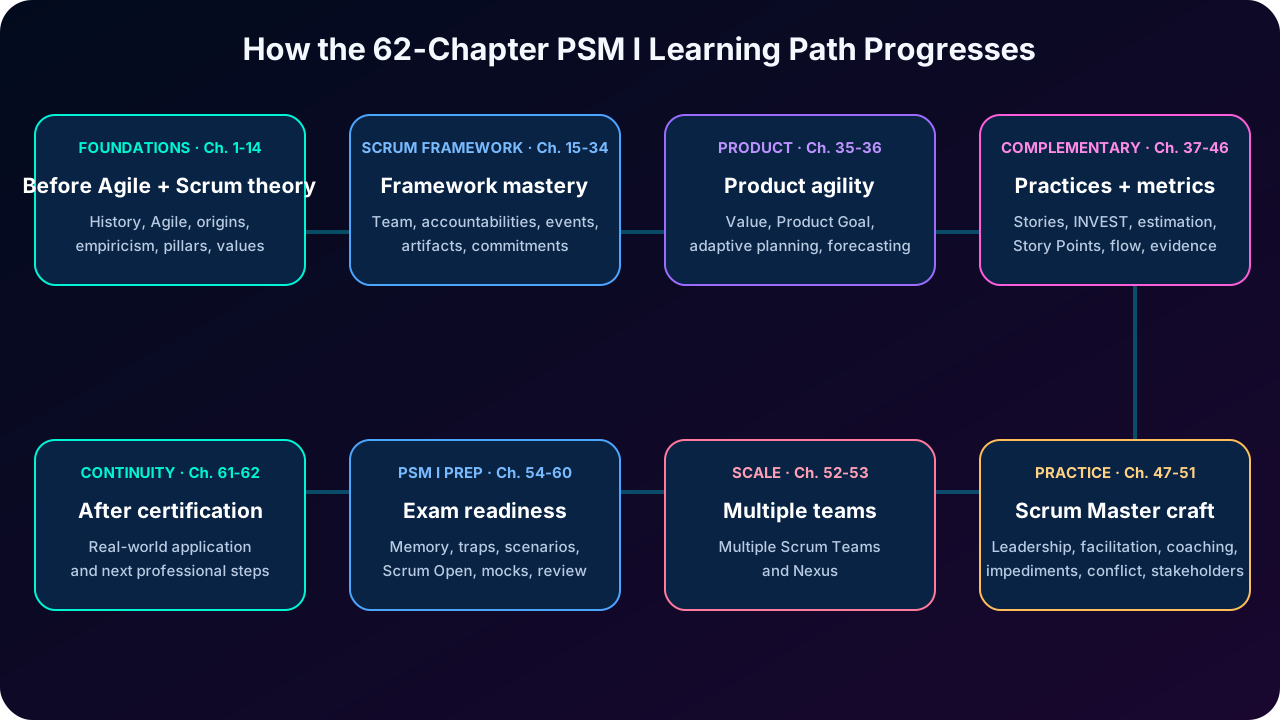
The syllabus is deliberately progressive. Chapters 1-53 build understanding; Chapters 54-60 convert that understanding into exam performance; Chapters 61-62 return the learner to professional growth after the exam.
Figure 1. The course moves from historical context to framework mastery, complementary practices, skills, scaling, exam preparation and post-certification growth.
PART I - UNDERSTANDING WHY EMERGED
The course begins before . It establishes why long feedback cycles, extensive upfront planning and changing requirements pushed software professionals toward more adaptive ways of working. This historical context prevents from becoming a set of rituals without a problem to solve.
Ch. / Time
Title
Coverage
1 · 20 min
Introduction to the Certification
Defines , who maintains it, what “” means, intended candidates, expected knowledge, preparation structure, the central role of the Scrum Guide, the difference between knowing and applying it, why experience alone does not replace framework study, and why exam answers must not be based on “how my company does it.”
2 · 25 min
Software Development Before
Explores traditional software project organization: extensive upfront planning, functional separation between analysis, development, testing and delivery, management, predictability versus uncertainty, why software differs from industrial production, and the cost of long feedback cycles.
3 · 25 min
The
Covers history and context; requirements, analysis, design, implementation, testing, deployment and maintenance; situations where can help; limitations under changing needs; late error discovery and validation; and the contrast between sequential and .
4 · 25 min
Complexity and Uncertainty in Projects
Differentiates simple, complicated and complex problems; examines changing requirements, markets and technology; user feedback; hypotheses versus facts; limits of predicting the whole project upfront; and the need for short learning cycles.
PART II - FOUNDATIONS
The second part introduces as a broader movement and mindset rather than a synonym for . The student learns the values and principles that shaped modern adaptive product development and how differs from traditional planning.
Ch. / Time
Title
Coverage
5 · 20 min
The Rise of the Movement
Reviews the software industry of the 1990s, , problems practitioners were trying to solve, the 2001 Snowbird meeting, the , as a mindset and principle set, and why is not one specific methodology.
6 · 25 min
The Four Values of the
Studies ,,, and Responding to change; explains the meaning of “over,” why the items on the right still matter, practical examples and common misinterpretations.
7 · 30 min
The 12 Principles of the
Examines all 12 principles individually and connects them to value delivery, changing requirements, short cycles, collaboration, motivation, communication, ,,, simplicity, and - while showing how several ideas later appear in .
8 · 25 min
vs. Traditional Software Development
Compares planning, scope, feedback, delivery, change management, customer participation, team organization, risk, metrics and learning. Clarifies iterative, incremental, adaptive and predictive approaches and when different approaches may be appropriate.
PART III - FOUNDATIONS
With the historical and context established, the roadmap moves into itself: origins, definition, ,, pillars and values. This is the conceptual base on which every later topic depends.
Ch. / Time
Title
Coverage
9 · 25 min
History and Origins of
Covers the origin of the name, Takeuchi and Nonaka’s “The New New Product Development Game,” Jeff Sutherland, Ken Schwaber, development in the 1990s, public presentation, the Scrum Guide, framework evolution and expansion beyond software.
10 · 25 min
What Is ?
Explains ’s definition as a lightweight framework for complex products and adaptive solutions, value generation, why is not a prescriptive methodology, its minimum structure, its ability to contain complementary practices, and what happens when essential elements are removed.
11 · 25 min
Explains knowledge from experience and observed evidence, the relationship between and complexity, feedback loops, , experimentation, hypotheses, validation and how operationalizes empirical control.
12 · 25 min
The Three Pillars of
Deeply studies Transparency, Inspection and Adaptation: visible information, shared understanding, , frequent inspection, detecting deviations, , timely adjustment and the core chain Transparency -> Inspection -> Adaptation.
13 · 20 min
and
Introduces waste reduction, focus on essentials, value creation, small cycles and the relationship between and , including why doing more work does not necessarily create more value.
14 · 25 min
The Five
Studies Commitment, Focus, Openness, Respect and Courage with definitions, examples, expected behavior, behavior that contradicts each value, and their relationship to and the .
PART IV - THE
This part turns theory into clear accountability boundaries. It explains who the is, how and work, and what , and are accountable for.
Ch. / Time
Title
Coverage
15 · 25 min
Structure
Covers the ,, and ; absence of -defined internal hierarchies and sub-teams; collective responsibility; recommended team size; focus on one ; and accountability for creating value.
16 · 25 min
and Teams
Explains ,, autonomy with accountability, who decides who does what and how work is performed, collaboration and complementary skills. It also distinguishes the older “” language from the current “” terminology.
17 · 30 min
Deep dive into accountability: maximizing value, ,, ordering and communicating PBIs, transparency, delegation without loss of accountability, the as one person, and relationships with stakeholders, and - including traps.
18 · 25 min
Explains who are in , creation of the ,,, daily planning and adaptation, professional and mutual accountability, quality and technical autonomy.
19 · 30 min
Deep dive into establishing , effectiveness, true leadership, , coaching, teaching, mentoring, facilitation, ,, and service to , and the organization. Emphasizes that the is not the ’s manager.
20 · 25 min
in the Organization
Examines the as : teaching , organizational adoption, barriers, stakeholder collaboration, culture change, structures, working with traditional organizations and improving organizational effectiveness.
PART V -
The event sequence is studied as a set of feedback loops rather than ceremonies. Each event has a specific purpose and and creates a formal opportunity for inspection and adaptation.
Ch. / Time
Title
Coverage
21 · 25 min
The
Covers the as the container for all other events, duration of one month or , start/end and continuous Sprints, , quality, refinement during the , scope adaptation, predictability and short learning cycles.
22 · 20 min
Explains when a may be cancelled, what it means for the to become obsolete, who has cancellation authority, responsibility, impacts, treatment of completed/unfinished work and common exam scenarios.
23 · 30 min
Explores the three planning topics - Why is this valuable? What can be Done? How will the work be done? - plus participation, ,, selected PBIs, Developer planning, forecast, initial and .
24 · 25 min
Explains purpose, Developer participation, 15-minute , progress inspection, , adaptation, freedom of format, the old three questions, why it is not a status meeting, ’s role, and good/bad examples.
25 · 25 min
Covers inspection of the outcome, stakeholder participation, feedback, environmental change, next steps, , value and collaboration. Explicitly distinguishes the Review from a presentation, demo, approval meeting or release gate.
26 · 25 min
Explores quality and effectiveness through people, interactions, processes, tools, , improvement identification and . Makes the essential distinction: Review -> product; Retrospective -> way of working.
27 · 20 min
Event Timeboxes
Explains for ,,, and ; durations for a one-month ; typically shorter events for shorter Sprints; why timeboxes exist; and common certification questions.
PART VI - ARTIFACTS AND COMMITMENTS
The roadmap then consolidates the information structures that make transparent. Each artifact is paired with its commitment so that work, goals and quality can be inspected against clear targets.
Ch. / Time
Title
Coverage
28 · 20 min
Overview of
Introduces , and and explains how they enable transparency, inspection and adaptation. Introduces their commitments: , and .
29 · 30 min
and
Covers the emergent ordered , Items, as long-term objective, backlog evolution, accountability, transparency, ordering, and refinement.
30 · 25 min
Explains refinement as ongoing activity rather than event; decomposition, clarity, size, ordering, Developer participation, role, continuous refinement, how much to do and preparation for future Sprints.
31 · 25 min
and
Explains components: , selected PBIs and plan to create the ; Developer accountability; continuous update and adaptation; scope flexibility; and protection of the .
32 · 25 min
Explains the as usable value, integration with previous Increments, multiple Increments in one , delivery before , relationship to and quality.
33 · 30 min
Deep dive into Done, as the commitment, transparency, quality, organizational standards, shared , work that fails the , incomplete PBIs, and evolution of the .
34 · 20 min
The Three Commitments
Consolidates -> , -> , -> ; explains each commitment’s purpose, how commitments improve transparency and focus, and their relationship with .
PART VII - MANAGING PRODUCTS WITH AGILITY
After learning the framework, the course widens the lens to : value, outcomes, and in complex environments.
Ch. / Time
Title
Coverage
35 · 25 min
Product, Value and
Explores product, value, stakeholders, users, customers, outcomes versus outputs, , product hypotheses, feedback, learning and value-based decisions.
36 · 25 min
and
Differentiates forecast from absolute commitment, addresses uncertainty and planning in complex environments, historical evidence, capacity, progressive planning, changes based on learning, releases and the relationship between planning and .
PART VIII - COMPLEMENTARY PRACTICES COMMONLY USED WITH
This part is intentionally labeled complementary. It presents practices many Teams use, while repeatedly reinforcing that these are not mandatory elements of . That distinction is especially important for .
Ch. / Time
Title
Coverage
37 · 25 min
User Stories
Explains User Stories, their origin, the common “As a / I want / so that” format, stories as conversation mechanisms, contrast with traditional requirements, , large versus small stories and the fact that User Stories are not mandatory in .
38 · 25 min
INVEST and Good User Stories
Covers Independent, Negotiable, Valuable, Estimable, Small and Testable; good and bad examples; ; and how INVEST can support .
39 · 20 min
Explains , their relationship to PBIs, examples, Given/When/Then, versus , and the difference between item-specific requirements and global product quality standards.
40 · 25 min
Fundamentals of Estimation
Explores why teams estimate, uncertainty, , complexity, effort, risk, size, estimate versus deadline, and Developer responsibility for .
41 · 20 min
Explains ,, Fibonacci-like scales, complexity, effort, uncertainty, comparison between items, problems converting points into hours and why are not mandatory in .
42 · 20 min
Explains purpose and flow, simultaneous estimates, divergence, discussion, collective knowledge, reducing premature influence, limitations and as an optional technique.
43 · 25 min
Covers , historical delivery, , -to- variation, why cross-team comparisons are problematic, Goodhart’s Law, the dangers of targets, and as a possible tool rather than a requirement.
PART IX - METRICS AND EVIDENCE
Metrics are framed as evidence for , not as productivity theater. The student learns to interpret flow, value and quality indicators while understanding why does not prescribe most of them.
Ch. / Time
Title
Coverage
44 · 25 min
Burndown and Burnup Charts
Explains Burndown and Burnup charts, axes, remaining work, completed work, scope, trends, limitations, inspection use and why does not require these charts.
45 · 25 min
Covers ,,,, Aging , bottlenecks, predictability and value flow, showing how can support .
46 · 25 min
Value and Quality Metrics
Explores delivered value, user satisfaction, quality, defects, availability, product usage, conversion, outcomes versus outputs, and technical versus business metrics. Warns against task-count productivity measures and comparing professionals through .
PART X - IN PRACTICE
The course now shifts from exam knowledge to the behavioral craft of helping teams and organizations improve. Leadership, facilitation, coaching and organizational dynamics become central.
Ch. / Time
Title
Coverage
47 · 25 min
and True Leadership
Contrasts traditional leadership and with servant/true leadership, influence without hierarchical authority, autonomy, trust and responsibility.
48 · 30 min
Teaching, Mentoring, Coaching and Facilitation
Differentiates teaching, mentoring, coaching and facilitation; shows when to use each stance, practical examples, the risk of a solving everything, and how interventions should develop autonomy.
49 · 25 min
Impediments
Defines impediments versus everyday problems, responsibility, Developer problem-solving, organizational barriers, dependencies, escalation and ways to avoid excessive dependency on the .
50 · 25 min
Conflict and Teams
Covers healthy conflict, psychological safety, collective responsibility, facilitation, communication, autonomy, collective decisions, when intervention is appropriate and team maturity development.
51 · 25 min
and Stakeholders
Explores stakeholder relationships, transparency, , feedback, collaboration, accountability for maximizing value, protection against and educating stakeholders about .
PART XI - MULTIPLE TEAMS AND SCALE
The roadmap distinguishes the for multiple teams working on one product from optional scaling frameworks. The purpose is to preserve product coherence, integration and shared quality.
Ch. / Time
Title
Coverage
52 · 25 min
with Multiple Teams
Explains multiple teams on one product, shared product identity, ,,,, integration, dependencies, communication and scaling challenges.
53 · 25 min
Introduction to
Introduces , its relationship with .org, the problem it addresses, multiple Teams on one product, dependencies, integration, the and additional events/artifacts at a high level. Explicitly clarifies that complements and is not part of basic in the Scrum Guide.
PART XII - SPECIFIC PREPARATION FOR
This part converts accumulated knowledge into exam performance. It focuses on recall, traps, situational reasoning, Open, mocks, a final Scrum Guide review and a readiness gate.
Ch. / Time
Title
Coverage
54 · 20 min
What Really Needs to Be Memorized
Consolidates 3 accountabilities, 5 events, 3 artifacts, 3 commitments, 3 pillars and 5 values - the high-value core facts and relationships for rapid recall.
55 · 30 min
Common Traps
Works through traps such as as manager, as committee, Daily as status, as approval/demo, Review vs Retrospective, assigning work, /User Stories//Burndown as mandatory, as official metric, release timing, , change and .
56 · 30 min
How to Solve Situational Questions
Teaches a 10-question reasoning method: identify accountability, event purpose, artifact, commitment, transparency, inspection, adaptation, , risk and whether the practice actually exists in the Scrum Guide. Includes commented examples.
57 · 20 min
Open Assessment
Explains what Open is, how to use it, why not to memorize questions, identifying gaps, recording errors, classifying by topic, reviewing the Scrum Guide and repeating until performance is consistently high.
58 · 25 min
Mock Exam Strategy
Covers realistic simulation, time management, easy questions first, multiple-answer questions, absolute words, eliminating -incompatible alternatives, answer review, post-mock error analysis, and the cycle Mock -> Analysis -> Scrum Guide -> Review -> New Mock.
Guides a final reading in which each element is tested through purpose, accountability, transparency, inspection, adaptation, related Value and what problem would appear if the element were removed.
60 · 20 min
Readiness Checklist
Checks whether the student can explain without notes, , pillars, values, accountabilities, events, artifacts, commitments, , vs ,, optional practices, situational questions, timed mocks and consistently high Open performance.
PART XIII - AFTER
The final section makes an important point: certification is a milestone, not the end of professional development. The roadmap closes by connecting exam knowledge to actual growth and a broader learning journey.
Ch. / Time
Title
Coverage
61 · 25 min
Applying in the Real World
Explores the difference between passing the exam and being a , team observation, facilitation, coaching, experimentation, Retrospectives, metrics, organizational culture, and communities.
62 · 20 min
Next Steps in the Journey
Maps possible next steps: II, III, , complementary certifications, , Product Management, facilitation, coaching, , metrics, leadership and - above all - practical experience as the main engine of growth after certification.
Estimated Study Load and How to Use the Roadmap
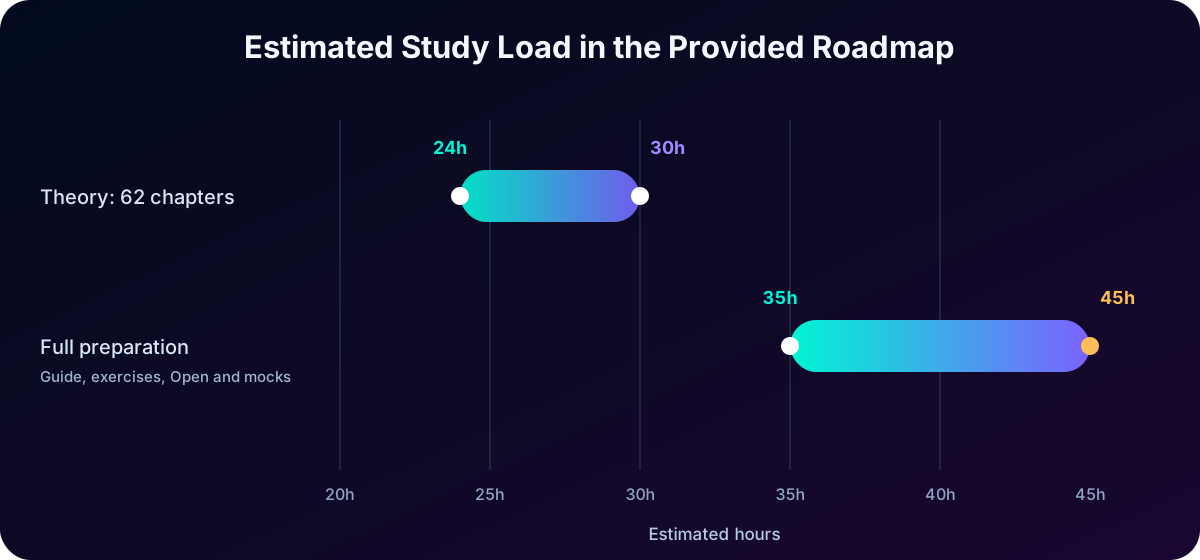
The provided roadmap estimates 24 to 30 hours of theoretical study for the 62 chapters, because most chapters are intentionally designed for roughly 20 to 30 minutes. The chapters are small enough to study independently without forcing the learner through very large blocks.
When the Scrum Guide, exercises, review, Open, commented questions and full mock assessments are added, the complete preparation is estimated at roughly 35 to 45 hours. The exact time should remain empirical: a learner with strong experience may move faster in some areas, while someone coming from predictive project management may need more deliberate practice around , value and .
Figure 2. Estimated workload from the provided course roadmap.
A practical pace
At two chapters per study day, the 62-chapter path takes 31 study days. At five study days per week, that is a little over six weeks - before adding extra time for weak areas, the Scrum Guide and full mock assessments.
Practical Example: How a Learner Moves Through the Path
Imagine a software engineer who has participated in “ projects” for three years but has never read the Scrum Guide carefully. In the first week, the learner discovers that many company habits - fixed , a assigning work and a used as approval - are not . Parts I-III give the historical and empirical context needed to understand why.
During Parts IV-VI, the learner rebuilds the framework around accountability boundaries, event purpose, artifacts, commitments and . Instead of memorizing isolated facts, the learner can now explain why own the , why the allows scope flexibility, and why is not a release gate.
Parts VII-X broaden the skill set. The learner studies value, , estimation and metrics, but also learns not to confuse or with requirements. Leadership chapters then show why a grows autonomy rather than becoming the team’s operational manager.
Parts XI-XII create the final certification layer. The learner understands how multiple teams can work on one product, recognizes as complementary, then drills the high-value memory structure, common traps, situational reasoning, Open, mocks and the final readiness checklist.
After passing the exam, Part XIII prevents the most important mistake of all: believing the learning is finished. Certification becomes the beginning of real practice - observing teams, facilitating, coaching, experimenting, using evidence and joining professional communities.
What Success Should Look Like Before the Exam
A learner who completes this roadmap well should be able to do more than repeat terminology. Before attempting , the learner should be able to:
Explain from memory as a coherent framework based on and .
Name and distinguish the three accountabilities, five events, three artifacts, three commitments, three pillars and five values.
Explain , and and connect each one to the correct artifact.
Reason through situational questions using accountability, event purpose, transparency, inspection, adaptation and .
Identify optional practices without promoting them into requirements.
Use Open diagnostically rather than as a question bank to memorize.
Complete fresh mock assessments inside the real time constraint with consistent accuracy and controlled review behavior.
The real goal
The certificate is an outcome of the learning path, not the only reason for it. The stronger result is a reader who can recognize real , explain why its design matters, and continue developing professional judgment after the assessment.
Conclusion: Build the Right Mental Model Before You Build Speed
The most important lesson of an introductory chapter is simple: preparation begins with a correct mental model of . The certification is maintained by .org and validates a fundamental level of mastery, including understanding the framework, the accountability, and how is applied. It is suitable for aspiring Masters and for many other professionals involved in complex product delivery, but it does not reward job titles or years of experience automatically.
The Scrum Guide is the primary reference because it contains the official definition of . Read it repeatedly, but do not reduce your study to memorization. Learn the purposes and relationships behind the words. Understand why depends on transparency, inspection, and adaptation. Understand how the support behavior. Understand why accountabilities are separated, why the team is , and why the artifact commitments create focus and transparency.
Most importantly, learn to detect the difference between and “ as practiced in my company.” Real organizations add governance, tools, approval flows, reporting practices, estimation techniques, and local terminology. Some additions are useful; some are harmful. None changes the definition of . The assessment expects you to reason from the framework first.
My view is that this is one of the certification's greatest strengths. A good preparation process does more than help you answer exam questions. It forces you to separate principles from habits. That skill is valuable in any organization because improvement starts when teams can identify which constraints are necessary, which are optional, and which exist only because “we have always done it this way.”
As you continue to the next chapters, keep one question in mind whenever appears simple: “What problem is this element trying to solve in a complex environment?” If you keep asking that question, the framework stops being a collection of ceremonies and starts becoming a coherent system for learning, focus, value, and adaptation. That is the level of understanding on which success is built.
Exam Snapshot
Provider
.org
Details verified
August 2026
Current price
USD 200 per attempt
Assessment length
60 minutes
Questions
80
Passing score
85%
Typical formats
Multiple choice, multiple answer, and true/false
Course prerequisite
No
Practice assessment
Open
Assessment password
Does not expire until used; valid for one attempt
Certificate validity
Lifetime; no annual renewal fee
Core reference
The Scrum Guide (current official version: November 2020)
Key Takeaways
validates foundational mastery, not just memorized terminology.
.org maintains the certification program; Ken Schwaber founded .org in 2009.
The Scrum Guide is the primary source of truth for what is and is not.
Professional experience helps only when you separate contextual practice from the official framework.
The most common reasoning error is answering from company habits instead of from .
Study should progress from framework definition to relationships, situational reasoning, and timed practice.
Official References Used for This Chapter
.org - About .org - .org explains that the organization was founded by co-creator Ken Schwaber and provides training, certification, and resources.
.org - training and certification pages - Current course and certification information confirms the 85% passing threshold and the focus on understanding ,, the accountability, , and effective product delivery.
.org - Suggested Reading for - Official preparation guidance to master the Scrum Guide, distinguish practices that are not part of , explain the framework, and use Open diagnostically.
.org - Where is the Scrum Guide? - Explanation that the Scrum Guide is the definitive source for and that professional assessments require interpretation and application, not only reading.
scrumguides.org - Official Scrum Guide download page - The official current Scrum Guide is the November 2020 edition by Ken Schwaber and Jeff Sutherland.
The Scrum Guide, November 2020 - Primary source for the definition of , its accountabilities, events, artifacts, commitments, values, and empirical foundation.
Course Roadmap - CAPITULOS.txt - Author-provided 13-part, 62-chapter study syllabus used as the basis for the complete curriculum overview in this chapter.
Note: Assessment details can change over time. Always verify current exam information on .org before purchasing or taking the assessment.