Assertions, bindings, metadata, XML signatures, SSO, and identity federation in enterprise environments
In-depth edition - study material and professional reference
By João Ricardo Dutra••Complete material
Chapter presentation
Previous chapters studied OAuth 2.0, OpenID Connect, and the JOSE family. These standards dominate modern applications and APIs, but they have not completely replaced the enterprise federation mechanisms built before them. SAML 2.0 remains widely present in corporate portals, SaaS systems, academic environments, governments, banks, and cross-organization integrations that require browser-based Single Sign-On and standardized attribute exchange.
SAML, short for Security Markup Language, is an XML framework for communicating authentication assertions, attributes, and authorization decisions. Its best-known use is the Web Browser SSO , in which an Identity Provider authenticates the user and sends a signed SAML to the Service Provider. However, understanding the visual flow of redirection alone is insufficient. Security depends on bindings, , certificates, XML signature validation, temporal conditions, audience, recipient, correlation and replay protection.
Unlike a simple bearer token transported directly to an API, the SAML response is typically consumed by a specific Service Provider endpoint called an Consumer Service. The validates the message and creates its own local session. This separation explains why SAML is especially suited to federated login for web applications, but less natural for delegated authorization of APIs and service-to-service calls.
This chapter builds a complete mental model of SAML 2.0: actors, assertions, protocol messages, bindings, profiles, ,, attributes, signature, encryption, Single Logout, federation and integration with gateways. The focus is to enable secure design, review and troubleshooting, without reducing the standard to copying certificates between two administrative consoles.
How to study this chapter
Always separate four layers: , protocol message, and . Then, follow the trust relationship described in and validate each security restriction. This decomposition makes SAML much less confusing and avoids mixing transport, identity and session.
Learning Objectives
Explain the responsibilities of principal, Identity Provider, Service Provider, and SAML authorities.
Distinguish , protocol message, , and .
Describe authentication statements, attributes and authorization decisions.
Detail the Web Browser SSO in -initiated and -initiated modes.
Interpret , Response, , Subject, Conditions and .
Compare HTTP-Redirect, HTTP-POST, HTTP-Artifact and SOAP bindings.
Understand ,, SSO Service, Service, KeyDescriptor and certificate rotation.
Apply secure XML Signature validation and recognize signature wrapping and replay.
Understand , attributes, identity mapping, and discovery.
Compare SAML 2.0 with OpenID Connect and recognize the role of identity gateways and brokers.
Chapter structure
19.1 SAML 2.0 Fundamentals and Components
19.2 Assertions and statements
19.3 Protocol messages
19.4 Web Browser SSO
19.5 -initiated and -initiated SSO
19.6 in depth
19.7 Response and in depth
19.8 Conditions, and correlation
19.9 SAML Bindings
19.10 and trust
19.11 XML Signature and encryption
19.12 , attributes and mapping
19.13 Sessions, and discovery
19.14 SAML x OIDC, gateways, security and troubleshooting
Summary, checklist, exercises, glossary and references
19.1 SAML 2.0 Fundamentals and Components
SAML organizes the federation into entities with well-defined roles. The principal is normally the user. The Identity Provider, or , authenticates this principal and issues claims. The Service Provider, or , offers the application and trusts the assertions produced by the according to a previously configured relationship. In broader scenarios, there may also be Attribute Authorities, Authentication Authorities and Policy Decision Points.
The pattern is made up of complementary pieces. Core defines assertions and protocol messages. Bindings describe how these messages are transported over protocols such as HTTP or SOAP. Profiles combine assertions, messages and bindings to solve concrete use cases, such as browser SSO or Single Logout. describes entities, endpoints, supported bindings, identifiers, certificates, and other information necessary for interoperability.
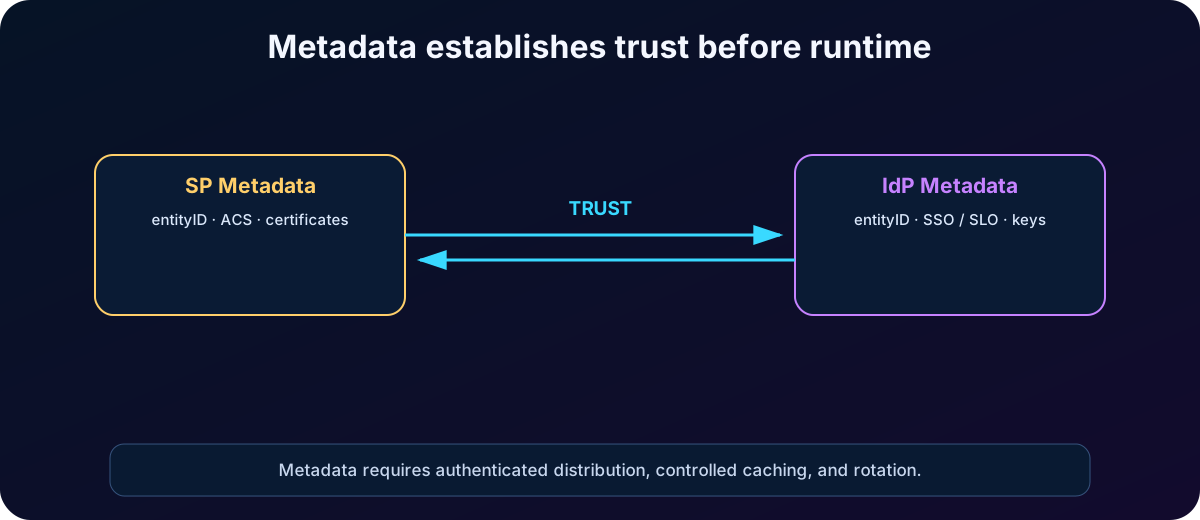
The trust relationship does not arise because a message contains a certificate. The must know in advance the of the and the keys accepted for signing. Likewise, the needs to know the of the , its endpoints and, depending on the policy, the keys used by the . is the standard mechanism for distributing this information, but obtaining and updating it also needs to be authenticated and governed.
Table 1 - SAML layers must be analyzed separately.
Concept
Responsibility
Example
Contains statements about a subject.
Authenticated user with MFA and corporate attributes.
protocol
Coordinates SAML requests and responses.
and Response.
Defines the transport of the message.
HTTP-Redirect or HTTP-POST.
Combines rules for a use case.
Web Browser SSO .
Publishes identity, endpoints, and keys.
EntityDescriptor of the or .
19.2 Assertions and statements
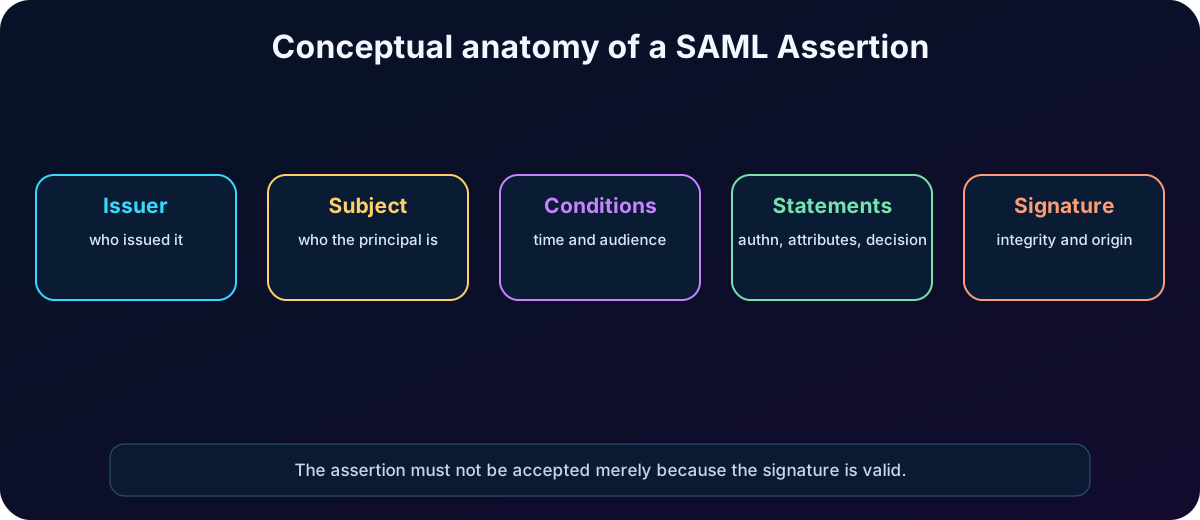
A SAML is an XML structure issued by an authority and related to a subject. It has identifier, version, issue time, issuer and zero or more statements. It may also contain a signature, conditions and information on how the subject must confirm its identity to the recipient.
The Authentication Statement records that an authority authenticated the subject at a given time and context. It can include SessionIndex, SessionNotOnOrAfter and AuthnContextClassRef, elements used by applications that need to distinguish password, MFA, certificate or other methods. The Attribute Statement carries name and value pairs, such as internal identifier, email, organizational unit, or groups.
The Authorization Decision Statement represents an authorization decision about a resource, but is less common in modern Web SSO. In practice, many SPs use authentication attributes and context to power their own local policies. This choice preserves domain autonomy, but requires clear agreements on semantics, cardinality, namespaces, and handling of missing attributes.
Figure 1 - A secure combines origin, subject, restrictions, statements and cryptographic protection.
Table 2 - Statements carry different semantics within the .
statement
Main statement
Recurring use
AuthnStatement
How and when the user was authenticated.
SSO, step-up and audit.
Attributes associated with the subject.
Logical provisioning and local authorization.
AuthzDecisionStatement
Decision on action on appeal.
Specific and legacy integrations.
19.3 Protocol messages
SAML protocol messages coordinate interactions between entities. asks for authentication; Response carries one or more assertions or an error status; LogoutRequest and LogoutResponse participate in Single Logout; ArtifactResolve and ArtifactResponse retrieve messages by reference; AttributeQuery and AuthnQuery query specialized authorities.
Each message has ID, Version, IssueInstant and, depending on the type, Destination, Consent, and other attributes. These fields are not decorative. The ID allows for correlation and replay protection. Destination restricts the expected endpoint. links a response to a previously issued request. IssueInstant assists with temporal validation and investigation of misaligned clocks.
The Response status needs to be interpreted before the . Success indicates that the main processing is complete, but does not override all validations. Other codes may represent requester error, reply error, authentication failed, unsupported method, unknown user, or lack of consent.
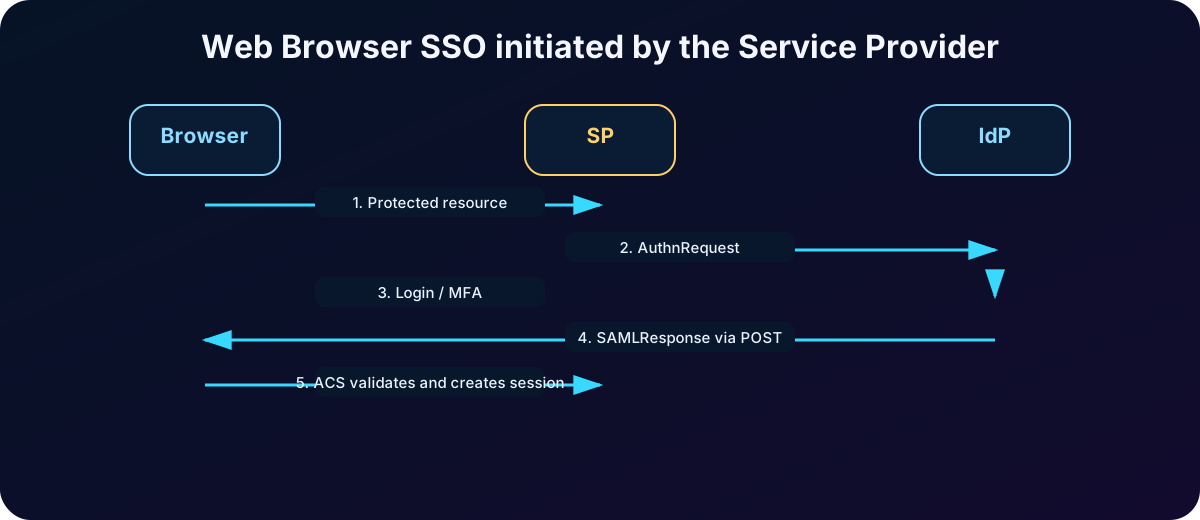
The Web Browser SSO is the most well-known use of SAML 2.0. The browser acts as an intermediary between and . When the user accesses a protected resource, the creates an and redirects or sends the browser to the . The authenticates the user, creates the Response, signs the or the response itself according to the agreement and returns the result to the 's Consumer Service.
The receives the message, performs structural, cryptographic and semantic validations and, if everything is correct, creates a local application session. SAML does not define how this local session should be implemented. It may use a secure cookie, server-side session or other mechanism. This means that post-login security also depends on classic controls such as Secure, HttpOnly, SameSite, expiration, rotation and fixation protection.
preserves application state, such as the resource originally requested. It should not be treated as a trusted authorization channel and needs to be protected against open redirect and tampering. The implementation must only accept predicted targets or opaque values stored server-side.
Figure 2 - In -initiated SSO, the Response must be correlated to the original .
19.5 -initiated and -initiated SSO
In -initiated SSO, the flow starts at the Service Provider. The creates an , registers its ID, and expects a correlated response. This model allows better control of context, destination and return to the requested resource. validation mitigates cold-response attacks and helps associate authentication with the correct transaction.
In -initiated SSO, the flow starts in an portal or application catalog. The sends an unsolicited Response to the 's . This mode is convenient for corporate portals, but it loses correlation with an . The implementation needs to compensate for this reduction in context with strict controls on issuer, audience, recipient, time, replay and allowed destinations.
Some applications support both modes. In this situation, the validation code must clearly distinguish between requested and unsolicited responses. It's not safe to simply make optional in all cases. The policy needs to define when -initiated is accepted, for which IdPs, ACSs and business flows.
Table 3 - The two modes require different validation policies.
Appearance
-initiated
-initiated
Home
User accesses the .
User leaves the portal.
It exists and must be tracked.
Normally absent.
Correlation
and local state.
There is no original request.
Additional risk
Open redirect and request tampering.
Replay and unsolicited response.
Table 3 - The two modes require different validation policies.
19.6 in depth
The communicates to the which requests authentication and, optionally, which characteristics it wants. Issuer identifies the . Destination points to the endpoint. AssertionConsumerServiceURL or AssertionConsumerServiceIndex selects the . ProtocolBinding can indicate how the Response should return. NameIDPolicy requires identifier format and may allow creation of a new pseudonym.
ForceAuthn requests the to reauthenticate the user even if an SSO session exists. IsPassive asks that the not interact with the user; If silent authentication cannot be performed, the response should indicate appropriate failure. RequestedAuthnContext expresses requirements about authentication method or strength, but its interpretation needs to be aligned between the parties.
Signing may be required by policy, especially when the sends dynamic , requests ForceAuthn, or operates in federations with strong requirements. In Redirect , the signature occurs over URL parameters and not over a ds:Signature element within the XML. In POST , the message can carry XML Signature. Confusing these two forms is a common cause of failure.
Table 4 - controls more than a simple redirect.
Field
Function
Validation or policy
Issuer
Identifies the requesting .
Must match trusted .
Destination
endpoint.
Exact comparison with the received endpoint.
URL/Index
Response destination.
Only values recorded in .
ForceAuthn
Requests new authentication.
Apply only as per policy.
RequestedAuthnContext
Authentication requirement.
Map classes and comparison correctly.
19.7 Response and in depth
The Response is the protocol message delivered to the . It has Issuer, Status, Destination, and can contain assertions. In many profiles, Response and can be signed in different combinations. The policy must define exactly which signature is required and on which element, avoiding inconsistently accepting partially protected messages.
The contains the statements consumed by the application. The must find the authenticated by a validated signature, and not simply the first with a given XPath. This rule is central against , an attack in which a valid signed element is moved and another malicious element is placed in the location that the application processes.
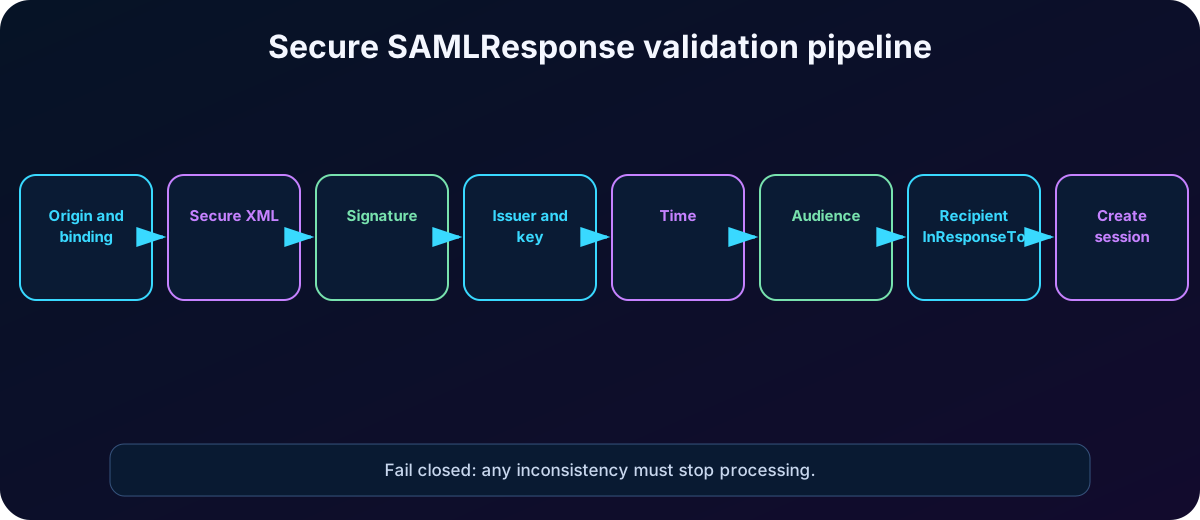
A full validation also checks Issuer, Version, IssueInstant, Conditions, AudienceRestriction, SubjectConfirmationData, Recipient, NotOnOrAfter, , AuthnStatement, and required context. After validation, attributes must be mapped by explicit rules. The fact that an XML has been signed does not make all values suitable for the application.
Estrutura simplificada de Response e Assertion
<samlp:Response Destination="https://app.example/saml/acs"
                    InResponseTo="_a12f...">
  <saml:Issuer>https://idp.example/metadata</saml:Issuer>
  <samlp:Status>...</samlp:Status>
  <saml:Assertion ID="_assertion123">
    <saml:Subject>...</saml:Subject>
    <saml:Conditions>...</saml:Conditions>
    <saml:AuthnStatement>...</saml:AuthnStatement>
    <saml:AttributeStatement>...</saml:AttributeStatement>
  </saml:Assertion>
</samlp:Response>
19.8 Conditions, and correlation
Conditions restrict when and where the can be used. NotBefore defines the starting instant, and NotOnOrAfter defines a unique limit. AudienceRestriction indicates the entities for which the was issued. The application must compare the audience with its expected identifier and use small and controlled clock tolerance, without transforming clock skew into a wide replay window.
typically uses the bearer method in Web Browser SSO. SubjectConfirmationData carries Recipient, NotOnOrAfter and . Recipient needs to match the actually used. must point to a pending when the flow was initiated by the . An already processed response must be marked as consumed to prevent replay.
Correlation also involves , temporary cookies, and local state. These elements do not replace each other. relates the Response to the ; returns application context; the temporary session stores information about the transaction. A robust design maintains all links and removes the state after use.
Figure 3 - Signing is a pipeline step, not complete validation.
19.9 SAML Bindings
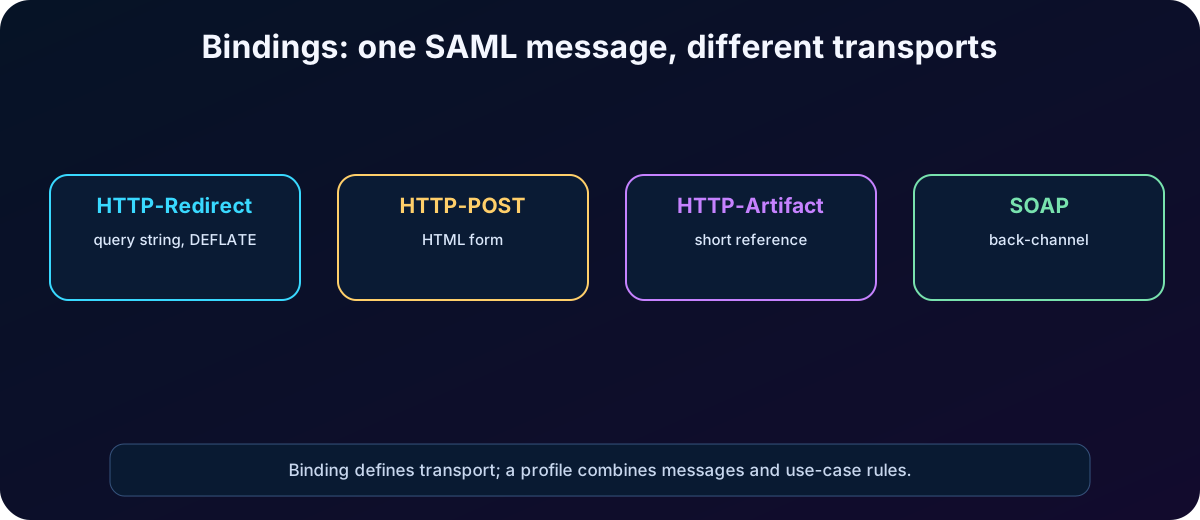
defines how a SAML message is mapped to another protocol. In HTTP-Redirect , the message is normally compressed with DEFLATE, encoded in Base64 and placed in the query string. It's suitable for small AuthnRequests, but has URL limits and specific signature rules around SAMLRequest, , and SigAlg.
In HTTP-POST , the Base64 message is sent in an HTML form, usually by auto-submit. It is the most common to transport SAMLResponse to . As the browser delivers content from one domain to another, the endpoint needs to accept POST, protect local session and fully validate the message before any redirection.
HTTP-Artifact only sends a short reference via the browser. The exchanges the artifact for the actual message in a back-channel, typically with SOAP. This reduces exposure to the user agent, but adds availability, authentication and latency to the artifact resolution service. SOAP also appears in back-channel queries and Single Logout.
Figure 4 - is transport; the defines how this transport participates in the use case.
Table 5 - Each has its own format and operational risks.
Typical usage
Technical point
HTTP-Redirect
in the browser.
DEFLATE, URL encoding and parameter signature.
HTTP-POST
SAMLResponse for .
HTML form with Base64 message.
HTTP-Artifact
Front-channel reference.
Message resolution via back-channel.
SOAP
Consultations and direct exchange.
Server-to-server channel with XML SOAP.
19.10 and trust
SAML describes entities through EntityDescriptor. An is a stable identifier, often a URI, but does not need to be an accessible URL. Role descriptors inform whether the entity acts as an , or other authority. Endpoints include , location, index, and preference. KeyDescriptor publishes certificates associated with signing or encryption.
usually contains endpoints, formats and certificates. contains SingleSignOnService, SingleLogoutService, certificates, and other resources. The consumer must only accept endpoints and keys from trusted sources. Allowing arbitrary coming only from can turn the into a transmitter of assertions for an attacker.
Certificate rotation requires overlap. The new certificate must be published before it can be used; the old one remains while messages and caches can still depend on it. Expired certificate in should not be treated simplistically: the use of X.509 in SAML is often as a key container, but corporate policies may require additional validations. The important thing is to have explicit and auditable rules.
Figure 5 - reduces manual configuration, but needs reliable distribution chain.
Exemplo simplificado de metadata de SP
<md:EntityDescriptor entityID="https://app.example/saml">
  <md:SPSSODescriptor AuthnRequestsSigned="true"
      protocolSupportEnumeration="urn:oasis:names:tc:SAML:2.0:protocol">
    <md:KeyDescriptor use="signing">...</md:KeyDescriptor>
    <md:AssertionConsumerService
       Binding="urn:oasis:names:tc:SAML:2.0:bindings:HTTP-POST"
       Location="https://app.example/saml/acs"
       index="0" isDefault="true"/>
  </md:SPSSODescriptor>
</md:EntityDescriptor>
19.11 XML Signature and encryption
XML Signature protects the integrity and authenticity of XML elements. It references an element by ID, applies transforms, canonicalization and digest and produces SignatureValue. Canonicalization exists because semantically equivalent XML can have differences in whitespace, namespaces, and attribute ordering. The implementation must use mature libraries and a strict policy on algorithms, transforms and references.
The attack exploits divergence between the verified element and the consumed element. The core defense is to resolve the signed reference securely, require unique IDs, reject unexpected structures, and process exactly the authenticated node. Generic XPath queries like looking for the first in the document are dangerous when they are not tied to cryptographic verification.
XML Encryption allows you to encrypt the , the or attributes. The uses the 's public encryption key, and the decrypts with its private key. Signing and encryption solve different problems: encryption protects confidentiality along the way and at intermediaries; signature protects integrity and origin. Even an encrypted needs to be validated after decryption.
Table 6 - Cryptographic controls are complementary.
Cryptographic control
Protects
Does not replace
Response Signature
Protocol and destination message.
Validation of and conditions.
Signature
Declarations and restrictions.
Session correlation and protection.
EncryptedAssertion
Content confidentiality.
Authenticity and audience.
TLS
Channel between participants.
End-to-end signature of the message.
Implementation Rule
Never implement XML Signature manually with string concatenation or improvised XPath. Use specialized library, maintain hardened XML parser, disable external entities and validate structure, IDs and references before consuming attributes.
19.12 , attributes and identity mapping
identifies the subject in standardized formats. Persistent produces a stable and generally opaque identifier. Transient creates a temporary value. EmailAddress uses email, but may be unsuitable as an immutable key. Unspecified depends on bilateral agreement. The choice must consider privacy, correlation between SPs, data changes and account lifecycle.
Attributes are identified by Name and, optionally, NameFormat and FriendlyName. The should not rely solely on informal names such as role or group without a contract. It is necessary to define namespace, type, cardinality, authoritative origin and meaning. A directory group may not equate to a business permission, and automatic mappings may inappropriately elevate privileges.
Account linking deserves care. When the receives a federated subject, it needs to link it to a local account. Linking via email only may allow takeover if different providers issue the same address or if email verification is not equivalent. The recommended key typically combines issuer and stable subject identifier, with controlled processes for migration.
Table 7 - Identifiers and attributes need a contract, not just valid XML.
Format/element
Feature
Caution
persistent
Stable and opaque by relation.
Preserve link during migration.
transient
Temporary and non-correlated.
Do not use as a permanent key.
emailAddress
Readable and familiar.
It may change and not be globally unique.
attribute
Additional value on the subject.
Define semantics, origin and cardinality.
19.13 Sessions, Single Logout and discovery
There are at least two distinct sessions: the user session on the and the local session on the . The AuthnStatement can contain SessionIndex and SessionNotOnOrAfter, but the decides how to create and expire its cookie. Terminating the session does not automatically terminate all local sessions unless Single Logout is supported and works across the chain.
Single Logout coordinates LogoutRequest and LogoutResponse between participants. You can use front-channel through the browser or back-channel. In practice, partial failures are common: an unavailable , blocked cookie or timeout can leave sessions active. Therefore, should not be treated as a substitute for short sessions, local revocation and own risk controls.
Discovery appears when an accepts multiple providers. The choice can be made by user domain, portal, discovery cookie or dedicated service. The interface should avoid phishing and confusing selection. In broad federations, aggregated and discovery services need to be operated with signature, expiration, filters and governance.
19.14 SAML 2.0 x OpenID Connect
SAML 2.0 and OpenID Connect resolve federated authentication, but they have different models and ecosystems. SAML uses XML, assertions, bindings and browser profiles. OIDC uses OAuth 2.0, JSON, JWT, HTTP and Discovery/JWKS endpoints. OIDC tends to fit better into mobile applications, SPAs, APIs and modern architectures; SAML remains very strong in enterprise SaaS and legacy B2B integrations.
The comparison should not be reduced to old versus new. SAML has rich , mature federations, and consolidated interoperability across many enterprise products. OIDC offers better alignment with APIs, modern libraries, and JSON tokens. An organization can operate both for many years, using an identity broker to translate protocols and centralize policies.
Translation between SAML and OIDC is not mere syntactic conversion. , subject, attributes, , acr, amr, session and logout have different semantics. The broker needs explicit mappings, trust policy, and observability so that the authentication guarantee is not degraded during the transformation.
Table 8 - The standards overlap in objective, but not in all details.
Appearance
SAML 2.0
OpenID Connect
Format
XML and XML Signature.
JSON, JWT and JOSE.
Dominant use
Corporate Web SSO and B2B federation.
Web, mobile apps, APIs and modern identity.
Discovery
SAML .
Discovery and JWKS.
Identifier
and attributes.
sub and claims.
Session and logout
for SAML messages.
RP-Initiated and OIDC logout channels.
19.15 SAML in API Gateways and Identity Brokers
API Gateways typically secure APIs with OAuth, JWT, mTLS tokens, or technical credentials. SAML can appear in developer portal authentication, administrative console login, or as an identity broker input protocol. When a SAML application needs to call APIs, the common pattern is to exchange the federated session with an appropriate access token, and not send the SAML directly to all backends.
Some gateways can validate SAML assertions, extract attributes and transform them into context or internal tokens. This capability must be used with care: the gateway needs to validate signature, issuer, audience, recipient, time and replay with the same rigor as an . You should also avoid turning generic attributes into broad privileges without explicit policy.
In hybrid architectures, a broker can receive SAML from partners and issue OIDC/OAuth for modern applications. This bridge reduces the need for each API to understand XML Signature, but focuses trust on the broker. Logs must record external issuer, federated subject, authentication method, mappings and issued token, preserving end-to-end traceability.
19.16 Threats and hardening
The main threats include replay, invalid signature or wrong element, unexpected issuer acceptance, inadequate audience, open ,, XML parser vulnerable to external entities, weak algorithms, tampered , session theft, open redirect via and insecure attribute mapping.
Hardening starts with and allowlists, authenticated , modern algorithms, accurate endpoint validation, unique IDs, replay caches, tight clock tolerance, and fail closed. The XML parser must disable DTD and external entities. The application should only process signed elements and reject messages with ambiguous structure, duplicate signatures or unexpected references.
The operation also matters. Certificates need inventory, alerts, and rotation with overlap. Clocks must use reliable synchronization. Attribute and changes require regression testing. Logs should not store complete assertions unnecessarily, because they may contain personal data and authentication information.
Table 9 - Most failures occur in validation and integration, not in the concept of SAML.
Threat
Flaw exploited
Control
Replay
Valid reused.
ID caching and short time windows.
Signature wrapping
Verified element differs from consumed one.
Process exactly the referenced and signed node.
injection
Destiny controlled by the attacker.
Only endpoints registered in .
XXE
Parser resolves external entity.
DTD and external entities disabled.
Privilege mapping
Attribute becomes excessive permission.
Explicit mapping and least privilege.
19.17 Evidence-driven troubleshooting
Troubleshooting must identify the exact point in the flow: creation of the , redirection, authentication at the , issuance of the Response, delivery to the , cryptographic validation, attribute mapping or session creation. Browser, gateway, and application errors may appear similar, so request IDs, timestamps, entityIDs, and endpoints are essential.
Messages such as invalid signature can result from incorrect certificate, canonicalization, altered XML, disallowed algorithm, or checking the wrong element. Audience invalid points to divergent . Recipient mismatch indicates different . Response expired could be a misaligned clock, long queue or small window. unknown points to lost state, multiple nodes not sharing a session, or unsolicited response.
Capture tools must be used in authorized environments and with care not to expose assertions. The ideal diagnosis compares active , request issued, response received, selected certificate and application configuration. In clusters, check affinity, request ID storage, and clock for all nodes.
Table 10 - SAML diagnostics requires correlation between message, and local state.
Symptom
Hypotheses
Evidence
Invalid signature
Wrong key, changed XML, algorithm or reference.
Certificate, SignedInfo, Reference URI and library logs.
Audience mismatch
different from expected.
AudienceRestriction and configuration.
unknown
Lost status or unsolicited response.
Request ID, temporary cookie and cluster node.
expired
Clock skew or excessive delay.
NotBefore, NotOnOrAfter and hosts time.
User without permission
Missing attribute or incorrect mapping.
and local policy.
19.18 Case studies and labs
Case Study 1: A company integrates its corporate with an external SaaS. requires persistent and specific groups. The team defines two-sided , signing certificates, attribute mapping, rotation window, and multi-unit user testing. The project initially failed because the email was used as an immutable key; the fix adopts stable identifier and controlled migration.
Case study 2: a banking portal accepts partners via SAML and converts the identity into internal tokens for APIs. The broker validates the , applies issuer policy and , maps the external subject to a partner application and issues access token with restricted audience. The gateway never receives the original on the backends, reducing XML exposure and centralizing federation.
Case Study 3: An cluster experiences intermittent failures. The cause is local storage of the on each node without shared affinity or session. The browser starts at one node and returns to another. The fix uses distributed storage of pending requests and maintains replay cache throughout the validity window.
Suggested labs
1) Examine and and identify ,, SSO, and certificates. 2) Decode an and a Response from the laboratory environment. 3) List all validations in addition to the signature. 4) Simulate certificate rotation with overlapping period. 5) Compare a SAML flow with Authorization Code + OIDC.
Chapter summary
SAML 2.0 is an XML federation framework based on assertions, protocol messages, bindings, profiles and . Its most common use case is Web Browser SSO between an Identity Provider and a Service Provider. The authenticates the principal, issues claims, and the validates the message before creating its own local session.
Security depends on much more than a valid signature. Issuer, audience, recipient, destination, , time, , replay, XML structure and need to be validated coherently. and insecure parsing demonstrate why mature libraries and effectively signed element processing are indispensable.
SAML remains relevant in enterprise and B2B federations, while OpenID Connect is a better fit for modern applications and APIs. Identity brokers enable coexistence and translation, but need to preserve semantics and traceability. On API platforms, SAML typically authenticates users to portals or enters the broker, which then issues appropriate tokens to the APIs.
Next step of the course
Chapter 20 will delve deeper into Identity Federation and Single Sign-On as an architecture, comparing trust domains, brokers, home realm discovery, provisioning, lifecycle and coexistence between SAML, OpenID Connect and other mechanisms.
Implementation and review checklist
EntityIDs, endpoints, and bindings come from trusted, versioned .
IDs are unique and stored until Response correlation.
accepts only registered destinations and rejects messages for another recipient.
The library validates XML Signature and the application consumes exactly the signed element.
Issuer, audience, destination, recipient, and temporal conditions are checked.
Processed assertions are recorded in the replay cache during the required window.
XML Parser disables DTD, external entities and dangerous constructions.
and attributes have a semantic, cardinality and origin contract.
Mappings of groups to permissions follow least privilege and have tests.
Certificates have inventory, monitoring, overlay, and rollback plan.
Local Session uses secure cookies and does not rely solely on Single Logout.
Logs preserve correlation without storing unnecessary personal data.
Exercises
Differentiate between , protocol message, , and .
Describe the -initiated SSO flow and indicate where is validated.
Explain why a valid signature is not sufficient to accept an .
Compare HTTP-Redirect, HTTP-POST, HTTP-Artifact and SOAP bindings.
Explain the role of AudienceRestriction, Recipient and SubjectConfirmationData.
Differentiate between Response signature and signature.
Describe and the main defense rule.
Propose certificate rotation without downtime.
Compare persistent, transient and emailAddress .
Explain why may partially fail.
Compare SAML 2.0 and OpenID Connect in an enterprise architecture.
Design a SAML to OAuth/OIDC bridge using an identity broker.
Glossary
Table 11 - Essential vocabulary of the chapter.
Term
Definition
Consumer Service; endpoint of the that receives the Response.
XML structure with declarations about a subject.
Statement that carries attributes of the subject.
Information about the authentication method or strength.
Message from the that requests authentication from the .
Mapping SAML messages to another protocol.
Stable identifier of a SAML entity.
Identity Provider that authenticates and issues statements.
Correlation between Response and previous request.
Entity description, roles, endpoints, bindings and keys.
Subject identifier in defined format.
Set of rules for a SAML use case.
Application state carried by the browser flow.
Single Logout coordinated between participants.
Service Provider that consumes assertions and offers the application.
Rules by which the subject presents the .
Attack that separates verified element from consumed element.
Technical references
OASIS. Assertions and Protocols for the OASIS Security Markup Language (SAML) V2.0.
OASIS. Bindings for the OASIS Security Markup Language (SAML) V2.0.
OASIS. Profiles for the OASIS Security Markup Language (SAML) V2.0.
OASIS. for the OASIS Security Markup Language (SAML) V2.0.
OASIS. Security Markup Language (SAML) V2.0 Technical Overview.
OASIS. SAML V2.0 Interoperability Version 1.0.
W3C. XML Signature Syntax and Processing.
W3C. XML Encryption Syntax and Processing.
OWASP. SAML Security Cheat Sheet.
NIST. Digital Identity Guidelines, when applicable to the context of authentication and federation.
Update note
SAML 2.0 is a stable standard, but products, allowed algorithms, interoperability profiles, and hardening practices continue to evolve. Before deploying, validate official documentation for the ,, gateway and library used, including signing behavior, and rotation.