Identity, context, policies, enforcement, proof of possession, microsegmentation, and adaptive decisions per request
In-depth edition - study material and professional reference
By João Ricardo Dutra••Complete material
Chapter presentation
Traditional security architecture was built around network boundaries. Users, servers and applications located within a corporate network received, explicitly or implicitly, a greater level of trust. This model lost effectiveness as APIs began to connect clouds, partners, mobile devices, suppliers, SaaS applications, data centers and ephemeral workloads. The origin of a connection remains relevant as a signal, but is no longer sufficient to decide whether an operation should be authorized.
Zero Trust is a set of principles and an architectural strategy based on eliminating implicit trust. Resources are protected individually or in small groups; subjects and devices are identified; access decisions use current policies and information; communications are protected; and telemetry is used to continually improve posture. The objective is not to distrust people in a generic way, but to prevent location, ownership or past authentication from producing broad and permanent authorization.
APIs are a natural point to apply Zero Trust because they already materialize operations, identities, data and policies. An API Gateway can act as a Policy Enforcement Point at the edge, while service meshes apply controls between workloads. Identity providers issue credentials and tokens; posture mechanisms provide context; policy drivers make decisions; and observability records what happened. However, purchasing a gateway, enabling mTLS, or requiring MFA does not alone create a .
This chapter connects the fundamentals of identity, OAuth, mTLS, API Gateways, policies, service mesh, Kubernetes and observability studied previously. The focus is technical and operational: how to model subjects and resources, how to evaluate each request, how to limit privileges, how to reduce lateral movement, how to handle failures in decision components and how to evolve the deployment without interrupting critical integrations.
How to study this chapter
For each flow, identify: subject, resource, action, context, identity source, decision engine, enforcement point and recorded evidence. This decomposition transforms the term Zero Trust into verifiable architecture.
Learning Objectives
Explain Zero Trust without reducing it to product, VPN, mTLS or multi-factor authentication.
Relate the principles of NIST SP 800-207 to the design of corporate APIs.
Distinguish ,, Policy Enforcement Point, , and .
Model human identities, applications, workloads, devices and sessions.
Apply contextual authorization and least privilege to API operations and data.
Understand bearer tokens, pegged tokens, mTLS, and in the context of replay reduction.
Design Zero Trust controls in API Gateways, service meshes and Kubernetes.
Combine , controlled egress, data protection and observability.
Define availability, caching, , and strategies for policy decisions.
Plan a maturity journey with metrics, testing, governance and adaptive response.
Chapter structure
35.1 What Zero Trust is and isn’t
35.2 Logical principles and components
35.3 Protected resources, subjects and surfaces
35.4 Decision by request and dynamic trust
35.5 Human identity, application, workload and device
35.6 Tokens, mTLS and proof of ownership
35.7 Granular authorization and policy architecture
35.8 API Gateways as enforcement points
35.9 Service mesh, Kubernetes and east-west traffic
35.10 , egress and data protection
35.11 Telemetry, risk and adaptive response
35.12 Availability, governance, maturity and troubleshooting
Summary, checklist, exercises, glossary and references
35.1 What Zero Trust is and isn’t
Zero Trust is a security model, a set of design principles, and a coordinated management strategy. Its premise is that threats can exist within and outside traditional boundaries and that no element should be given implicit trust solely by location, ownership or organizational relationship. Protection moves from broad network segments to specific users, devices, workloads, applications, data and resources.
The term does not mean blocking everything, manually re-authenticating the user with every click, or completely eliminating private networks. It means that each access needs to be supported by identity, policy and context sufficient for the risk of that action. A request to read public data and an irreversible financial transaction do not necessarily require the same authentication strength, the same set of signals or the same authorization validity time.
There is also no single product called Zero Trust. Identity providers, gateways, service meshes, EDRs, policy engines, data catalogs, SIEMs and observability platforms can participate in the architecture. Value arises from the coherent integration between these components, the quality of policies, the coverage of resources and the ability to measure and react to deviations.
An internal network can still reduce exposure, and a firewall remains useful. The mistake is to transform presence on this network into sufficient proof of identity and authorization. Similarly, mTLS authenticates the ends of a channel, but does not itself define whether service A can perform operation X on resource Y on behalf of user Z.
Table 1 - Zero Trust should be understood as an architecture and process, not as a product brand.
Affirmation
Assessment
Explanation
Zero Trust is the total absence of trust.
Incorrect.
Trust is no longer implicit and becomes explicitly assessed and limited.
VPN implements Zero Trust.
Incomplete.
VPN creates connectivity; does not guarantee granular authorization or continuous assessment.
mTLS is sufficient.
Incorrect.
Authenticates peers, but needs policies, business identity and data controls.
Every request must be evaluated.
Correct as a principle.
The assessment can use local decisions, secure caching, and current signals as per risk.
35.2 Logical principles and components
NIST SP 800-207 describes principles that can be applied directly to APIs: resources and services are treated as assets; all communication is protected regardless of location; access is granted per session and with least privilege; decisions consider identity, asset status, behavior and context; and the organization collects information to continually improve posture.
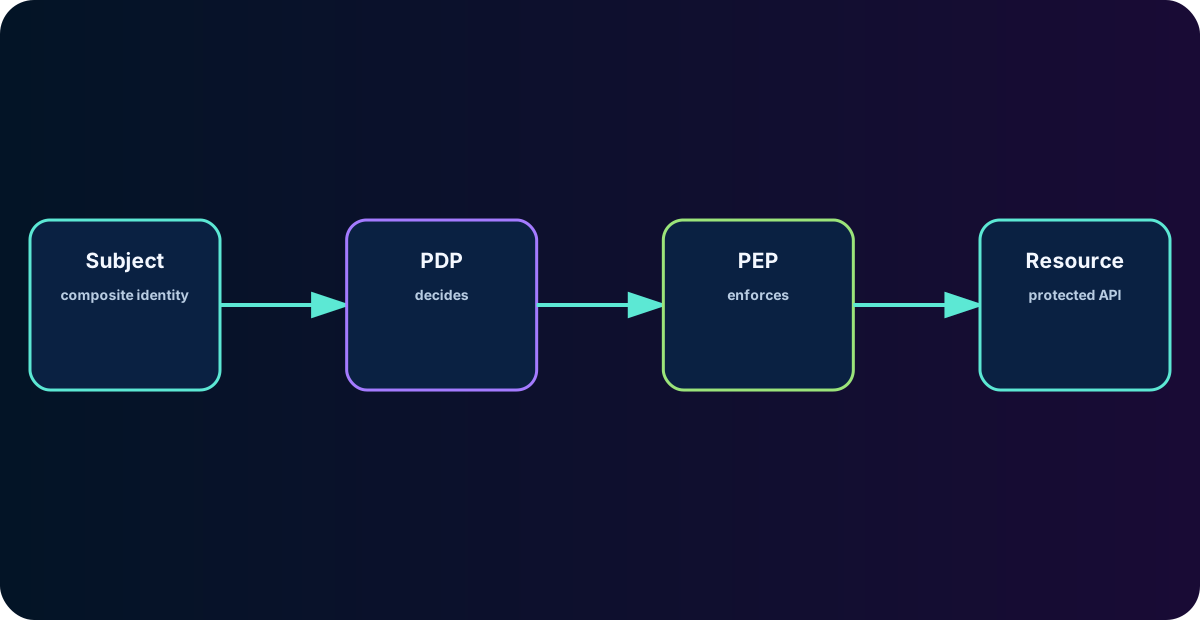
In NIST's logical architecture, the makes the decision to grant, deny, or revoke access. The executes this decision, for example by configuring or terminating a session. The Policy Enforcement Point enables, monitors, and terminates the connection between the subject and the resource. On an API platform, the gateway, a mesh proxy, a sidecar or the backend itself can play the role of enforcement.
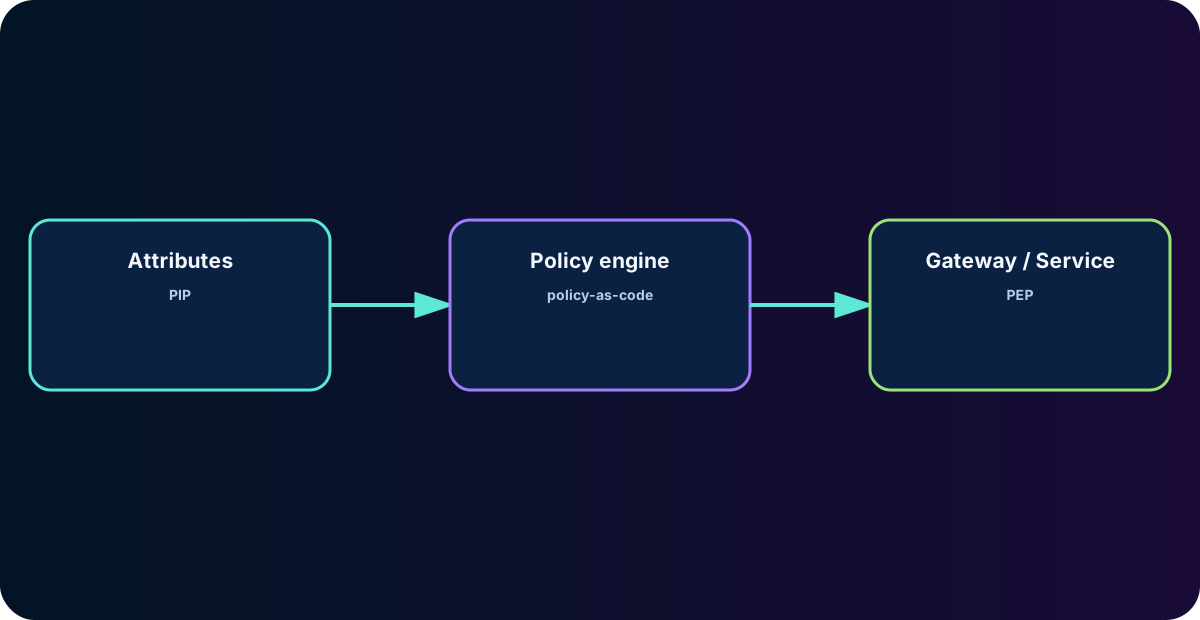
Authorization terminology used in software architectures often complements this model with ,,, and . Policy Decision Point evaluates the policy; the Policy Information Point provides attributes; the Policy Administration Point administers policies; and the Policy Enforcement Point enforces the decision. Names vary between products, but responsibilities need to remain clear to avoid blind spots and conflicting decisions.
A decision can be binary, but advanced architectures also generate obligations: require step-up, mask fields, reduce transactional limit, activate reinforced logging, impose specific rate limit or forward the operation for approval. These obligations need to be supported by enforcement and audited as part of the outcome.
Figure 1 - Decision-making and enforcement are distinct functions, fed by multiple signal sources.
35.3 Protected resources, subjects and surfaces
Zero Trust starts by identifying the resources that truly need protection. In APIs, the resource is not just the hostname or the endpoint. It can be an operation, a record, a sensitive field, a dataset, a queue, a secret, a signing key, or an administrative function. The more precise the classification, the more granular the policy can be.
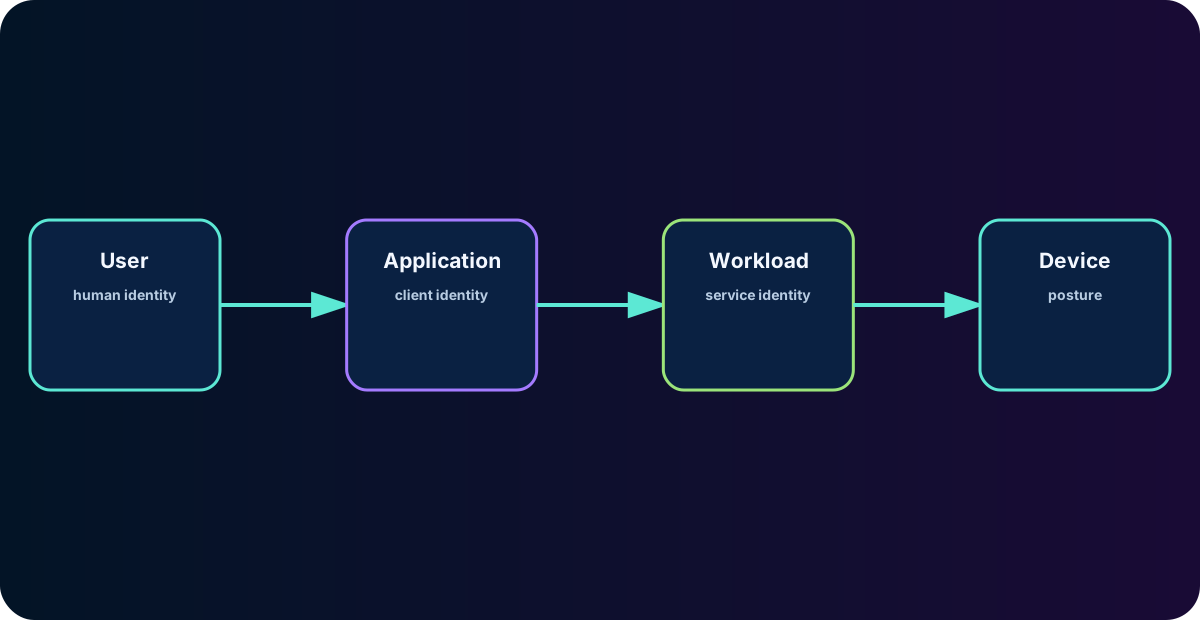
The subject also needs to be modeled correctly. The same request can carry the identity of the end user, the client application and the intermediate workload. In delegated flows, the backend needs to distinguish who is acting and on whose behalf. Losing this distinction produces generic tokens, incomplete logs, and excessive privileges.
The protected surface includes public interfaces, B2B integrations, internal APIs, administrative endpoints, messaging channels, and external dependencies. The inventory must list owner, processed data, authentication method, exposure, consumers, criticality and policies. Unknown, old, or test APIs are difficult to bring into a Zero Trust strategy because they have no risk context or governed lifecycle.
Data classification influences the decision. An authenticated consumer can receive basic fields but not full financial data. A workload authorized to read one record may not have permission to export thousands of records. The principle of least privilege needs to cover volume, purpose, time, context, and object properties.
Different identities participate in the same call
Figure 2 - The effective identity of a call is made up of several layers, not just the user.
35.4 Decision by request and dynamic trust
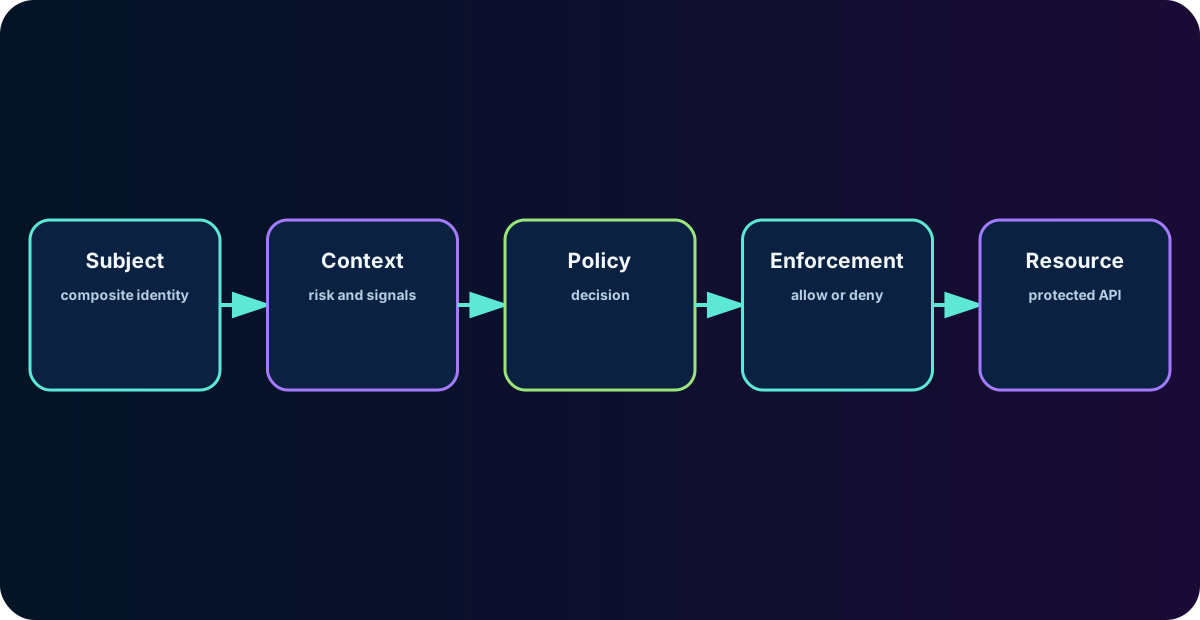
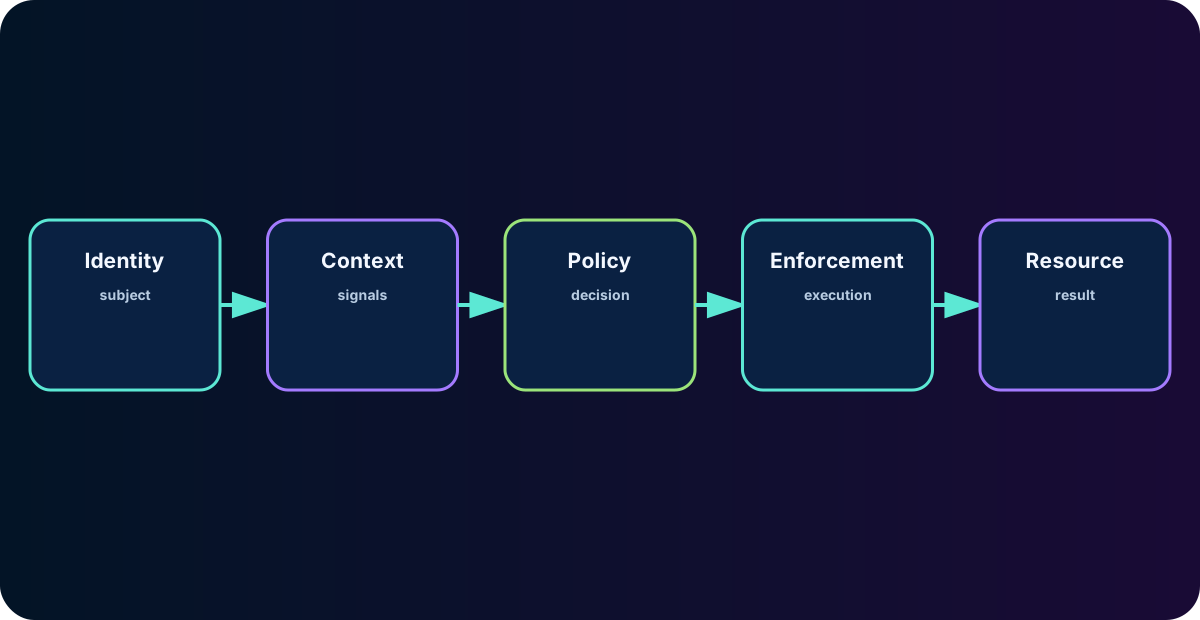
In an API, the practical decision unit is typically the request or a short session associated with a limited set of operations. The gateway identifies the subject, validates the credential, extracts claims, queries attributes when necessary and evaluates the policy applicable to the method, path, resource and context. Authorization should not be inferred merely because a previous connection was accepted.
Dynamic confidence means that the outcome can change when the signals change. A user authenticated with MFA may lose access if the device is compromised, the location becomes incompatible, the token is revoked, or the session risk increases. In critical applications, sensitive actions may require re-authentication, additional proof, or out-of-band confirmation.
Continuous evaluation does not imply that each call depends on dozens of remote services. Policies can be compiled and distributed to local PDPs; attributes can have short TTLs; low-risk decisions can be cached; and revocation events can invalidate state. The challenge is to balance timeliness, availability, latency and security.
The design needs to specify behavior when signals are unavailable. A public query API may operate in a degraded fashion, while a high-value transfer must deny access if the , anti-fraud service, or posture confirmation cannot be queried. and are decisions per class of operation, not global options.
Figure 3 - Authorization is a sequence of identification, contextual assessment, decision and enforcement.
35.5 Human identity, application, workload and device
Human identity is typically established by an identity provider with multi-factor authentication and risk policies. The resulting token must have an appropriate issuer, subject, audience, scopes, time and authentication level. Corporate groups are useful, but often too broad for fine-grained authorization; attributes of function, unit, relationship and context can complement the decision.
The client application is also a subject. In OAuth 2.0, the client_id identifies the registered software and the client type influences the available controls. Confidential clients authenticate to the token endpoint; Public customers depend on PKCE and environmental protection. In B2B integrations, the identity of the organization and partner system must be separated from the identity of the end user.
avoids static credentials shared between services. Short-lived certificates, SPIFFE IDs, managed identities, and tokens designed for service accounts allow you to bind the call to the running instance or service. In Kubernetes, ServiceAccounts and identity federation with the cloud reduce the need for permanent secrets in Pods.
The device provides additional signals: logging, integrity, versioning, encryption, EDR posture, and compliance. These signals should not be confused with the user's identity. A valid person on an unmanaged device can be granted limited access; a valid workload on a compromised node may require quarantine. Mature policies combine the dimensions without transforming one of them into absolute trust.
Table 2 - Zero Trust combines identities and signals without assuming that a single attribute is sufficient.
Identity
Examples of evidence
Use in politics
User
sub, acr, amr, groups, risk.
Allowed actions, step-up and segregation of duties.
Application
clientid, certificate, software statement.
Consumer, channel, quotas and scopes.
Workload
SPIFFE ID, managed identity, ServiceAccount.
Calls between services and access to backends.
Device
registration, posture, EDR, version.
Adaptive access and privilege reduction.
35.6 Tokens, mTLS and proof of ownership
Bearer tokens are used by whoever owns them. If they are copied from compromised logs, memory, browser or channel, they can be reused until they expire or are revoked. Therefore, they need protected transport, secure storage, restricted audience, minimum scopes and short lifespan. Zero Trust does not eliminate bearer tokens, but it reduces their scope and assumes that leaks are possible.
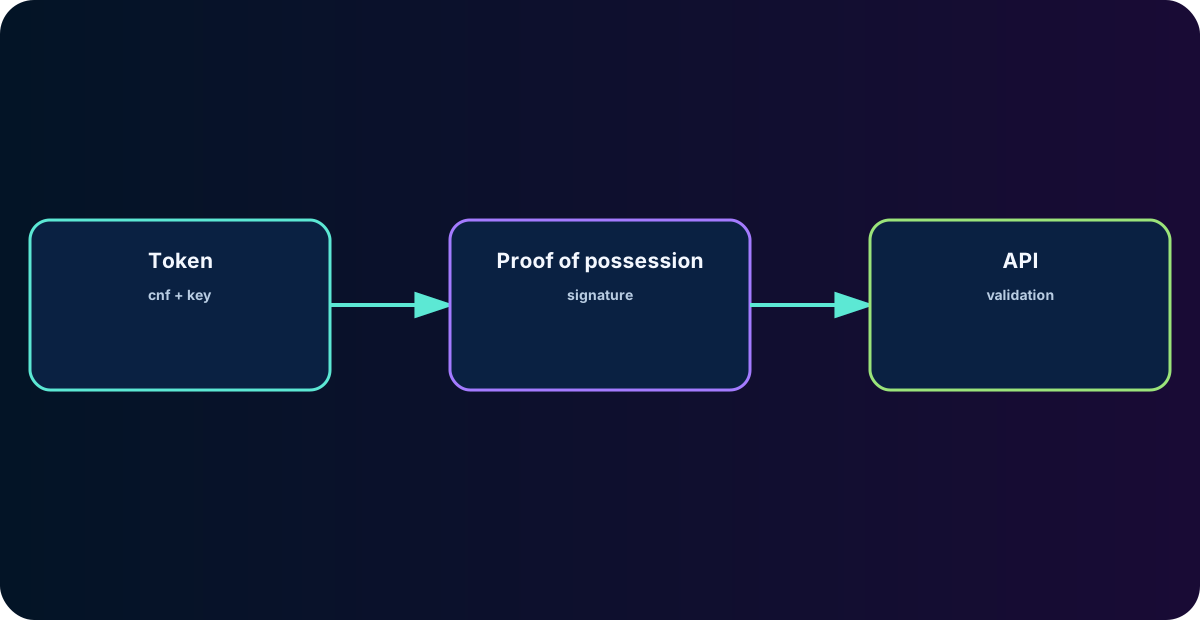
Sender-constrained tokens bind token usage to a cryptographic key. In OAuth, mTLS can bind the token to the client certificate, while uses an application-level signed proof and binds the token to a public key. The resource server validates not only the token, but also the demonstration of possession of the corresponding key.
mTLS is especially suited to server-to-server integrations, workloads, and environments with operational PKI. can be used by clients who are unable to conveniently present TLS certificates. Both reduce the value of a stolen token, but do not prevent misuse by a compromised legitimate client nor do they replace authorization and replay protection of the operation itself.
In high-risk APIs, proof-of-possession must be combined with idempotence, message signing when necessary, specific audience and anomaly detection. Broad tokens, long duration, and indiscriminate propagation between microservices contradict least privilege, even if they are cryptographically linked.
Figure 4 - Linking the token to a key adds a cryptographic condition for its use.
Table 3 - Proof of Possession improves token replay resistance, but requires correct validation and operation.
Mechanism
Evidence presented
Typical usage
Caution
Bearer
Just the token.
General APIs and common OAuth flows.
Strict leakage protection.
OAuth mTLS
Client certificate in TLS.
B2B and workloads with PKI.
Certificate lifecycle and TLS termination.
Proof JWT signed by request.
Application clients and HTTP APIs.
Validation of htm, htu, iat, jti and nonce when used.
35.7 Granular authorization and policy architecture
RBAC is useful for stable responsibilities, but is rarely sufficient alone for complex APIs. ABAC allows you to combine attributes of the subject, resource, action and environment. ReBAC represents relationships, such as principal, representative or member of an organization. Policies can combine these models as long as they remain understandable, testable, and auditable.
The architecture needs to define where the decision occurs. A gateway can query a central , use local policy-as-code, or combine decisions. The backend remains responsible for rules that depend on the business state and for preventing direct access that bypasses the gateway. In a service mesh, authorization between workloads can occur in the proxy, while object authorization remains in the application.
PIPs provide directory attributes, CMDB, device inventory, data classifiers, risk, and context. The manages policies and their lifecycle. For production, policies need versioning, review, unit testing, simulations with historical traffic, approval, gradual rollout and rollback.
The result of the decision must be explainable. Logs do not need to expose the entire policy, but should record decision identifier, policy version, subject, resource, action, result and main reason. This evidence is essential for auditing, troubleshooting and incident investigation.
Figure 5 - Authorization depends on non-circumvent enforcement and a governed chain of policies and attributes.
API Gateway is a natural for north-south traffic. It can terminate TLS, validate tokens, verify certificates, query PDPs, apply rate limits, remove external credentials, propagate controlled identity, and record decisions. Its central position facilitates consistency, but does not authorize turning the gateway into the sole security component.
The gateway must validate issuer, audience, signature, time, token type and mandatory claims. Generic policies based only on token presence generate a false sense of protection. The route must be associated with an explicit authorization policy, and administrative endpoints must have even more restrictive controls.
The identity propagated to the backend needs to be protected against spoofing. Internal headers must be removed from the external request and recreated by the gateway; the channel to the backend must be authenticated; and the service needs to accept these headers only from authorized sources. Alternatively, the gateway can exchange the token for a specific audience token or use workload credentials.
High availability requires evaluating gateway dependencies: introspection, JWKS, , KPS, directories, and risk services. Caches must respect expiration, revocation and versioning. Metrics should separate authentication failures, policy denials, unavailability, backend error, and threshold blocks.
Table 4 - The gateway needs to produce diagnostics per step, without returning sensitive details to the consumer.
Step at the gateway
Zero Trust Control
Fault that must be differentiated
TLS/mTLS
Protected channel and peer identity.
Invalid certificate, SNI, CA or revocation.
Token
Issuer, audience, signature, time and cnf.
Invalid, expired or unlinked token.
Politics
Subject + action + resource + context.
Legitimate denial or unavailable.
Propagation
Headers or controlled internal token.
Spoofing, wrong audience or excessive claims.
35.9 Service mesh, Kubernetes and east-west traffic
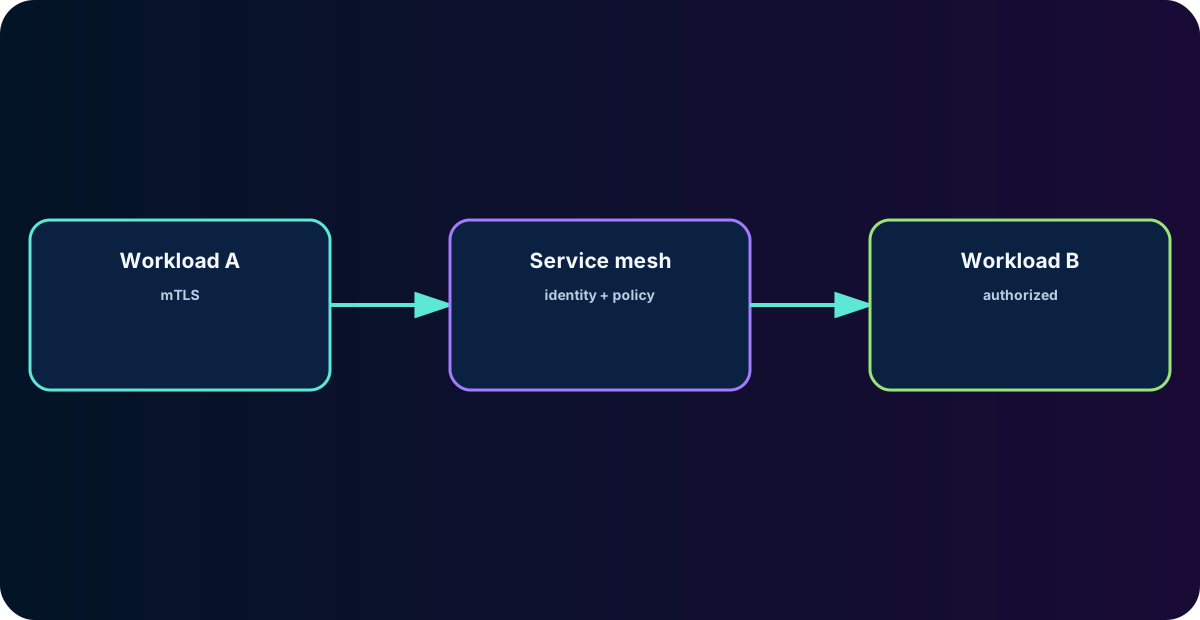
Edge security does not prevent lateral movement if internal services trust any source on the network. A service mesh can provide automatic mTLS, , and L4/L7 authorization between services. Each call becomes associated with the , regardless of the ephemeral IP or the node on which the Pod is running.
In Kubernetes, identity can come from ServiceAccounts and be federated with cloud providers. Pods should not share long-lived static credentials. RBAC controls actions on the cluster's API, while mesh policies and NetworkPolicies control workload communications. These mechanisms act on different planes and need to be designed together.
The mesh policy can restrict which workloads call which service, port, method, or path. For authorization on behalf of the user, the proxy can evaluate propagated claims, but origin and integrity must be guaranteed. The backend remains necessary for decisions based on objects, balances, relationships or business state.
Gradual adoption should avoid the belief that permissive mode is an end state. First, the traffic would be inventoried; then, mTLS and identity are enabled; then explicit policies replace broad permissions. Telemetry helps detect hidden dependencies before blocking.
Figure 6 - The mesh reduces implicit trust between workloads and allows enforcement close to the service.
35.10 , egress and data protection
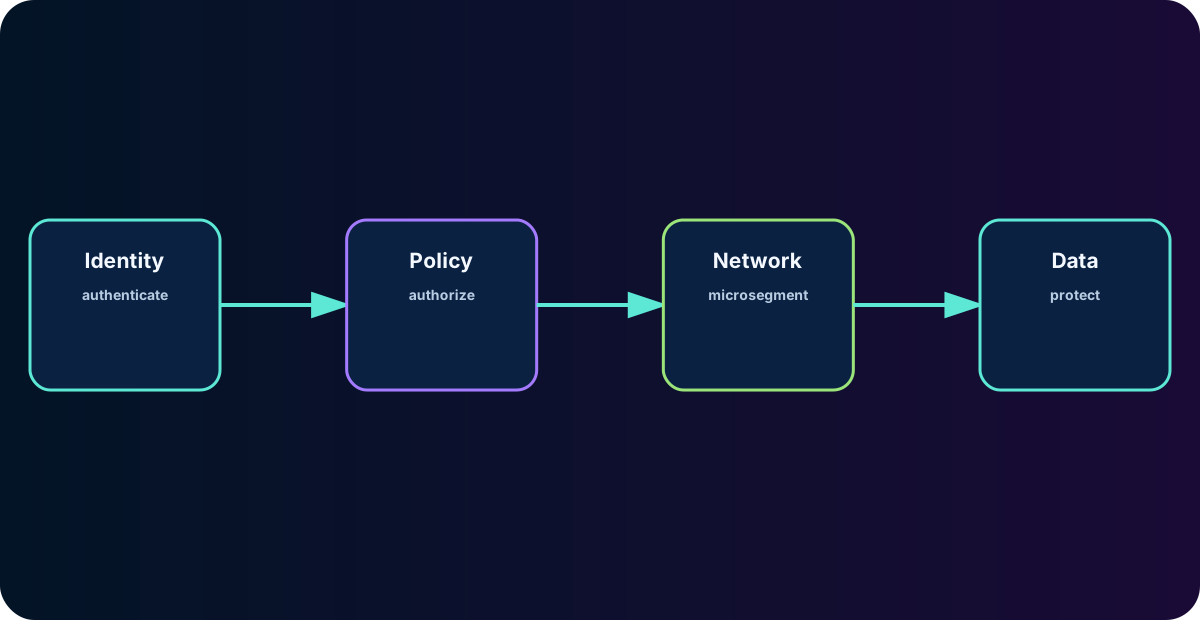
limits communication paths to reduce attack surface and impact radius. In APIs, segmentation can use , namespace, domain, sensitivity, and purpose, rather than relying solely on IP addresses. NetworkPolicies, mesh policies, firewalls and internal gateways can cooperate, as long as ownership and precedence are defined.
Controlled egress is an important part of the model. A compromised workload must not be able to access any Internet destination, cloud metadata, or internal service. Egress gateways, name and identity allowlists, controlled DNS, proxies, and monitoring help limit exfiltration and SSRF. Rules must consider resolution, redirects, private IPs, protocols and destination changes.
Zero Trust is resource and data driven. Encryption in transit and at rest is necessary, but policies also need to control minimization, masking, finalization, retention, and export. An API that returns unnecessary fields or allows unlimited pagination may violate least privilege even with strong authentication.
Secrets, keys, and certificates must have scope, rotation, and usage track. Access can be mediated by identity-aware proxies, secret stores and managed identities. Credentials shared between services prevent selective assignment and revocation, increasing the impact radius of a compromise.
Table 5 - is just one layer of a resource-oriented strategy.
Layer
Objective
Control example
Network
Reduce possible paths.
NetworkPolicy, firewall and egress gateway.
Identity
Link call to verifiable subject.
mTLS, and token.
Application
Restrict action and object.
ABAC, ReBAC and resource authorization.
Data
Minimize exposure and impact.
Masking, classification and export limits.
35.11 Telemetry, risk and adaptive response
Adaptive decisions depend on reliable telemetry. IdP, gateway, mesh, endpoint, WAF, SIEM and application produce signals that may indicate anomaly: location changes, unusual volume, object enumeration, repeated failures, degraded device posture, new certificate or non-standard access. These signals need to be normalized, correlated, and evaluated with latency compatible with the use case.
The answer doesn't have to be just blocking. The architecture may require MFA, reduce scopes, rate limit, disable export, mark the session for review, or revoke credentials. The choice must consider the impact and reliability of the detector. Overly aggressive controls without feedback create unavailability and encourage permanent exceptions.
Zero Trust Observability needs to record decisions, not just traffic. Useful metrics include per-policy allow/deny ratio, latency, cache hit, attributeless decisions, propagation failures, stale credential usage, mTLS coverage, uninventoried flows, and revocation time. Traces help identify which or backend made the final decision.
Privacy and security of the signals themselves need to be considered. Authorization logs can contain identifiers, groups, risk, and context. Collection must be minimized, protected by access and retention, and never include full tokens, private keys, or unnecessary sensitive data.
Continuous scanning is not indiscriminate surveillance
Collection must be proportional, finalistic and protected. Zero Trust requires sufficient signals for decisions and investigation, but does not justify recording credentials, sensitive payloads or attributes without operational need.
35.12 Availability and failures of trust components
A adds critical components to the path: IdP, JWKS, introspection, ,, risk service, and certificate infrastructure. Each dependency needs SLO, redundancy, timeout, cache, fallback and runbook. A secure policy that makes all APIs unavailable due to simple failure is operationally incomplete.
Public key caching is usually secure when respecting rotation and identifiers. Decision caching is more delicate because attributes and risk can change. The cache must include subject, resource, action, relevant context, policy version, and TTL. Revocation events may invalidate decisions before expiration.
may be acceptable for public or low-impact operations, as long as the degraded mode is explicit and monitored. is appropriate for financial, administrative or sensitive data operations. Between extremes, the organization may offer limited reading, freeze changes, or require an alternate channel.
Recovery needs to be tested. Certificate rotation, IdP unavailability, policy rollback, cache loss and issuer change are continuity scenarios. Controlled exercises show whether the team can distinguish legitimate denial from infrastructure failure.
Table 6 - Availability and security need to be modeled together.
Dependency
Risk
Strategy
JWKS/PKI
Key unavailable or incorrect rotation.
Caching, key rollover and monitoring.
Latency or unavailability.
Local instances, timeout and degradation policy.
/risk
Missing or outdated attribute.
TTL, signal quality and conservative decision.
IdP
Login or issue failure.
Redundancy, existing short sessions and continuity plan.
35.13 Governance and maturity journey
Adopting Zero Trust is a journey of transformation, not a one-off project. A practical starting point is to inventory resources, identities, flows and policies; remove shared credentials; centralize identity; secure communications; make decisions explicit; and expand observability. The exact order depends on the organization's risk and capacity.
Maturity models help organize work into pillars. CISA Zero Trust Maturity Model 2.0 works with identity, devices, networks, applications and workloads, data, visibility/analytics, and automation/orchestration. For APIs, these pillars translate into strong identity, posture, , gateway policies, data protection, telemetry, and automatic response.
Exceptions need an owner, justification, scope, deadline and compensation. Policies and attributes must have catalogue, versioning and test evidence. Maturity metrics should measure coverage and results: percentage of inventoried APIs, restricted audience tokens, workloads without static credentials, mTLS traffic, explicit policies, revocation time and improper access incidents.
The strategy must avoid big bang. An observation mode identifies flows; policies are applied to controlled groups; denials are analyzed; and coverage grows per domain. Security results need to be combined with latency, availability and customer experience metrics.
Evolution of maturity: from isolated controls to adaptive decisions
Figure 7 - Maturity grows through coordination between pillars, not through the isolated optimization of a product.
35.14 Troubleshooting and investigation
A Zero Trust denial can be created in multiple layers: certificate, token, posture, policy, rate limit, mesh or business rule. Troubleshooting begins by identifying the that responded, the decision_id and the stage of the failure. The consumer must receive a safe answer; details remain in protected logs.
In authentication, check certificate chain, issuer, audience, signature, time, nonce and binding. In authorization, compare subject, action, resource, context, provided attributes, and policy version. In mesh, confirm , mTLS mode and applied rule. In Kubernetes, validate ServiceAccount, labels, namespace, and NetworkPolicy.
Incorrect clocks, old caches, incomplete rotation, removed headers, wrong audiences, and missing attributes produce intermittent incidents. Distributed traces must preserve correlation without propagating tokens. When an external participates, its latency and result must appear as span or event.
The investigation should avoid disabling broad controls as a first attempt. A temporary bypass needs to be minimal, approved, monitored and removed. Otherwise, the organization turns troubleshooting into creating security debt.
Figure 8 - The investigation follows the chain of identity, context, policy, enforcement and resource.
Table 7 - The HTTP response is just the final symptom; the evidence needs to localize the decision.
Symptom
Initial hypotheses
Evidence
401 after rotation
Old JWKS, incorrect AC or clock skew.
kid, string, cache, dates and IdP logs.
403 only on one route
Policy/scope/audience or object authorization.
decisionid, policyid, claims and resource.
Intermittent fault
Regional , cache, risk signal or propagation.
latency per instance and full trace.
Internal service blocked
or mesh policy.
SPIFFE ID, certificate, labels and L7 rule.
35.15 Case studies and labs
Case 1 - B2B integration: a partner uses OAuth Client Credentials with mTLS. The access token has a specific audience and minimum scopes; the gateway validates the certificate and token binding; the backend receives a controlled internal identity. The rotation occurs with overlapping certificates and telemetry identifies consumers still stuck with the old material.
Case 2 - microservices in Kubernetes: workloads receive short identities and communicate via service mesh with mTLS. Policies allow only necessary flows and NetworkPolicies limit network paths. End user identity is propagated in a verifiable form only where necessary; Object decisions remain in the domain service.
Case 3 - adaptive financial transaction: a common transfer is authorized with a valid MFA session, compliant device and daily limit. When the risk increases, the requires step-up and reduces the maximum value. The result, signals, and policy version are audited without logging the token or full payload.
Suggested labs
1) Model subject, resource, action and context for three APIs. 2) Implement a policy in a test environment. 3) Compare bearer token and /mTLS. 4) Configure workload authorization in service mesh. 5) Simulate unavailability and validate degraded mode. 6) Build a coverage, decisions and latency dashboard.
Chapter summary
Zero Trust eliminates implicit trust based solely on network, ownership, or past authentication. Protection focuses on explicit resources and decisions. In APIs, this means identifying subjects, classifying data, validating credentials, evaluating context, applying authorization by action and object, and continuously observing the result.
API Gateways, service meshes and backends play complementary enforcement roles. mTLS authenticates peers; linked tokens reduce replay; RBAC, ABAC and ReBAC express policies; replaces static secrets; reduces lateral movement; and telemetry supports adaptive response. No single control implements Zero Trust.
The architecture needs to be available, governable and explainable. Policies, attributes and caches have a life cycle; critical dependencies require SLO and fallback; denials must be investigable; and adoption needs to advance gradually by risk and ownership. Maturity is measured by coverage and effective reduction of privilege and impact radius.
Next step of the course
The next chapter applies the fundamentals of APIs, identity, security and governance to the Open Finance and Open Banking Brasil ecosystem, in which federated trust, consent, certificates, security standards and high availability are central requirements.
Zero Trust Checklist for APIs
APIs, operations, data, owners and consumers are inventoried and classified.
No network location is used as sufficient proof of authorization.
User, client, workload and device are separate and correlatable identities.
Tokens have a minimum audience, scope and useful life; static credentials are controlled exceptions.
mTLS or is applied where the reduction in replay justifies the operational cost.
Policies evaluate subject, action, resource and context and have when appropriate.
PEPs are non-circumventable and backends maintain business and object authorization.
Workloads use short identities; service mesh and NetworkPolicies reduce lateral movement.
Egress, secrets, data, and exports are controlled by purpose and least privilege.
Decisions, policy_id, version, latency, and reasons are observable without recording secrets.
IdP, ,, JWKS and PKI failures have degradation mode and runbook tested.
The maturity journey has coverage, deadline, owner and exception removal metrics.
Exercises
Explain why a private network should not grant automatic authorization to an API.
Map , and into a gateway and service mesh architecture.
Differentiate user identity, application, workload and device in a single call.
Compare bearer token, OAuth mTLS and from a replay and operation point of view.
Design an ABAC policy for consulting and changing financial data.
Define ,, and degraded behavior for three classes of operation.
Propose and controlled egress for an API in Kubernetes.
Describe which signals should be recorded to explain an access decision.
Create a migration plan from static credentials to .
Define Zero Trust maturity indicators for an enterprise API platform.
Glossary
Table 8 - Essential vocabulary of the chapter.
Term
Definition
Recurrent use of current signals to maintain, limit or revoke access.
Posture in which access not explicitly permitted is denied.
OAuth proof of ownership mechanism at the application level.
Behavior that denies access when the safe decision cannot be obtained.
Behavior that allows access on failure, applicable only to explicitly accepted risks.
Granular restriction of communication paths to reduce lateral movement.
Point responsible for administration and policy life cycle.
Component that evaluates the policy and produces an authorization decision.
Component that applies the access decision to traffic or resource.
Source of attributes and context used by the decision.
Component that executes the decision and establishes or terminates access.
Logical component that decides to grant, deny or revoke access.
Token whose use requires proof-of-possession of a linked key.
Stronger authentication requirement for action or high risk.
Identity assigned to software, service, or execution instance.
Architecture that eliminates implicit trust and protects resources with explicit decisions.
Technical references
NIST SP 800-207 - . 2020.
NIST SP 800-207A - A Model for Access Control in Cloud-Native Applications in Multi-Location Environments. 2023.
CISA - Zero Trust Maturity Model, Version 2.0. 2023.
NIST SP 800-204B - Attribute-based Access Control for Microservices-based Applications Using a Service Mesh. 2021.
NIST SP 800-204C - Implementation of DevSecOps for a Microservices-based Application with a Service Mesh. 2022.
IETF RFC 9449 - OAuth 2.0 Demonstrating Proof of Possession at the Application Layer ().
OpenID Foundation - OpenID Connect Core and related specifications.
SPIFFE Project - SPIFFE and SPIRE specifications and documentation.
Kubernetes Documentation - Service Accounts, RBAC, Network Policies and Pod Security.
Istio Documentation - Security, PeerAuthentication and AuthorizationPolicy.
Update note
Zero Trust is an evolutionary strategy and depends on the product version, threat model and regulatory context. Before applying the examples, validate the official specifications, gateway, fabric, identity provider, and deployed platform support.