Foundations, model architectures, large language models, RAG, multimodal systems, AI agents, security, governance, and future directions
Technical scope updated through July 25, 2026
By João Ricardo Dutra••Complete material
Research scope and date
This article synthesizes foundational research and current technical guidance available through July 25, 2026. Because generative AI changes rapidly, model names, product availability, benchmark leadership, pricing, and certification objectives should always be rechecked before a high-stakes implementation.
Abstract
Generative artificial intelligence is the branch of AI that learns patterns in data and uses those patterns to create new text, images, audio, video, code, simulations, designs, and actions. Its recent visibility is strongly associated with large language models, but the field is broader: it includes variational autoencoders, generative adversarial networks, diffusion models, autoregressive Transformers, multimodal foundation models, retrieval-augmented generation, and increasingly autonomous AI agents. This article explains the entire conceptual stack, from probability distributions, tokens, embeddings, attention, training objectives, alignment, decoding and hallucination to RAG, fine-tuning, tool use, evaluation, security, responsible AI and enterprise architecture. It also reviews major market players and the most important technical directions visible in mid-2026. The goal is not merely to describe what generative AI can do, but to show why it behaves as it does, where it fails, and how to design systems that are useful, measurable and trustworthy.
Keywords: generative AI, artificial intelligence, large language models, LLM, foundation models, Transformer, prompt engineering, context engineering, retrieval-augmented generation, RAG, vector database, embeddings, fine-tuning, LoRA, diffusion models, multimodal AI, AI agents, agentic AI, responsible AI, AI security, enterprise AI.
Contents at a Glance
Introduction: history, value and market players
1. What Generative AI Is
2. Historical Evolution
3. Mathematical and Machine-Learning Foundations
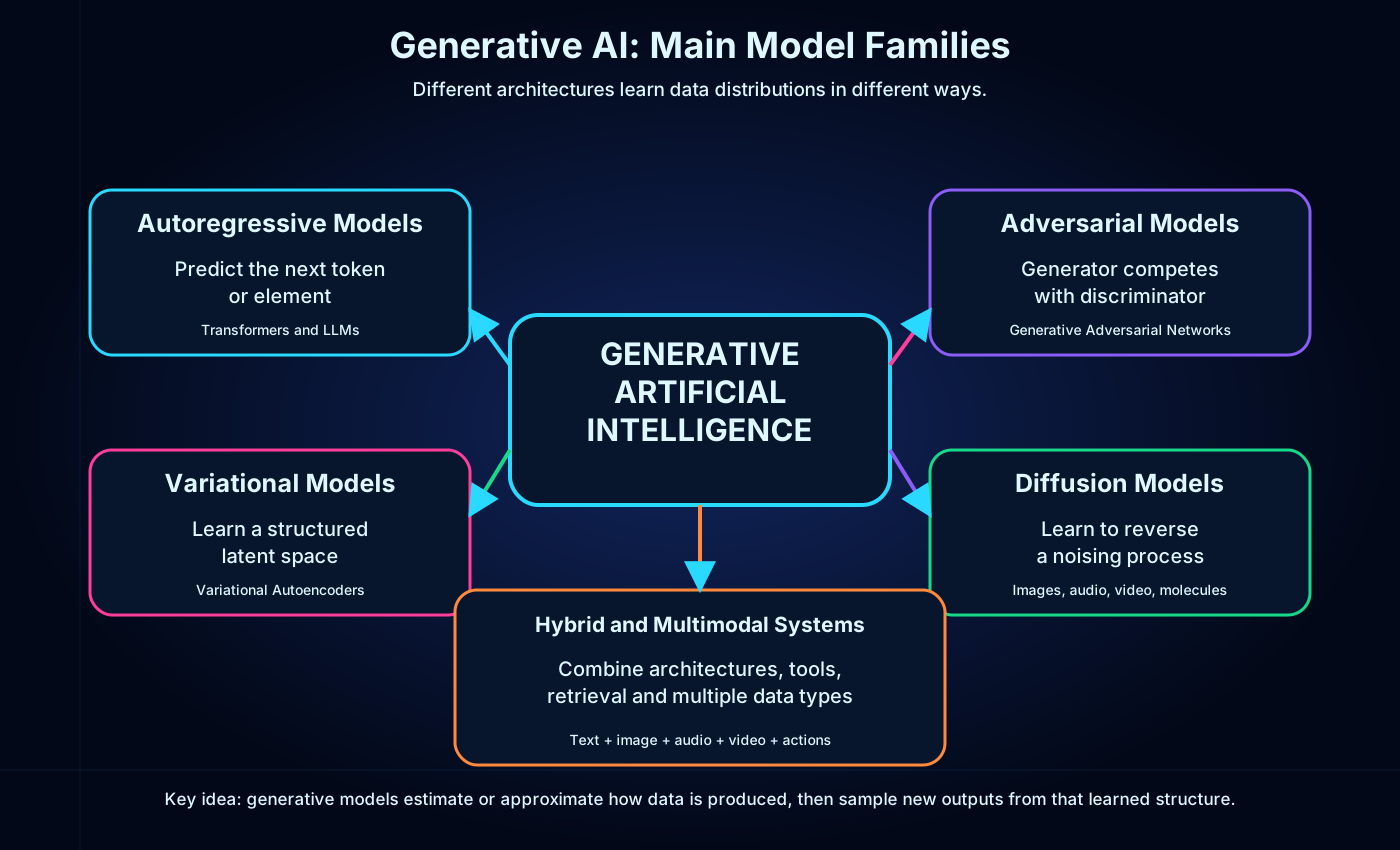
4. Main Generative Model Families
5. Large Language Models and the Transformer
6. Training, Alignment and Reasoning
7. Inference, Decoding and Context Windows
8. Prompt Engineering and Context Engineering
9. Retrieval-Augmented Generation
10. Model Customization and Fine-Tuning
11. Multimodal Generative AI
12. AI Agents and Agentic Systems
13. Evaluation and Benchmarking
14. Responsible AI, Ethics and Governance
15. Security Threats and Defensive Architecture
16. The Generative AI Market
17. Enterprise Architecture and Implementation
18. Applications and Societal Impact
19. Technical Developments Through Mid-2026
20. Microsoft Learn and Certification Alignment
Conclusion and Future Outlook
Knowledge Check
Glossary
References
Introduction
The modern history of generative AI is a sequence of breakthroughs in statistical modeling and neural networks. Early probabilistic models attempted to represent how data was generated. Neural language models later learned to predict words from context. Variational autoencoders and generative adversarial networks opened new ways to synthesize images, while the Transformer architecture, introduced in 2017, made it practical to train highly parallel sequence models at unprecedented scale. Diffusion models then transformed image generation, and instruction-tuned large language models turned next-token prediction into a general interface for knowledge work. The public release of conversational systems in the early 2020s made generative AI a mainstream technology rather than a specialist research topic [9-14].
For readers, understanding generative AI is increasingly a form of digital literacy. It helps professionals evaluate AI-generated information, automate repetitive work, design new products, communicate with models more effectively, and recognize when human verification is essential. For society, generative AI can expand access to tutoring, translation, software development, scientific discovery, design and accessibility tools. The same technology can also amplify misinformation, bias, surveillance, fraud and concentration of power. The decisive question is therefore not whether generative AI will be used, but how well its technical limits, incentives and safeguards will be understood.
The market is led by model developers and platform providers with different strategies. OpenAI, Google DeepMind and Anthropic compete at the frontier of general-purpose and multimodal models. Meta has promoted a large open-weight ecosystem around Llama. Microsoft combines model access, application development, agents and governance through Microsoft Foundry and Copilot products. Amazon Web Services provides a multi-model enterprise platform through Amazon Bedrock. NVIDIA supplies much of the accelerated computing and inference software that makes large-scale training and serving possible. Cohere focuses strongly on enterprise, multilingual and sovereign deployment. Other influential organizations include Mistral AI, DeepSeek, Alibaba, xAI and a rapidly expanding open-source community. The 2026 Stanford AI Index reports that industry produced more than 90% of notable frontier models in 2025, organizational AI adoption reached 88%, and generative AI reached approximately 53% population adoption within three years [1].
The rest of this article follows the technology from first principles to production. The most useful way to read it is to keep one question in mind: when a model produces an impressive answer, which parts came from learned statistical structure, which parts came from external evidence, which parts came from system design, and which parts still require human judgment?
Figure 1. The principal families of deep generative models and the hybrid systems built from them.
1. What Generative AI Is
A generative model learns a representation of the distribution that produced observed data. In simplified terms, if real examples are drawn from an unknown distribution p_data(x), the model attempts to learn a distribution p_model(x) that is close enough to generate plausible new examples. A conditional generative model learns p(x | c), where c may be a prompt, class label, image, audio clip, document set, user profile, tool result or another modality.
This objective differs from discriminative learning. A discriminative classifier learns a boundary or conditional probability such as p(label | input). A generative system learns enough structure about the data to create, reconstruct or transform it. In practice, modern systems often combine both approaches. A text-to-image service may use a generative model to synthesize pixels, a discriminative safety classifier to block prohibited content, a ranking model to select the best result, and a language model to interpret the user's prompt.
1.1 Generation is probabilistic, not a database lookup
A language model does not normally retrieve a stored sentence and paste it into the answer. It calculates a probability distribution over possible next tokens and selects from that distribution. This is why two requests can produce different outputs, why small prompt changes can matter, and why fluent text can still be wrong. Model parameters encode statistical regularities learned during training, not a perfectly indexed encyclopedia of facts.
1.2 Foundation models
A foundation model is trained on broad data at scale and adapted to many downstream tasks. The same base model can support summarization, translation, question answering, extraction, coding, image understanding, planning and tool use. This reuse changes software architecture: instead of training a separate model for every narrow task, developers combine a general model with prompts, retrieval, fine-tuning, tools, policies and evaluation.
1.3 Generative AI is a system, not only a model
A production generative AI application usually contains far more than a model endpoint. It includes authentication, authorization, prompt assembly, business rules, retrieval, data stores, model routing, content filters, tool permissions, observability, evaluation datasets, incident response, human escalation and cost controls. Many failures attributed to the model are actually failures of context, data quality, interface design, access control or missing validation.
A useful mental model
Model quality sets the ceiling, but system quality determines whether the application is reliable. A powerful model with weak retrieval, permissions and evaluation can be less useful than a smaller model inside a well-designed system.
2. Historical Evolution
2.1 From symbolic AI to statistical learning
Early AI systems relied heavily on explicit rules, logic and symbolic representations. These systems could be precise in narrow domains, but they were expensive to build and brittle when language or the environment changed. Statistical machine learning shifted the focus from manually encoding every rule to learning patterns from examples. Probabilistic language models estimated the likelihood of word sequences, initially with n-grams and later with neural networks.
2.2 Representation learning and deep neural networks
Deep learning made it possible to learn hierarchical representations directly from data. Convolutional networks transformed image recognition; recurrent networks and long short-term memory networks improved sequence modeling. Autoencoders learned compressed representations by reconstructing their input, creating the conceptual basis for variational autoencoders.
2.3 VAE, GAN and diffusion milestones
The variational autoencoder formalized a probabilistic latent space and a tractable training objective [10]. Generative adversarial networks introduced a competition between a generator and a discriminator, producing sharp synthetic images but creating training instability and mode collapse challenges [11]. Diffusion models learned to reverse a gradual noising process and eventually became a dominant approach for high-quality image generation [12].
2.4 The Transformer and the foundation-model era
The Transformer replaced recurrence with attention, enabling parallel processing of sequences and more efficient scaling [9]. Large-scale pretraining demonstrated that one model could acquire broad linguistic and factual patterns, then adapt to many tasks through prompting. Instruction tuning and reinforcement learning from human feedback improved the model's ability to follow user intent [14]. This produced the conversational interface that made generative AI accessible to non-specialists.
2.5 The move from assistants to agents
The next architectural step was to connect language models to tools, memory and external environments. Research such as ReAct showed how reasoning and action could be interleaved [17]. By 2026, major platforms were emphasizing persistent agents, orchestration, enterprise controls, agentic retrieval and runtime monitoring. This does not mean fully autonomous general intelligence has arrived. It means the model is increasingly one component in a loop that observes, plans, calls tools, receives results and continues until a task is completed or escalated.
3. Mathematical and Machine-Learning Foundations
3.1 Probability distributions and likelihood
Generative modeling is fundamentally probabilistic. The model assigns likelihood to possible observations and uses that structure to sample new ones. For a token sequence x_1 through x_T, an autoregressive model factorizes the joint probability into conditional probabilities. Training increases the likelihood of real sequences, usually by minimizing negative log-likelihood or cross-entropy.
A neural network contains parameters, commonly called weights. During training, the model processes examples, computes a loss that measures error, and uses backpropagation to calculate how each parameter contributed to that loss. An optimizer such as stochastic gradient descent or Adam updates the parameters. Training a frontier model can involve trillions of token presentations, distributed across many accelerators and coordinated through data, tensor, pipeline and expert parallelism.
3.3 Latent variables and latent spaces
A latent variable is an unobserved factor that helps explain observed data. In a generative model, latent space can encode abstract properties such as style, topic, pose, tone or structure. Moving through latent space can produce smooth changes in generated outputs. VAEs explicitly regularize this space; diffusion and language models also form internal representations, although their geometry and interpretability are more complex.
3.4 Embeddings
An embedding is a vector representation in which semantic or structural similarity can be reflected by geometric proximity. Token embeddings are the model's internal representations of tokens. Text embeddings used in search represent sentences, passages or documents. Image and audio embeddings serve analogous roles.
Embeddings are central to semantic search, clustering, recommendation, deduplication, retrieval and multimodal alignment.
3.5 Softmax, logits and probability
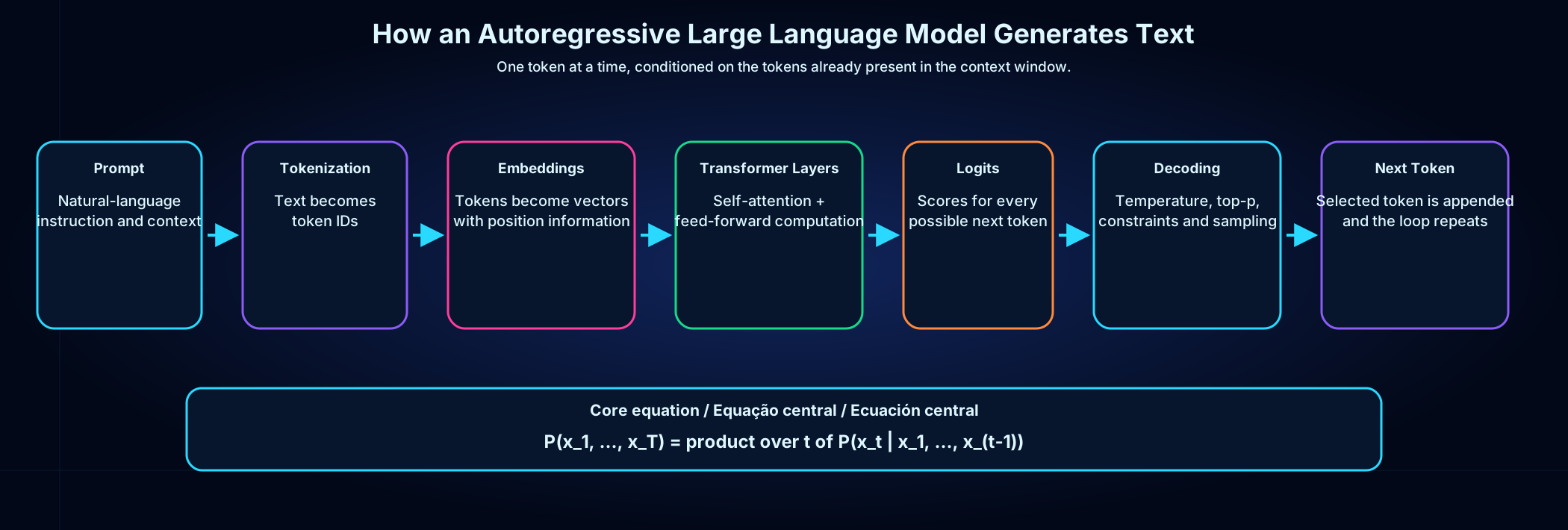
The final layer of a language model produces logits: unnormalized scores for candidate next tokens. Softmax converts these scores into probabilities. The probability distribution can then be modified by temperature, top-k, top-p or constraints before a token is selected. High-probability output is often more predictable, while broader sampling can increase creativity and error.
From logits to token probabilities
softmax(z_i) = exp(z_i) /sum_j exp(z_j)
Temperature-adjusted probability uses z_i /T before softmax. Lower T -> sharper distribution; higher T -> flatter distribution.
3.6 Generalization, memorization and scaling
Generalization is the ability to perform well on examples not seen during training. Memorization is not inherently bad; language requires remembering patterns and facts. The risk appears when a model reproduces sensitive, copyrighted or unique training examples, or when benchmark data leaks into training. Scaling laws describe predictable relationships among model size, data, compute and loss. Research showed that compute-optimal training requires balancing parameters and data rather than increasing model size alone. Modern mixture-of-experts architectures further separate total parameter capacity from the smaller subset activated for each token.
4. Main Generative Model Families
Main generative model families
Model family
Core idea
Strengths
Typical limitations
Autoregressive
Generate one element after another, conditioned on prior elements.
Excellent for language and code; flexible; natural streaming.
Sequential decoding; exposure to compounding errors; hallucination.
Variational autoencoder
Encode data into a probabilistic latent distribution and decode samples.
Outputs may appear smoother or less sharp than adversarial or diffusion methods.
Generative adversarial network
Train a generator to fool a discriminator in a minimax game.
Sharp outputs; fast one-pass generation after training.
Training instability, mode collapse, difficult evaluation.
Diffusion model
Add noise during a forward process and learn the reverse denoising process.
High-fidelity image and media generation; controllability.
Iterative sampling can be computationally expensive.
Normalizing flow
Use invertible transformations with exact likelihood.
Exact density evaluation and reversible mapping.
Architectural constraints and memory/computation costs.
Hybrid/multimodal
Combine multiple model types, encoders, decoders, retrieval and tools.
Broader capabilities and richer interaction.
System complexity, evaluation and security surface increase.
4.1 Variational autoencoders
A variational autoencoder contains an encoder that estimates a distribution q(z | x) over latent variables and a decoder that reconstructs x from z. Training balances reconstruction quality with a regularization term that keeps the learned latent distribution close to a prior, often a standard normal distribution. The reparameterization trick makes sampling differentiable enough for gradient-based optimization [10].
VAEs are useful when a smooth, structured latent space matters, including representation learning, anomaly detection, controllable generation, scientific modeling and data compression. Their classic weakness is that likelihood-based reconstruction can reward averaged outputs, which may reduce visual sharpness.
4.2 Generative adversarial networks
A GAN trains two neural networks together. The generator maps random noise to synthetic samples. The discriminator predicts whether a sample is real or generated. The generator improves by making outputs that the discriminator classifies as real, while the discriminator improves at detecting them [11].
Classic GAN minimax objective
min_G max_D E_x[log D(x)] + E_z[log(1 - D(G(z)))]
GANs were especially influential in image synthesis, super-resolution and style transfer. Their adversarial objective can create sharp results, but the equilibrium is difficult to optimize. Mode collapse occurs when the generator produces limited varieties that fool the discriminator instead of covering the full data distribution.
4.3 Diffusion models
A diffusion model gradually corrupts data with noise in a forward process and trains a network to predict or remove that noise. Generation begins from random noise and applies the learned reverse process through multiple steps. Conditional information, such as a text prompt, can guide denoising through cross-attention or other conditioning mechanisms [12].
Latent diffusion reduces cost by performing the process in a compressed representation instead of raw pixel space. Faster samplers, distillation and consistency techniques reduce the number of denoising steps. Diffusion principles now extend beyond images to audio, video, 3D, molecular structures and even language-like generation.
4.4 Autoregressive models
Autoregressive models generate sequentially. For language, they predict the next token from all prior tokens in the context. For images or audio, they can predict pixels, patches, codes or waveform elements. The approach is conceptually simple and scales well, but generation is inherently sequential unless specialized parallel or speculative methods are used.
5. Large Language Models and the Transformer
A large language model is usually a Transformer trained on very large text and code corpora. It learns the statistical structure of language through a self-supervised objective, most often next-token prediction. The adjective large may refer to parameter count, training data, compute, context window or capability; there is no universal threshold.
Figure 2. The autoregressive generation loop used by decoder-style large language models.
5.1 Tokens and tokenization
Models do not read text exactly as humans do. A tokenizer divides text into units such as words, subwords, punctuation and byte sequences. Each token maps to an integer ID. Tokenization affects cost, context usage, multilingual performance, code handling and the spelling of rare terms. A word may be one token in one language and several tokens in another.
5.2 Embeddings and positional information
Token IDs are mapped to dense vectors. Because attention alone does not inherently know sequence order, the model also encodes position. Positional encodings or rotary positional embeddings allow the model to distinguish between the same token appearing at different locations and to reason about relative distance.
5.3 Self-attention
Self-attention allows each token representation to selectively incorporate information from other tokens. Every token produces query, key and value vectors. Similarity between queries and keys determines how strongly values are combined. Multiple attention heads learn different relationships, such as syntax, reference, topic or long-range dependency.
Scaled dot-product attention
Attention(Q, K, V) = softmax( Q K^T /sqrt(d_k) ) V
In causal language modeling, a mask prevents a token from attending to future tokens. This preserves the next-token prediction objective. Attention has quadratic cost with sequence length in its standard form, which makes long contexts expensive and motivates sparse attention, memory compression, recurrence, retrieval and other optimizations.
5.4 Feed-forward layers, residual paths and normalization
A Transformer block alternates attention with a position-wise feed-forward network. Residual connections preserve information and improve gradient flow. Layer normalization stabilizes training. Many modern models replace dense feed-forward layers with mixture-of-experts modules, where a router sends each token to a small subset of specialized expert networks.
5.5 Encoder, decoder and encoder-decoder models
Encoder-only models create contextual representations and are strong for classification, retrieval and understanding tasks.
Decoder-only models use causal attention and dominate open-ended text and code generation.
Encoder-decoder models encode an input sequence and generate an output sequence, making them natural for translation and transformation tasks.
5.6 Context windows and attention limits
The context window is the maximum amount of tokenized information available to the model during one interaction. It may include system instructions, conversation history, retrieved documents, tool results and the expected output. A larger window does not guarantee perfect recall. Models can overlook information, struggle with conflicting evidence, or perform unevenly depending on where facts appear. Context engineering therefore includes selection, compression, ordering, labeling and conflict resolution.
6. Training, Alignment and Reasoning
6.1 Data collection and curation
Pretraining data may include web pages, books, source code, scientific papers, reference material, conversations, images, audio and licensed or synthetic data. Quality is determined not only by volume but by deduplication, language balance, freshness, domain coverage, provenance, privacy handling, filtering and mixture design. Poor data can encode stereotypes, factual errors, malicious instructions and private information.
6.2 Pretraining
During pretraining, the model learns general representations through self-supervised objectives. In an autoregressive LLM, each sequence supplies many training targets because every next token becomes a prediction task. Pretraining creates broad capability but does not guarantee that the model will answer questions safely, follow instructions or admit uncertainty.
6.3 Supervised instruction tuning
Instruction tuning uses examples of prompts and desired responses to teach a pretrained model how to behave as an assistant. Examples can cover style, task format, refusal behavior, tool calls and structured output. The quality and diversity of instructions strongly influence usability.
6.4 Reinforcement learning from human feedback
RLHF typically collects human preferences among model outputs, trains a reward model to predict those preferences, and optimizes the language model to increase reward while limiting deviation from the reference model. The InstructGPT work demonstrated that a smaller aligned model could be preferred over a much larger base model [14]. RLHF is powerful but expensive and sensitive to reward-model errors, annotator bias and reward hacking.
6.5 RLAIF, constitutional methods and preference optimization
Reinforcement learning from AI feedback uses model-generated critiques or preferences to supplement human data. Constitutional methods evaluate behavior against written principles. Direct Preference Optimization simplifies preference learning by optimizing a classification-style objective without a separate reinforcement learning loop [16]. These methods are not interchangeable; organizations choose them based on control, cost, data and safety requirements.
6.6 Reasoning models and test-time compute
A major recent direction is to allocate more computation during inference for planning, verification, search or iterative refinement. Instead of producing the first plausible continuation, a system may generate candidate solutions, check intermediate steps, call tools, compare answers or use a verifier. This can improve mathematics, coding and complex decision tasks, but it increases latency and cost. It also does not guarantee correctness; a long rationale can confidently support a wrong conclusion.
6.7 Chain-of-thought and hidden reasoning
Chain-of-thought prompting asks a model to produce intermediate reasoning steps. It can improve performance on some tasks, especially with demonstrations, but visible reasoning is not a perfect window into internal computation. Production systems may use private deliberation, concise justifications, verification traces or tool logs instead of exposing unrestricted internal reasoning. The important design goal is auditable evidence and reproducible results, not the appearance of a persuasive explanation.
6.8 Reinforcement learning from verifiable rewards
When a task has an objective checker, such as a unit test, compiler, theorem prover or exact mathematical answer, training can reward verified success rather than subjective preference. This is especially valuable for coding, mathematics and structured tasks. The limitation is that many real-world goals are incomplete, multi-objective or difficult to verify automatically.
6.9 Synthetic data and self-improvement loops
Models can generate examples, critiques, edge cases and simulated interactions for additional training. Synthetic data helps cover rare scenarios and reduce annotation cost, but repeated training on low-quality synthetic outputs can amplify errors and reduce diversity. Strong pipelines filter synthetic data, mix it with trusted human or real-world data, and evaluate whether the new data actually improves target tasks.
7. Inference, Decoding and Context Windows
7.1 Inference
Inference is the process of running a trained model to generate an output. Key production metrics include time to first token, tokens per second, end-to-end latency, throughput, concurrency, memory usage, accelerator utilization, availability and cost per successful task. The cheapest model per token is not always the cheapest per outcome if it requires retries or human correction.
7.2 Decoding strategies
Decoding techniques
Technique
What it does
Typical effect
Greedy decoding
Always selects the highest-probability token.
Deterministic and fast, but can be repetitive or locally optimal.
Samples only from the k highest-probability tokens.
Removes the long low-probability tail.
Top-p sampling
Samples from the smallest set whose cumulative probability exceeds p.
Adapts the candidate set to model confidence.
Beam search
Keeps several high-scoring partial sequences.
Useful for constrained generation; can reduce diversity.
Constrained decoding
Restricts output to a schema, grammar or allowed tokens.
Improves machine-readable output and policy compliance.
Speculative decoding
A smaller model proposes tokens that a larger model verifies.
Can reduce latency without changing the target distribution.
7.3 KV cache
During autoregressive generation, attention keys and values for previous tokens can be cached so they do not need to be recomputed at every step. The KV cache is essential for performance but consumes substantial memory, especially with long contexts and many concurrent users. Quantization, paging, grouped-query attention and cache reuse improve efficiency.
7.4 Quantization and compression
Quantization represents weights or activations with fewer bits, reducing memory and often increasing throughput. Distillation trains a smaller student model to reproduce a larger teacher's behavior. Pruning removes less important parameters or structures. Each technique trades some fidelity or flexibility for cost, speed and deployment reach, including on-device inference.
7.5 Determinism and reproducibility
Even with a fixed temperature and seed, exact reproducibility can be affected by distributed execution, numerical precision, model updates and provider infrastructure. High-assurance applications should store model version, prompt version, retrieved evidence, tool outputs, parameters and evaluation results. Reproducibility is a system property, not merely a decoding setting.
8. Prompt Engineering and Context Engineering
Prompt engineering designs instructions and examples that guide model behavior. Context engineering is broader: it decides what information, tools, memory, policies and state should enter the model's working context, in what order and at what level of detail. As applications become agentic, context engineering is often more important than clever wording.
8.1 Anatomy of an effective prompt
Role and objective: define what the model should accomplish.
Context: provide the relevant facts, assumptions and boundaries.
Input: clearly delimit user data, documents or records.
Constraints: specify prohibited actions, allowed sources, length and tone.
Output contract: require a schema, sections, citations or confidence indicators.
Examples: show acceptable inputs and outputs when format is difficult.
Verification: ask for checks against evidence, rules or tests.
8.2 Zero-shot, one-shot and few-shot prompting
Zero-shot prompting provides instructions without examples. One-shot includes one demonstration. Few-shot prompting supplies several examples in context. Examples can teach format and decision boundaries without changing model parameters, but they consume context and can accidentally bias the model toward superficial patterns.
8.3 Structured output
When the model feeds another system, prose is often the wrong interface. JSON schemas, grammars, tool-call structures and typed validation reduce ambiguity. The application should reject malformed or semantically invalid output rather than trusting it because it looks structured.
8.4 Prompt templates and versioning
Prompts should be treated as code: stored in version control, reviewed, tested, measured and rolled back. A prompt change can alter factuality, safety, latency and cost. Evaluation sets should include normal cases, edge cases, adversarial inputs and multilingual examples.
8.5 Prompt injection
Prompt injection occurs when untrusted input attempts to override system instructions, reveal secrets or cause unauthorized tool actions. Direct injection comes from the user. Indirect injection is embedded in documents, web pages, emails or tool results. The model cannot reliably distinguish instructions from data by text alone, so robust defense requires isolation, permissions, filtering, validation and least privilege, not just a stronger system prompt [7].
Prompting is not a security boundary
System instructions influence behavior, but they do not replace authentication, authorization, network controls, data classification, tool allowlists or output validation.
9. Retrieval-Augmented Generation
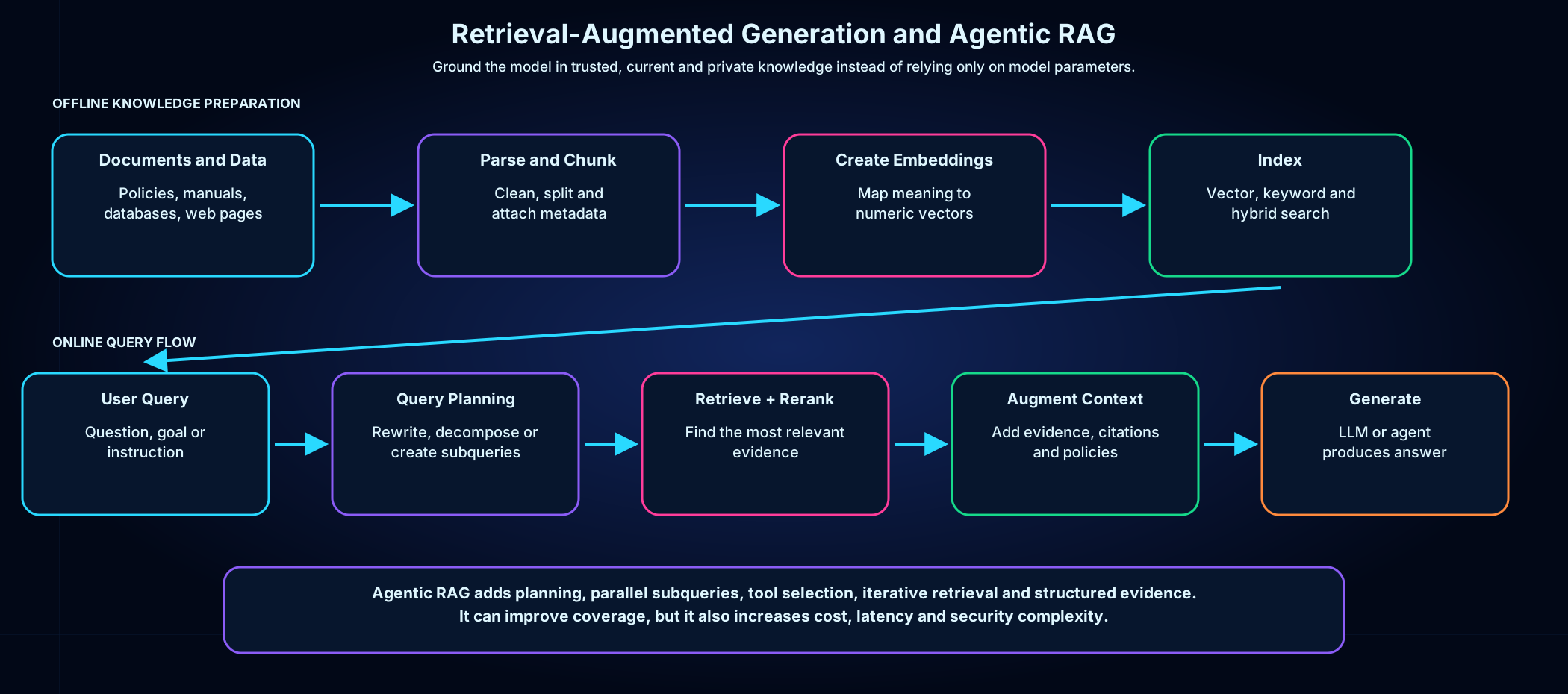
Retrieval-augmented generation combines a generative model with external search. Instead of expecting the model to contain every fact in its parameters, the application retrieves relevant evidence and inserts it into the prompt. The original RAG research combined parametric model memory with a non-parametric document index [13]. Modern implementations support keyword, semantic, vector and hybrid retrieval, often with reranking and citations.
Figure 3. Classic RAG and its evolution toward agentic retrieval and multi-step evidence gathering.
9.1 The ingestion pipeline
1. Collect data from approved sources and record provenance.
2. Parse files, remove irrelevant markup and preserve structural metadata.
3. Split content into chunks that are coherent enough to answer questions.
4. Create embeddings and store them with text, access labels and metadata.
5. Build keyword, vector or hybrid indexes and define update schedules.
6. Evaluate retrieval with representative queries before connecting an LLM.
9.2 Chunking
Chunking is one of the highest-impact RAG design decisions. Chunks that are too small lose context; chunks that are too large dilute relevance and consume the context window. Better strategies respect headings, paragraphs, tables, code blocks and document boundaries. Overlap can preserve continuity, but excessive overlap creates duplicates and wastes tokens.
9.3 Embedding and vector search
The application embeds both stored chunks and the query into a vector space. Approximate nearest-neighbor search finds vectors with high similarity. Vector search captures semantic relation beyond exact words, but it can miss rare identifiers, numbers and exact phrases. Hybrid search combines keyword and vector signals, and semantic reranking can improve final ordering.
9.4 Retrieval, augmentation and generation
Microsoft describes the core RAG flow as retrieve, augment and generate [6]. Retrieval finds relevant content. Augmentation combines the user's question, evidence and instructions. Generation creates a response grounded in that evidence. A strong system also attaches citations, enforces document permissions and refuses to answer when evidence is insufficient.
9.5 Reranking and query transformation
A first-stage retriever is optimized for recall: it should find potentially relevant content quickly. A reranker is optimized for precision: it reorders a smaller candidate set using a more expensive relevance model. Query rewriting expands abbreviations, resolves references and converts conversational questions into search-friendly queries.
9.6 Agentic RAG
Agentic retrieval uses a model to plan multiple subqueries, execute them in parallel or sequence, inspect results, and decide whether more evidence is needed. Microsoft Foundry documentation describes agentic retrieval as an evolution from a single query toward context-aware query planning, parallel execution, structured grounding data and built-in semantic ranking [6]. It can answer complex questions more completely, but creates additional opportunities for loops, excessive spend, conflicting evidence and prompt injection.
9.7 RAG is not a guarantee against hallucination
A model can ignore retrieved evidence, misinterpret it, combine incompatible sources or invent a citation. RAG quality depends on source quality, parsing, chunking, retrieval, ranking, prompt design and generation. Evaluation should separately measure retrieval recall, context relevance, answer groundedness, citation correctness and end-task success.
9.8 Fine-tuning versus RAG
When to use RAG and when to use fine-tuning
Need
RAG
Fine-tuning
Fresh or private knowledge
Best fit: retrieves current content without changing base weights.
Weak fit: knowledge becomes stale and requires retraining.
Change tone or behavior
Can influence through prompts, but limited.
Strong fit for stable style, format or task behavior.
Source citations
Natural fit when metadata is preserved.
Not naturally traceable to training examples.
Cost to update
Reindex changed content.
Requires a new training and evaluation cycle.
Data exposure risk
Data enters retrieval and context at inference.
Training data may become encoded in adapted weights.
Complexity
Requires search, indexing and context assembly.
Requires training infrastructure, datasets and model lifecycle.
10. Model Customization and Fine-Tuning
10.1 Full fine-tuning
Full fine-tuning updates all or most model parameters using a specialized dataset. It offers maximum flexibility but is expensive, memory-intensive and operationally complex. It can also cause catastrophic forgetting, where improvements in one domain degrade general capability.
10.2 Parameter-efficient fine-tuning
Parameter-efficient fine-tuning updates only a small number of added or selected parameters. LoRA freezes the base model and trains low-rank matrices inserted into selected layers [15]. Adapters and prompt tuning follow related principles. PEFT reduces training cost and allows multiple task-specific adaptations to share one base model.
10.3 Continued pretraining
Continued pretraining exposes a base model to large amounts of domain text using the original language-modeling objective. It can improve domain vocabulary and representations, but requires more data and compute than instruction tuning and can alter broad behavior. It is useful when the domain distribution is substantially different from general web text.
10.4 Distillation
Distillation trains a smaller model using outputs, probabilities or reasoning traces from a larger teacher. The goal is to retain useful capability at lower latency and cost. Distillation can also transfer teacher errors, biases and policy weaknesses, so the student must be evaluated independently.
10.5 Choosing a customization method
Use prompt and context engineering first when behavior can be described at inference time.
Use RAG when knowledge is private, traceable or frequently changing.
Use fine-tuning when stable behavior, style or domain task performance must change.
Use distillation or a smaller model when cost and latency dominate after quality is established.
Combine methods when necessary, but evaluate the incremental value of each layer.
11. Multimodal Generative AI
Multimodal AI processes or generates more than one data type. A multimodal model may accept text, images, audio and video, then produce text, images, speech, actions or structured data. The central research challenge is alignment: representations from different modalities must refer to the same concepts and events.
11.1 Text and code
Language models generate prose, summaries, translations, plans, classifications and structured records. Code models generate, explain, review and transform source code. Because code can be executed and tested, it is a particularly valuable domain for tool-assisted verification. However, generated code can contain insecure dependencies, logic flaws, licensing issues and hidden assumptions.
11.2 Images
Text-to-image systems convert linguistic descriptions into visual representations, commonly through diffusion or hybrid architectures. Control methods may use sketches, depth maps, poses, masks or reference images. Evaluation must consider prompt adherence, visual quality, identity consistency, spatial relations, text rendering, provenance and safety.
11.3 Speech, audio and music
Generative audio includes text-to-speech, voice conversion, sound effects, speech enhancement, translation and music synthesis. Natural interaction increasingly combines speech recognition, language reasoning and low-latency speech generation. Consent and identity protection are essential because synthetic voices can enable impersonation.
11.4 Video and world models
Video generation must maintain temporal consistency, object identity, physics and camera motion across frames. World models attempt to learn how environments evolve and may support simulation, robotics, games and planning. High visual realism does not imply causal understanding; generated scenes can still violate physical or logical constraints.
11.5 Documents, charts and interfaces
Modern multimodal systems can analyze document layout, screenshots, diagrams and charts. This enables visual question answering, document automation and interface agents. The risk is that models may infer values incorrectly from dense charts or overlook small but important visual details. Critical extraction should be validated against source data.
11.6 Robotics and embodied AI
Embodied systems connect perception, language, planning and physical action. A model may interpret camera input, receive a natural-language goal, plan a sequence and control a robot through tools. Physical environments require stricter safety because an incorrect action can damage equipment or injure people. Simulation, constrained control, monitoring and human oversight are therefore central.
12. AI Agents and Agentic Systems
An AI agent is a software system that uses a model to pursue a goal through a sequence of observations and actions. A chatbot mainly produces responses. An agent may call APIs, search documents, execute code, create files, update records or coordinate workflows. Agency is a spectrum: some systems make one tool call; others plan and execute long-running tasks with checkpoints.
12.1 Core components
Core components of an AI agent
Component
Purpose
Key risk
Model
Interprets goals, plans and generates actions.
Reasoning error, hallucination, policy failure.
Instructions
Define objectives, boundaries and escalation rules.
Ambiguity or prompt injection.
Tools
Provide external capabilities such as search, APIs or code execution.
Unauthorized or destructive action.
Memory
Stores conversation, user preferences or task state.
Privacy leakage, stale or poisoned memory.
Planner/orchestrator
Decomposes tasks and coordinates steps or agents.
Loops, cascading errors, excessive cost.
Evaluator/guardrail
Checks outputs, evidence, policy and completion.
False confidence or incomplete coverage.
Human oversight
Approves, corrects or handles exceptions.
Poor handoff design or alert fatigue.
12.2 Tool use and function calling
Tool calling allows the model to emit a structured request for a function instead of directly answering. The application validates the arguments, checks permissions, executes the tool and returns the result. The model should never be given unrestricted credentials. Tools should have narrow scopes, explicit schemas, rate limits, audit logs and confirmation requirements for consequential actions.
12.3 Memory
Short-term memory is the active context. Long-term memory may store user facts, task history or summarized interactions. Memory should be selective, consent-aware and correctable. A wrong memory can systematically distort future decisions. Sensitive memory requires encryption, access controls, retention limits and deletion mechanisms.
12.4 Single-agent and multi-agent systems
A single agent can be easier to understand and govern. Multi-agent systems assign specialized roles, such as researcher, planner, executor and critic. They can improve decomposition and parallelism, but communication overhead and correlated errors may outweigh the benefits. Multi-agent design should be justified by measurable task performance rather than novelty.
12.5 Human-in-the-loop and human-on-the-loop
Human-in-the-loop systems require approval before specific actions. Human-on-the-loop systems operate automatically while humans monitor and intervene. The correct model depends on reversibility, impact, confidence and regulation. High-impact actions such as payments, access grants, legal submissions or safety decisions should use stronger approval and separation-of-duty controls.
12.6 Interoperability
Agent ecosystems increasingly use standardized descriptions for tools, resources and context so models can interact with external systems consistently. Protocols such as the Model Context Protocol illustrate this direction. Interoperability reduces custom integration, but it also makes identity, authorization, provenance and tool trust even more important because one agent may connect to many external capabilities.
13. Evaluation and Benchmarking
Evaluation is the discipline that converts impressive demonstrations into evidence. A good evaluation answers: useful for whom, on which tasks, under which constraints, compared with what baseline, at what cost, and with what failure rate?
13.1 Offline and online evaluation
Offline evaluation uses fixed datasets before deployment. Online evaluation measures real usage through A/B tests, task completion, correction rates, user satisfaction and incident metrics. Offline tests are reproducible; online tests reveal real behavior. Production systems need both.
13.2 Common metrics
Evaluation areas, metrics, and cautions
Area
Example metrics
Caution
Language modeling
Perplexity, negative log-likelihood.
Lower perplexity does not directly equal better assistant behavior.
Text generation
ROUGE, BLEU, semantic similarity.
Reference-based metrics can penalize valid alternative answers.
Image generation
FID, CLIP similarity, human preference.
Metrics can miss prompt details, bias and artifacts.
Latency, throughput, availability, cost per successful task.
Token cost alone ignores retries and human correction.
13.3 Human evaluation
Human reviewers can judge relevance, clarity, factuality and preference, but evaluation design must control for reviewer expertise, instructions, fatigue, cultural differences and presentation order. Inter-annotator agreement reveals whether the rubric is clear. High-stakes domains require qualified experts, not only general crowd workers.
13.4 LLM-as-a-judge
A model can score another model's output against a rubric, enabling large-scale evaluation. This is useful for triage and iteration, but the judge may share biases with the model under test, prefer verbosity, be sensitive to answer order or fail on specialized facts. Calibrate model judges against human-labeled samples and use multiple methods for important decisions.
13.5 Benchmark contamination and saturation
Public benchmark questions may appear in training data, invalidating the assumption that the model is generalizing. As scores approach the top of a benchmark, small differences become less informative. The 2026 AI Index emphasizes both rapid benchmark gains and the difficulty of reliable measurement, including a jagged frontier where models excel at advanced tasks yet fail on simple ones [1]. Private, frequently refreshed and task-specific evaluations are increasingly necessary.
13.6 Red teaming
Red teams actively search for failures through adversarial prompts, unusual languages, conflicting instructions, malicious documents, tool abuse and social engineering. Red teaming should test the entire system, including APIs, retrieval permissions, memory, logging, human workflows and supply-chain components.
14. Responsible AI, Ethics and Governance
14.1 Fairness and bias
Models learn from historical and cultural data, which contains unequal representation and prejudice. Bias can appear in associations, recommendations, generated images, dialect handling and refusal behavior. Fairness is context-dependent; a metric appropriate for one decision may be harmful in another. Mitigation combines representative data, subgroup evaluation, policy, human review and ongoing monitoring.
14.2 Transparency and explainability
Users should know when they are interacting with AI, what data sources influence an answer, whether the result is generated or retrieved, and how to challenge it. Model cards, system cards, data documentation, audit logs and source citations improve transparency. Explainability should not overpromise: a plausible natural-language explanation is not necessarily a faithful causal account of the model's computation.
14.3 Privacy
Privacy risks include training on personal data without proper basis, memorization, sensitive prompt logging, cross-tenant leakage, insecure retrieval and overly persistent memory. Controls include data minimization, classification, encryption, regional processing, retention limits, opt-out mechanisms, redaction, private deployment and contractual review of provider data use.
14.4 Intellectual property and provenance
Generative AI raises questions about training-data rights, output ownership, similarity to protected works, attribution and license compatibility. Organizations should track data provenance, provider terms, model licenses and generated code dependencies. Provenance standards, content credentials and watermarking can help identify synthetic media, but no single method is universally reliable.
14.5 Misinformation and deepfakes
Low-cost generation increases the volume and realism of misleading content. Defensive measures include identity verification, source authentication, provenance metadata, media forensics, platform policy, public literacy and rapid incident response. Detection alone is an arms race; trustworthy distribution channels are equally important.
14.6 Environmental and infrastructure costs
Training and serving large models consume energy, water, hardware and data-center capacity. Inference can dominate lifecycle impact when a model serves millions of requests. Efficiency improvements include smaller models, quantization, batching, caching, specialized accelerators, workload scheduling and selecting the minimum sufficient model for each task.
14.7 Workforce and education
Generative AI can automate tasks, augment workers and change which skills are valuable. Its effect is rarely a simple replacement of an entire occupation; it often redistributes tasks and creates new review, governance and integration work. Education must teach both productive use and verification. The 2026 AI Index reports widespread student use alongside incomplete institutional policies, illustrating how adoption can outpace governance [1].
14.8 Governance
AI governance defines who may deploy models, which data may be used, how risks are classified, which evaluations are mandatory, how incidents are handled and when human approval is required. Effective governance connects written policy to technical controls and evidence. A policy that cannot be tested, monitored or enforced at runtime is unlikely to protect users.
15. Security Threats and Defensive Architecture
Generative AI creates a new application security layer because models interpret untrusted natural language, access data and sometimes control tools. Traditional security remains necessary, but new attack paths arise from the probabilistic interface.
15.1 Threat categories
Generative AI security threats and defenses
Threat
Description
Primary defenses
Direct prompt injection
User attempts to override instructions or extract protected information.
Input screening, policy enforcement, refusal tests, least privilege.
Indirect prompt injection
Malicious instructions are embedded in retrieved documents or tool results.
Treat external content as data, isolate instructions, sanitize, permission tools.
Data exfiltration
Model is induced to reveal secrets, private context or other users data.
Data segmentation, redaction, output filters, tenant isolation, authorization.
Tool abuse
Agent calls an API with harmful or unauthorized parameters.
Microsoft's Prompt Shields documentation distinguishes user prompt attacks from document attacks and explicitly notes that false positives and false negatives remain possible [7]. This reinforces a general principle: classifiers and guardrails are layers, not guarantees. Defensive architecture combines content screening with identity, authorization, data boundaries, tool constraints, secure execution and monitoring.
15.3 Zero Trust for agents
A Zero Trust approach assumes that no user, model, tool or retrieved document is inherently trusted. Every action should be authenticated, authorized, scoped and logged. Agents should receive just-in-time access to the minimum resources needed. Sensitive actions should require stronger authentication or human approval.
15.4 Sandboxing and secure execution
Code execution, browser automation and file manipulation should occur in isolated environments with restricted network access, time and resource limits, disposable state and malware scanning. The model must not have direct access to host credentials or unrestricted shells.
15.5 Monitoring and incident response
Logs should capture prompts, model versions, retrieval references, tool calls, approvals, policy decisions and outcomes, subject to privacy rules. Security teams need playbooks for prompt injection, data leakage, unsafe outputs, model-provider incidents, compromised plugins and runaway cost. Detection should focus on behavior and consequences, not only suspicious words.
16. The Generative AI Market
The generative AI market is not a single race for the largest model. It is an ecosystem of model laboratories, cloud platforms, hardware suppliers, open-source communities, application vendors, data providers and governance tools. Organizations often use several models because cost, latency, modality, privacy, license and regional availability differ by workload.
Major generative AI market players
Player
Strategic role in the ecosystem
Representative strengths
OpenAI
Frontier model developer, ChatGPT platform, APIs and enterprise agent products.
Developer of the Llama open-weight ecosystem and supporting safety tools.
Open ecosystem, customization, research and broad deployment options.
Microsoft
Cloud and application platform through Foundry, Azure OpenAI and Copilot experiences.
Enterprise identity, security, governance, data integration and agents.
Amazon Web Services
Multi-model managed platform through Amazon Bedrock and related services.
Provider choice, cloud integration, enterprise controls and scale.
NVIDIA
Accelerated computing, networking and software for training and inference.
GPU ecosystem, inference optimization, enterprise AI infrastructure.
Cohere
Enterprise-focused language, embedding, reranking and agentic models.
Private and sovereign deployment, multilingual enterprise search and RAG.
Other influential providers
Mistral AI, DeepSeek, Alibaba, xAI and numerous open-source projects.
Regional competition, efficient models, open weights and specialized capabilities.
16.1 Frontier versus open-weight models
Closed frontier models often provide leading capabilities, managed safety and rapid product updates, but reduce transparency and may create provider dependence. Open-weight models allow private deployment, customization and research, but require organizations to manage infrastructure, licensing, security and safety. Open weight is not the same as fully open source; training data, code and methodology may remain unavailable.
16.2 Model marketplaces and abstraction layers
Platforms such as Amazon Bedrock and Microsoft Foundry make multiple models available behind managed infrastructure and governance [8,24]. Model abstraction can reduce switching cost, but true portability remains difficult because providers differ in prompts, tool schemas, safety behavior, context limits, multimodal features and pricing.
16.3 Hardware and inference competition
Training receives attention, but production economics increasingly depend on inference. NVIDIA and competitors optimize accelerators, networking, memory, compilers, serving engines and disaggregated inference. In 2026, NVIDIA described Dynamo as an inference operating system for generative and agentic AI at scale [25]. The broader trend is toward higher token throughput, better cache management, model routing and lower cost per successful task.
16.4 Sovereign and private AI
Governments and regulated organizations increasingly seek control over where models run, which languages they support and how data is governed. Private cloud, on-premises and regional deployment are therefore strategic differentiators. Cohere, for example, emphasizes secure and sovereign enterprise deployment, while open-weight ecosystems offer additional control [29].
17. Enterprise Architecture and Implementation
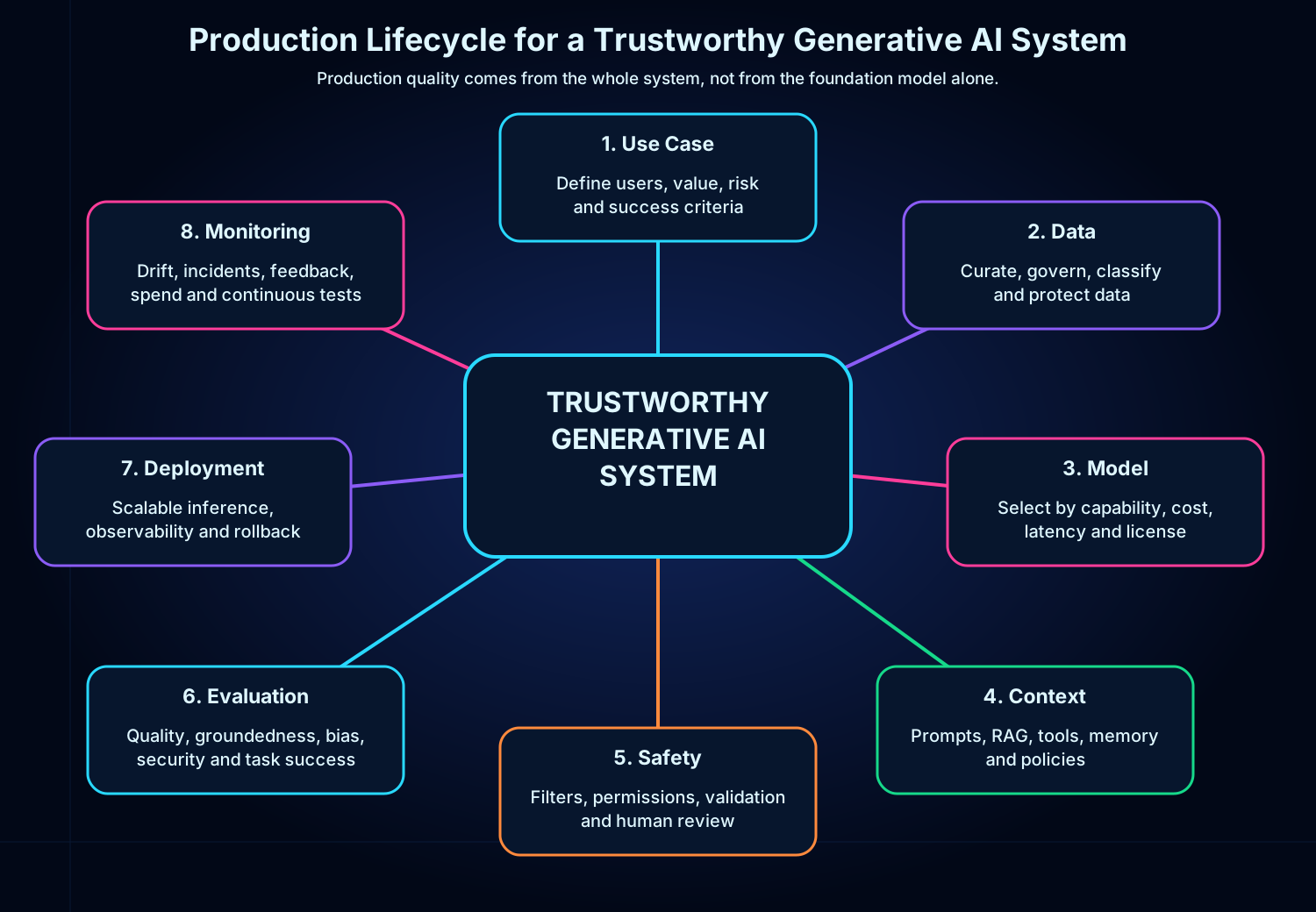
Figure 4. A complete lifecycle for developing, deploying and operating trustworthy generative AI systems.
17.1 Start with the task, not the model
A useful project begins with a specific user, workflow and measurable outcome. 'Add AI' is not a requirement. Better questions are: Which task is slow or inconsistent? What evidence does a worker need? Which actions are reversible? What quality threshold is acceptable? What happens when the system is uncertain?
17.2 Reference architecture
A secure enterprise chat or agent architecture typically includes a user interface, identity provider, application API, orchestration layer, model endpoint, retrieval index, source data, tool gateway, secrets store, content safety, evaluation service, telemetry and human escalation. Microsoft's baseline Foundry architecture emphasizes private endpoints, managed identity, network isolation, grounding data and observability [8].
17.3 Model selection
Select models using a weighted scorecard rather than benchmark reputation alone. Criteria include task quality, context length, modality, tool use, structured output, latency, throughput, cost, regional availability, data policy, license, safety, model stability and vendor support. Route simple tasks to smaller models and reserve expensive reasoning models for cases that justify them.
17.4 Data architecture
Classify source data before indexing or prompting. Preserve document permissions in the search layer so users retrieve only what they are authorized to see. Record provenance, effective dates and ownership. Retrieval should respect deletion and retention policies. Sensitive data should be minimized and redacted when full detail is unnecessary.
17.5 Guardrails and validation
Guardrails operate before, during and after generation. Input controls detect malicious or prohibited requests. Runtime controls restrict tools and budgets. Output controls validate schemas, factual support, code safety and policy. Human review handles low-confidence or high-impact cases. A deterministic rules engine should enforce hard business constraints instead of asking the model to remember them.
17.6 Observability
AI observability connects model behavior to system outcomes. Trace each request through prompt assembly, retrieval, model calls, tool calls and validation. Track token usage, latency, errors, refusals, fallback models, citation coverage, user corrections, policy violations and task success. Distributed tracing is especially valuable for multi-step agents.
17.7 Cost engineering
Cost depends on input tokens, output tokens, repeated context, retrieval, reranking, tools, storage, networking and human review. Techniques include prompt compression, caching, batch processing, smaller models, response limits, adaptive retrieval, model routing and early termination. Measure cost per successful business outcome, not cost per API call.
Dedicated cloud deployment: stronger isolation and capacity control.
On-premises or edge: maximum data control, higher operational burden.
Hybrid: sensitive retrieval and policy remain private while selected model calls use cloud services.
Multi-model routing: choose a model dynamically by task, risk, cost and availability.
17.9 Practical example: an internal policy assistant
Consider a company assistant that answers questions about policies. The system authenticates the employee, retrieves only documents permitted for that role, reranks passages, and prompts the model to answer strictly from evidence. It includes citations and document dates. If evidence conflicts or confidence is low, it says so and routes the question to a policy owner. It cannot modify policies. This design limits risk by separating knowledge access from authority.
Generative AI can draft, summarize, translate, extract, compare and reorganize information. The largest gains often come from accelerating the first draft and reducing search time, while humans remain responsible for judgment, negotiation and accountability.
18.2 Software engineering
Coding assistants generate boilerplate, tests, documentation and migration suggestions. Agentic systems can inspect repositories, run tests and propose changes. Benefits depend on code review, secure execution, dependency checks and architectural context. Generated code should meet the same standards as human code.
18.3 Education
AI tutors can explain concepts at different levels, create practice questions and provide feedback. They can improve access but may also provide incorrect answers, reduce productive struggle or facilitate academic dishonesty. Good educational design uses transparent assistance, source-based answers, teacher oversight and assignments that reward reasoning rather than copyable output.
18.4 Healthcare and life sciences
Applications include clinical documentation, literature review, patient communication, molecule design and research support. Because errors can affect health, systems need validated sources, domain evaluation, privacy protection, human professionals and clear limitations. Generative AI should support rather than silently replace qualified decision-makers.
18.5 Science and engineering
Models can propose hypotheses, generate code, search literature, design experiments and create candidate molecules or materials. The highest value comes when generative systems connect to simulation, laboratory automation and verifiable measurement. Scientific novelty requires empirical validation, not only plausible text.
18.6 Media and creative work
Creators use generative AI for ideation, storyboarding, editing, localization, visual effects and interactive media. This expands creative capacity while raising questions about consent, attribution, labor and training rights. The technology is most constructive when it gives creators control and preserves provenance.
18.7 Accessibility
Multimodal models can describe images, simplify text, generate captions, translate speech and adapt interfaces. Accessibility gains require testing with users who have disabilities, because an incorrect description or inaccessible interaction can create new barriers.
18.8 Public services and law
Government and legal applications can improve document access, translation and case preparation. However, automated recommendations can affect rights and benefits. Public-sector systems require transparency, appeal, records management, bias testing and clear human accountability.
19. Technical Developments Through Mid-2026
The most important developments are architectural trends rather than a single model release. The field is moving from standalone chat toward systems that reason, retrieve, use tools, operate across modalities and are evaluated continuously.
19.1 Capability continues to advance, but unevenly
The 2026 AI Index reports strong gains in scientific reasoning, coding, mathematics and agent benchmarks, while emphasizing the jagged frontier: models can solve difficult competition problems yet fail at simple perception or everyday reasoning [1]. This means benchmark progress should not be interpreted as uniform intelligence.
19.2 Agentic AI becomes a production discipline
Major platforms now provide agent runtimes, memory, tool integration, observability and governance. Microsoft's 2026 Foundry updates emphasize production hosting, tools, channels, evaluation and runtime controls [26-27]. The technical challenge is shifting from making an agent act once to making it act reliably across changing contexts.
19.3 Agentic RAG replaces single-shot retrieval in complex tasks
Classic RAG retrieves once. Agentic RAG decomposes questions, performs multiple searches, combines evidence and may iterate. This improves coverage for research and enterprise analysis, but requires budgets, loop detection, citation validation and defenses against malicious retrieved content [6].
19.4 Multimodal models become unified interfaces
Models increasingly process text, images, audio and video in one interaction rather than through disconnected pipelines. This supports real-time assistants, document understanding, media editing and richer agents. Evaluation must therefore test cross-modal consistency, temporal reasoning and identity preservation, not only text quality.
19.5 Inference efficiency becomes strategic
As usage grows, inference cost, memory and latency become as important as training. Techniques such as quantization, speculative decoding, KV-cache management, batching, disaggregated serving and model routing are central. NVIDIA's 2026 inference announcements reflect the broader shift toward production-scale token efficiency [25].
19.6 Smaller, open and sovereign models expand
Organizations increasingly use smaller specialized models, open-weight models and private deployment when latency, cost, data sovereignty or customization matter. Meta's open AI strategy and Cohere's enterprise and sovereign positioning illustrate this direction [23,29]. The strongest future architectures are likely to be heterogeneous, with multiple models serving different roles.
19.7 Evaluation and controls try to catch up
The 2026 AI Index reports that responsible AI measurement is not keeping pace with capability and that documented incidents have increased [1]. In response, platforms are adding policy-driven evaluation, prompt-attack detection, observability and runtime controls. The theoretical frontier is no longer only 'how capable is the model?' but 'how can a changing system remain within policy under adversarial conditions?'
19.8 AI for science and medicine grows
AI systems increasingly assist with literature synthesis, biological modeling, chemistry, medical imaging and experimental design. The 2026 AI Index added standalone science and medicine chapters, signaling that generative AI is becoming a research instrument as well as a productivity tool [1].
19.9 Open questions
Can models build robust causal and physical world models rather than only statistical approximations?
How can reasoning be verified without exposing misleading or sensitive internal traces?
Can agents remain aligned over long tasks, tool failures and conflicting instructions?
How should society measure labor, educational and environmental impacts?
Which governance mechanisms can adapt at the speed of model development?
How can open innovation coexist with security and misuse prevention?
20. Microsoft Learn and Certification Alignment
20.1 AI-901 is the primary Microsoft fundamentals alignment
As of July 25, 2026, Microsoft lists generative AI workloads as part of Exam AI-901: Microsoft Azure AI Fundamentals. The exam expects conceptual AI knowledge and foundational technical skills, including Python, REST APIs, SDKs, CLIs and Microsoft Foundry. The assessed domains are 'Identify AI concepts and capabilities' and 'Implement AI solutions by using Microsoft Foundry' [3]. Microsoft Learn's introductory generative AI module explicitly covers core concepts, large language models, prompts and AI agents [2].
20.2 SC-900 is not a general generative AI exam
SC-900 focuses on security, compliance and identity across Microsoft services [4]. Its direct connection to generative AI is through security products and concepts, particularly Microsoft Security Copilot, AI-assisted security operations and the need to secure AI-enabled environments. The Microsoft Security Copilot learning path begins with generative AI and agent fundamentals, then covers prompts, plugins, promptbooks, embedded experiences and security agents [5].
20.3 Relevant concepts for security learners
How generative models process prompts and why outputs are probabilistic.
How Security Copilot can summarize signals, support investigations and generate security queries.
How plugins, promptbooks and embedded experiences connect Copilot to security products.
Why identity, data protection, permissions, audit and human review remain essential.
How prompt injection, document attacks and unsafe tool use affect AI security.
Certification note
Certification outlines change. The English AI-901 exam page states it was updated on April 15, 2026. The SC-900 study guide available during this research also showed a forthcoming skills version effective July 28, 2026, three days after this article date. Always verify the live study guide before scheduling an exam.
Conclusion and Future Outlook
Generative artificial intelligence is best understood as a family of probabilistic technologies and system architectures rather than a single chatbot. VAEs create structured latent spaces, GANs learn through adversarial competition, diffusion models reverse noise, and autoregressive Transformers predict sequences token by token. Large language models become useful assistants through instruction tuning, preference optimization, retrieval, tools, safety controls and interfaces. They become agents when they can observe, plan and act across multiple steps.
The central technical lesson is that fluent generation is not equivalent to truth. Models optimize learned objectives and produce statistically plausible outputs. Reliability comes from grounding, constrained tools, permissions, verification, evaluation and human accountability. RAG can provide current evidence, fine-tuning can change behavior, multimodality can broaden interaction, and reasoning-time computation can improve difficult tasks; none of these removes the need for validation.
My assessment is that generative AI will become a general-purpose layer of software, comparable in importance to databases, search and cloud computing. The most valuable systems will not necessarily use the largest model. They will combine the right model with trusted data, efficient inference, clear user experience and enforceable governance. The future will likely be multi-model, multimodal and agentic, with more work performed by coordinated systems rather than single prompts.
The long-term opportunity is substantial: personalized education, scientific discovery, accessible interfaces, faster software development and better knowledge access. The long-term risk is equally real: automated misinformation, concentrated power, privacy loss, insecure agents and decisions that appear intelligent without being accountable. Progress should therefore be measured not only by benchmark scores, but by whether systems improve human capability while preserving safety, rights and trust.
For the reader, the next step is practical experimentation with discipline: choose one bounded task, define a measurable baseline, connect the model only to the data and tools it needs, test failures before success, and preserve human judgment where consequences matter. Curiosity creates prototypes; evaluation and governance turn them into dependable systems.
Knowledge Check: Four Questions
1. Which statement best distinguishes RAG from fine-tuning?
A. RAG changes all model parameters, while fine-tuning only changes prompts.
B. RAG retrieves external evidence at inference time, while fine-tuning changes model behavior through training.
C. RAG is used only for images, while fine-tuning is used only for text.
D. RAG guarantees that the model cannot hallucinate.
Answer
Correct answer: B. RAG retrieves current or private evidence and adds it to the model context. Fine-tuning updates model parameters or adapters to change behavior, style or task performance.
2. What does self-attention do in a Transformer?
A. It permanently stores every training document in a searchable database.
B. It allows token representations to weight and combine information from other tokens in the sequence.
C. It removes the need for tokenization.
D. It guarantees factual accuracy.
Answer
Correct answer: B. Self-attention calculates relationships among token representations so each token can incorporate relevant context from other positions.
3. Why is prompt injection primarily a system-security problem rather than only a prompt-writing problem?
A. Because prompts cannot contain natural language.
B. Because only model providers can write secure prompts.
C. Because untrusted text can influence model behavior, so permissions, tool constraints, validation and isolation are required.
D. Because prompt injection affects only image generators.
Answer
Correct answer: C. A stronger prompt alone is not a reliable security boundary. The application must restrict data and tool access, validate actions and isolate untrusted content.
4. Which metric is most meaningful for an enterprise AI agent?
A. Parameter count alone.
B. The number of words in its answer.
C. End-to-end task success with acceptable quality, safety, latency and cost.
D. The highest temperature setting.
Answer
Correct answer: C. Production value depends on successful outcomes under operational and risk constraints, not one model characteristic.
Glossary of Essential Terms
Glossary of essential terms
Term
Definition
Agent
A system that uses a model, tools and state to pursue a goal across one or more actions.
Alignment
Methods that shape model behavior toward human intent, policy or stated principles.
Autoregressive model
A model that generates each element conditioned on previous elements.
Benchmark
A standardized dataset or environment used to compare model performance.
Chunking
Splitting source content into retrievable units for RAG.
Context engineering
Selecting and organizing instructions, evidence, tools, memory and state for a model.
Context window
The maximum tokenized information available to the model in one interaction.
Diffusion model
A generative model trained to reverse a gradual noising process.
Distillation
Training a smaller model to imitate a larger teacher.
Embedding
A numeric vector representation of meaning or structure.
Foundation model
A broadly trained model adapted to many downstream tasks.
Fine-tuning
Additional training that adapts a pretrained model to a domain or behavior.
Glossary of essential terms — continued
Term
Definition
Grounding
Connecting generation to trusted evidence or external data.
Guardrail
A control that detects, blocks, redirects or validates model behavior.
Hallucination
A plausible-looking output that is unsupported or false.
Inference
Running a trained model to produce predictions or generations.
Instruction tuning
Supervised training on prompt-and-response examples.
KV cache
Stored attention keys and values used to accelerate autoregressive generation.
Latent space
An internal representation space that captures underlying factors in data.
LLM
Large language model, usually a Transformer trained on extensive text and code.
LoRA
Low-Rank Adaptation, a parameter-efficient fine-tuning method.
Mixture of experts
An architecture that routes each token to a subset of specialized networks.
Multimodal model
A model that processes or generates multiple data types.
Prompt
Instructions and context supplied to a model.
Prompt injection
Malicious or conflicting input intended to override instructions or cause unsafe actions.
Quantization
Reducing numerical precision to lower memory and inference cost.
RAG
Retrieval-augmented generation, which combines search with generation.
Reranker
A model that reorders retrieved candidates by relevance.
RLHF
Reinforcement learning from human feedback.
Softmax
A function that converts logits into a probability distribution.
Temperature
A decoding parameter that controls the sharpness of token probabilities.
Token
A unit of text processed by a language model.
Transformer
A neural architecture built around attention mechanisms.
Vector database
A store optimized for similarity search over embeddings.
Generative AI evolves quickly. Revalidate model capabilities, platform documentation, certification objectives, licenses, security guidance and regulatory obligations before using this article for procurement or high-stakes deployment.