
What do the three types of AI actually describe?
A recommendation engine chooses a film. A conversational assistant explains a paragraph. An image model identifies objects in a photograph. All three can involve artificial intelligence, but their visible results tell us relatively little about how broadly their capabilities extend. A convincing answer on one task is evidence about that task; it is not proof of general intelligence.
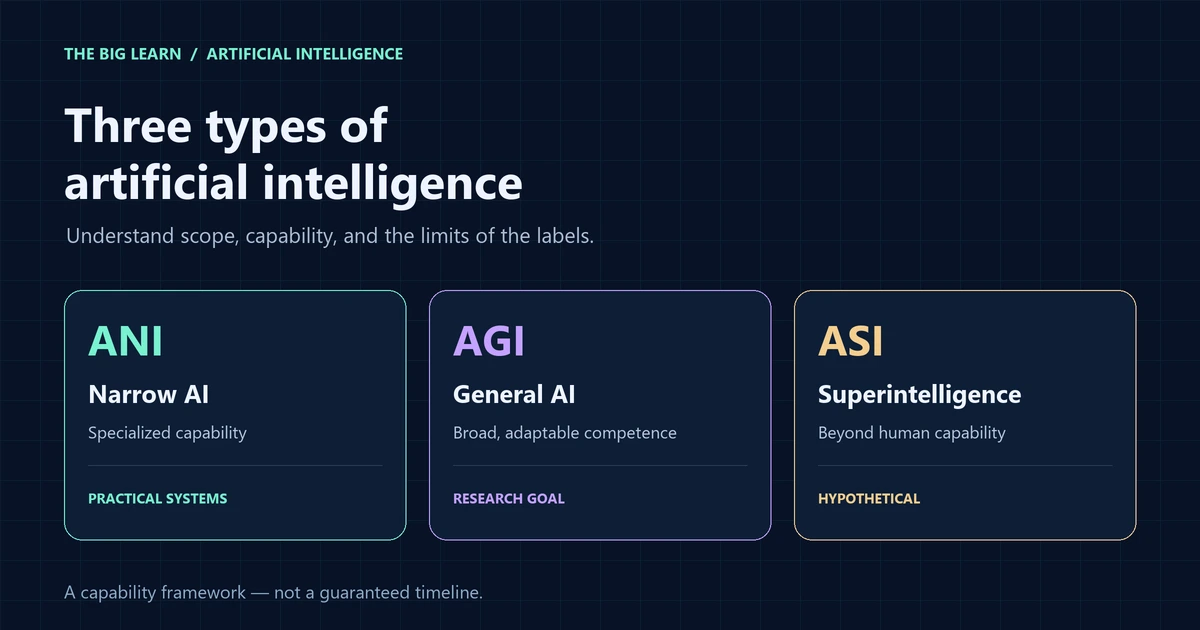
Artificial narrow intelligence (ANI), artificial general intelligence (AGI), and artificial superintelligence (ASI) describe different scopes and levels of capability. They offer a useful introductory vocabulary, provided we do not mistake them for three products already available to buy or three inevitable steps on a fixed timeline.
This guide builds on introductory explanations published by Zeev and Pós PUCPR Digital, with additional clarification from IBM and Google DeepMind research. It also separates those capability labels from machine learning, generative AI, multimodality, and autonomy: related terms that answer different questions.
ANI, AGI, and ASI at a glance
The table below is a conceptual comparison, not a forecast. In particular, the boundary of AGI depends on how breadth, performance, adaptation, and evaluation conditions are defined. Google DeepMind’s Levels of AGI framework explicitly separates the breadth of a system’s skills from how well it performs them.
| Category | Central idea | What would count as evidence? | How to interpret it |
|---|---|---|---|
| ANI — narrow AI | Capability within a bounded task or set of tasks. | Measured performance on the intended job, including difficult and unfamiliar cases. | The established practical category for specialized AI systems. Narrow does not mean simple. |
| AGI — general AI | Broad capability to learn and solve problems across domains. | A stated definition and broad, repeatable evaluation of transfer and adaptation. | A research goal with competing definitions; a fluent demonstration alone cannot establish it. |
| ASI — superintelligence | General intellectual capability substantially beyond human performance. | Broad superiority under a defensible comparison, rather than one specialist benchmark. | A hypothetical category used in research and discussions of future risks and governance. |
1. ANI: specialized capability can still be powerful
Narrow AI is designed, trained, or configured to operate within a particular task environment. Examples include ranking recommendations, identifying suspicious transactions, transcribing speech, and detecting defects in manufactured parts. Some systems cover a single operation; others support a substantial family of related tasks.
Consider an image classifier used to inspect packaging. Its value depends on identifying relevant defects under real lighting, camera, and production conditions. Even excellent inspection accuracy tells us little about its ability to negotiate a contract or plan a research project. Performance is meaningful only in relation to the job and conditions being evaluated.
The word narrow also does not mean that every answer is explicitly programmed. A learned model can handle examples it has never encountered before and still have important boundaries. Nor does narrow mean weak performance: a specialist system may outperform people on a particular task without becoming generally superintelligent.
Modern general-purpose models make the vocabulary less tidy because one model can support writing, coding, translation, and image analysis. Rather than forcing every new model into an overly precise box, describe its observed breadth, reliability, and failure modes. The traditional ANI label should not hide either useful generalization or persistent limitations.
2. AGI: broad competence requires more than a good conversation
AGI refers to the ambition of building systems with broad intellectual capability across tasks and domains. An important question is whether a system can acquire and apply skills in unfamiliar settings, instead of succeeding mainly where its training, examples, or surrounding tools already provide strong support.
There is no universally accepted checklist that settles every AGI claim. A useful claim must say which tasks are included, how performance is compared with human performance, how much assistance the system receives, and whether results hold beyond a selected demonstration. The Levels of AGI research offers one way to make those comparisons more explicit, rather than treating intelligence as a single on/off property.
Imagine an assistant that can produce a sensible project plan. A stronger evaluation would change the constraints, introduce contradictory evidence, ask it to learn an unfamiliar workflow, and check whether it recognizes when it needs help. Repeating that process across distinct domains reveals more than asking the same familiar question in several forms.
AGI is often called strong AI in introductory material, but the terms can carry different meanings in philosophical discussions. Broad competence, consciousness, human-like feelings, and physical embodiment are separate questions. A claim about one should not silently become a claim about all of them.
3. ASI: beyond human performance across a broad range of abilities
Artificial superintelligence describes a hypothetical system whose intellectual capabilities would substantially exceed human capabilities across a broad range of important activities. The breadth matters. Winning a game, processing a large dataset quickly, or finding a pattern that people missed is not enough by itself to establish ASI.
ASI is useful as a concept for examining possible future consequences: how highly capable systems could be evaluated, how their actions could remain accountable, and how benefits and risks might be distributed. Those are legitimate research questions, but they do not provide a dependable arrival date.
It is also a mistake to treat ANI, AGI, and ASI as a guaranteed escalator. Advances may be uneven, evaluation methods may change, and stronger performance can coexist with serious weaknesses. A responsible explanation separates the definition of superintelligence from predictions about whether, when, or how it might be developed.
Where do generative AI, chatbots, and multimodal models fit?
Generative AI describes systems that produce content such as text, images, audio, or code. It describes an output capability rather than a fourth rung above ANI, AGI, and ASI. A useful text generator does not become AGI simply because its sentences are fluent or because it can answer questions in several languages.
Multimodal AI processes more than one kind of information. For example, a vision-language model may receive a photograph together with a written question and generate a textual explanation. That combination broadens the interaction, but it does not by itself demonstrate general intelligence, reliable reasoning in every situation, or consciousness.
An AI agent combines a model with a workflow that can select actions, call tools, or pursue an objective. Its autonomy comes from the capabilities and permissions of the entire application. A model that drafts an email and an agent that can send it may share the same underlying model while creating very different operational risks.
Similarly, running a model locally in a browser describes its deployment. It changes practical considerations such as downloads, device memory, and where inference occurs. It does not change the definition of intelligence or establish that a model is more accurate. Evaluate deployment and capability separately.
Methods and functional categories are different maps
Machine learning is a family of methods for learning useful patterns from data. Neural networks are one family of models used within machine learning, and deep learning uses networks with multiple processing layers. Natural language processing concerns language tasks; computer vision concerns visual tasks. These terms describe methods or fields of work, rather than alternatives to ANI, AGI, and ASI.
Some introductory explanations also classify systems by function: reactive machines, limited-memory systems, theory-of-mind systems, and self-aware systems. This is another conceptual map, with speculative categories at its far end. It should not be presented as a proven sequence of engineering milestones or a precise subdivision of the three capability categories.
Memory needs particular care. The information stored in model parameters during training, the recent messages supplied in a conversation, and records retrieved from an external database are different mechanisms. Remembering an earlier message in a chat does not imply that the model updated its parameters or learned permanently from that exchange.
Claims of self-awareness deserve equally careful language. A system can generate statements about feelings or beliefs because those statements fit the conversation. Such output alone does not establish subjective experience. Product evaluations should focus on observable behavior and clearly stated evidence.
How an AI system turns data into a useful result
Many AI applications begin with a model trained on examples. During training, an optimization process adjusts model parameters to improve performance against an objective. During inference, the trained model processes new input and produces a prediction or generated output. Other AI approaches can also use explicit rules, search, or combinations of methods.
A deployed application normally adds more than the model: input preparation, access to relevant information, validation, user controls, logging, and a way to handle errors. The quality of that surrounding system can determine whether an impressive demonstration becomes a dependable tool.
More data is not automatically better. Relevance, accuracy, coverage, appropriate permissions, and evaluation quality matter. A system trained on unrepresentative examples can perform well on a familiar test while failing for the actual people or conditions it will encounter.
A practical example: helping a support team
Suppose a support team wants help handling incoming requests. A focused design could classify the request, retrieve an approved help article, and draft a reply. A person reviews uncertain or consequential cases before anything is sent. Each stage has a concrete purpose and an observable result.
Evaluate the stages separately. Does routing send requests to the right queue? Does retrieval return information relevant to the question? Does the draft accurately reflect that information? Does the application escalate when there is insufficient evidence? A single overall satisfaction score can conceal a serious weakness in one stage.
This workflow does not require a claim of AGI to be valuable. Its success depends on whether it improves a defined service outcome under acceptable conditions. A trial might compare handling time, correction rate, unresolved cases, and unsupported claims against the existing process. Benefits should be measured, not assumed.
- Define the task and who remains responsible for the result.
- Use approved information and limit access to what the task needs.
- Test representative cases, exceptions, and requests outside the supported scope.
- Set review and escalation rules before enabling consequential actions.
- Monitor performance and retain a way to stop or roll back the workflow.
Useful capability still needs boundaries
A generated answer can be plausible and wrong. A classifier can reproduce patterns that disadvantage groups poorly represented in its training data. A tool-using application can make a small model error consequential by executing an action immediately. These problems should be investigated at the system level, not explained away with an intelligence label.
Choose controls that match the job. A low-risk brainstorming assistant may need easy editing and a clear way to verify claims. A workflow that changes records or communicates with customers needs tighter permissions, traceability, and review rules. Protecting sensitive information also requires examining storage, integrations, and access, even when a model runs locally.
The most useful procurement question is therefore specific: what does this system reliably do, under which conditions, and what happens when it fails? Ask for evaluations relevant to your task, not only a benchmark score or a broad claim about being intelligent.
Frequently asked questions
Is generative AI a fourth type of intelligence?
It is a different classification axis. Generative describes the production of content; ANI, AGI, and ASI concern the scope and level of capability. One system can be described using both vocabularies.
Does understanding images and text make a model AGI?
Multimodality establishes the kinds of input a model can process. Establishing broad intelligence requires evidence about its performance, adaptation, and reliability across tasks, rather than counting input formats.
Does a chatbot improve permanently during our conversation?
Not necessarily. Supplying conversation history can change an answer without changing the model itself. Persistent storage, retrieval, and model training are separate features that an application must explicitly implement.
How should I evaluate a claim that AGI has arrived?
Start with the definition being used. Then examine the tasks, comparison group, evaluation conditions, degree of assistance, reproducibility, and remaining limitations. Different definitions can lead to different claims.
What is the most useful takeaway for a beginner?
Use the three categories to ask better questions, then return to evidence. The immediate value of AI comes from matching a demonstrated capability to a real task and designing a reliable process around it.
Sources and further reading
This original English synthesis draws on the Portuguese articles credited below. The research reference adds nuance to capability labels and the evaluation of AGI claims. Consult the original publications for their full explanations and context.
- Leonardo Salomão, Zeev — Os 3 tipos de Inteligência Artificial: quais são e como funcionam?
- Olivia Baldissera, Pós PUCPR Digital — Os 3 tipos de inteligência artificial (IA), February 22, 2023
- IBM — Understanding the different types of artificial intelligence
- Google DeepMind — Levels of AGI for Operationalizing Progress on the Path to AGI